Learn by Asking is aitutors.me's motto and its theory of learning, and the Feynman way is simply Learn by Asking when you're the one doing the explaining. Explaining shows you what to ask, and asking shows you what to explain. Together they make one loop any child can run at the kitchen table.
This guide is for parents and for students in Years 7 to 9: how the two ideas fit, one worked example, and what to try at home.
Two halves of one idea
Learn by Asking starts from a simple point. Today, an answer is never more than a search or a chatbot away, so the rare thing is a good question. A child who asks "why does this step work?" learns more from the same page than a child who asks "what's the answer?" You can read the whole theory in what is Learn by Asking.
The Feynman way, which we describe in what is the Feynman technique, starts from the other end. You explain an idea in plain words, notice where you get stuck, fix that gap, and explain it again more simply.
Here is how they meet. When you explain, you hit a wobble: "and then it... um..." That wobble is a feeling, not yet a question. The Feynman way turns it into a question. Learn by Asking makes that question a good one.
To be honest: Richard Feynman never used the phrase "Learn by Asking". That's our name. But he was famous for asking "why?" and for saying that knowing a bird's name is not the same as knowing the bird.
The loop: ask, explain, stuck?, ask again
Think of a torch in a dark room. The question points the torch, the explanation walks you across, and bumping into something is the "stuck" moment.
- Ask. Pick one thing worth asking about.
- Explain. Say it out loud, from memory, in plain words.
- Stuck? Find the exact spot where it breaks.
- Ask again. Turn that spot into a sharper question, find the answer, and explain it more simply.
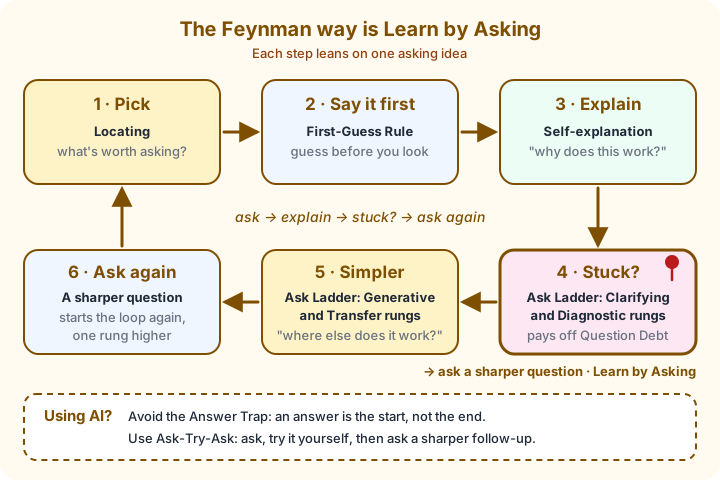
Each Feynman step leans on one Learn by Asking idea, and the loop ends where it began: with a better question.
Each Feynman step, and the asking idea it uses
Here is the map: each Feynman step, and the Learn by Asking idea doing the work underneath.
| Feynman step | What you do | The Learn by Asking idea it uses |
|---|---|---|
| Pick | Choose one small idea | Locating: deciding what's actually worth asking about |
| Say it first | Guess before you look | The First-Guess Rule |
| Explain | Say it in your own words | Self-explanation: asking yourself "why does this work?" |
| Stuck? | Find where it breaks | Clarifying and Diagnostic rungs of the Ask Ladder; paying off Question Debt |
| Simpler | Say it again more plainly | Generative and Transfer rungs: "what if...?" and "where else...?" |
| With AI | Use a tool to help | Avoid the Answer Trap; use Ask-Try-Ask |
Say it first. The First-Guess Rule says: commit to a guess before you ask anyone, even a wrong guess. Research on pretesting backs this up. In a 2009 study, Richland, Kornell and Kao found that trying to answer questions before studying helped people learn the material better, even when their first tries were wrong.
Explain. When Chi and colleagues asked 8th graders to explain each sentence of a text on the circulatory system to themselves, they understood it better than classmates who just read it twice. A 2018 review of many studies by Bisra and colleagues found a moderate positive effect for this kind of self-explanation (g = 0.55). Much of that research is with older students, so treat the numbers as a guide. Self-explanation is really a stream of small questions: why does this follow?
Stuck? This is where the question is born. "I don't get it" is too vague to fix. "Why does the second step work?" is a Clarifying question. "Where did my reasoning go wrong?" is a Diagnostic one. Each stuck point you name is one less swallowed question, and Learn by Asking calls that pile of swallowed questions Question Debt. It grows the longer you leave it. There's more on this step in where you get stuck is where you learn.
With AI. The Answer Trap is getting an answer and stopping. A 2025 study by Bastani and colleagues found that secondary school students who used a plain chatbot did better on practice problems but 17% worse on the later exam than students with no chatbot. A tutor version with guardrails removed most of that harm. Ask-Try-Ask is the habit to build: ask, try it yourself, then ask a sharper follow-up.
A worked example: the cold spoon
Maya, in Year 8, notices at breakfast that the metal spoon feels colder than the wooden one, though both spent the night in the same drawer.
Pick. Her question: "Why does the metal spoon feel colder?" Small and specific.
Say it first. Her guess: "Because metal is colder than wood." She writes it down.
Explain. She explains to her dad. "Metal is colder, because metal... keeps the cold in?" Then she stops. "But they've been in the same drawer. They should be the same temperature."
Stuck? There's the wobble. Her dad doesn't explain. He asks, "So what do you think your hand is actually feeling?" Maya makes it sharper: "If they're the same temperature, why do they feel different?" That's a Clarifying question. Then a Diagnostic one: "Where did my guess go wrong?" Her mistake was assuming that "feels cold" means "is cold".
She looks it up in her science book. Metal is a good conductor of heat, so it carries heat away from her warm hand quickly. Wood is an insulator, so it carries heat away slowly.
Simpler. Maya tries again: "Your hand doesn't measure temperature. It feels how fast heat leaves it. Metal is a fast road for heat. Wood is a slow one."
Ask again. Then the next question arrives on its own: "So is that why a tiled floor feels colder than the bath mat?" That's a Transfer question, the top of the Ask Ladder. The loop has started again, one level higher.
Her first guess was wrong, and that helped: it gave her something to test.
What parents can do
You don't need to know the answer, just to be curious.
- Ask for the guess first. "What do you think, before we look?"
- Be the listener, not the teacher. Let your child explain. Ask "why?" or "what does that word mean?"
- Listen for the "um". When they stall, don't fill the gap. Ask, "What's the exact bit you're not sure about?"
- Help shape the question. Turn "I don't get it" into "Why does this step work?"
- Ask one more. When the explanation flows, try "Where else does this work?"
For a ready-made list, see 10 questions to ask when your child explains.
How aitutors.me puts the two together
On aitutors.me, both halves are built in. The subject professors, from Professor Pi in maths to Professor Mercator in geography, ask questions and never give the final answer.
A child can explain a topic to Heddy Pip, a curious listener who only ever asks questions. (A pip is a tiny seed. Every big idea grows from a small why?)
In Jotters, a child reads their own notes or worksheet with short jots pinned beside the words. An Ask me jot puts a question behind a "Say it first" cover, so the guess comes before the answer. A stuck pin marks the exact spot where they got stuck, so the next question has a home. More on this in how aitutors.me uses the Feynman way.
But the loop needs no app: just a question, a listener, and the courage to say, "I'm stuck here."
FAQ
How is the Feynman technique connected to Learn by Asking?
Learn by Asking is aitutors.me's theory that asking well drives learning. The Feynman way is the same idea from the other side: when you explain, the place you get stuck shows you what to ask next.
Did Richard Feynman use the phrase Learn by Asking?
No. Learn by Asking is aitutors.me's name. Feynman was famous for asking why, so the link is fair, but the phrase is ours, not his.
What can parents do to use both at home?
Let your child explain while you ask. Ask for a guess first, listen for the moment they stall, and help them turn that stall into one clear question.
Duke Harewood runs aitutors.me: Socratic AI tutors for KS3, plus a free GCSE map and flashcards for Years 10–11. Updated 20 October 2026.