The four Feynman steps are: pick one small idea, explain it in plain words from memory, notice where you get stuck and fix that gap, then explain it again more simply. We call them Pick, Explain, Stuck?, Simpler. That's the whole method. The tricky part is doing each step properly, so this guide walks through all four with one real KS3 topic: why do we have seasons?
If you want the background first (who Feynman was, and why the steps work), start with what is the Feynman technique?. If you just want to use it tonight, read on. And think of the four steps as Learn by Asking, aitutors.me's motto, for when you're the one explaining: each step produces a question.
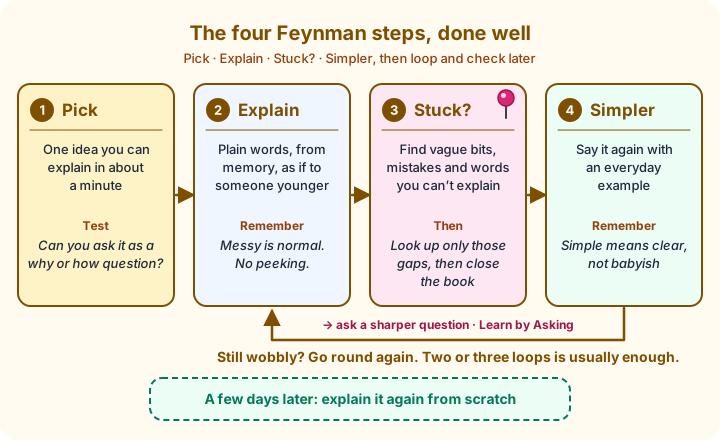
Each step has one thing to get right; loop until it flows, then check again a few days later.
Step 1: Pick
Choose one idea small enough to explain in about a minute.
This is where most people go wrong. "Space" is not an idea. "The solar system" is still too big. "Why we have seasons" is about right. It's one question with one answer.
A good test: can you write your topic as a question that starts with why or how? "Why do we have seasons?" works. "Seasons" on its own doesn't, because it doesn't tell you what you're trying to explain.
Write your question at the top of a blank page. Then close your book.
The ask it produces: deciding what is actually worth asking about is the first ask, the Locating rung of the Ask Ladder. Narrowing "space" down to "Why do we have seasons?" is exactly that move.
Step 2: Explain
Explain the idea in plain words, from memory, as if to someone younger who has never heard of it.
You can say it out loud, to a person, a pet or an empty chair. Or you can write it on the blank page. Either way, no peeking.
Here's what a first try might honestly look like:
"We have seasons because the Earth goes round the Sun. In summer we're closer to the Sun so it's hotter, and in winter we're further away so it's colder. Also something about the Earth being tilted."
Don't fix anything yet. Just get it all out. A messy first explanation is normal. It's supposed to be messy. That's how you find the gaps.
The ask it produces: saying it first, before you look anything up, is the First-Guess Rule. You commit to your own answer, even a wrong one, so there's something real to check.
Step 3: Stuck?
Look at what you said and find the exact places where it went wrong, went vague, or used a word you can't explain.
This is the most important step. In the example above, there are three warning signs:
- "Something about the Earth being tilted." That's a vague bit. You know the word tilted matters, but you can't say how. That's a gap.
- "Closer to the Sun in summer." This one is trickier, because it feels right. It's actually a very common mistake. (When it's summer in the UK, it's winter in Australia, at the same time and the same distance from the Sun. So distance can't be the main reason.)
- Hand-waving words like "something about", "kind of" or "basically" are always worth a second look.
Now go back to your textbook, your notes or your teacher. Fix only the gaps you found. Don't reread the whole chapter. Look up what the tilt does, then close the book again.
Here's what you'd find: the Earth's axis (the imaginary line it spins around) is tilted. As the Earth travels round the Sun over a year, for part of the year the northern half leans towards the Sun, and for part of the year it leans away.
When it leans towards the Sun, two things happen. Sunlight hits the ground more directly, so the same energy lands on a smaller patch. And the days are longer, so there's more time for heating. That's summer.
You may still have questions after this. That's fine. Write them down. Getting stuck is not failing. We explain why in where you get stuck is where you learn.
The ask it produces: a Clarifying or Diagnostic question. "What does the tilt actually do?" is Clarifying. "Why did I think closer means hotter?" is Diagnostic.
Step 4: Simpler
Explain it again, more simply, with an everyday example.
Here's a second try:
"The Earth is tilted, like a spinning top that leans a bit. As it goes round the Sun, our half of the Earth spends part of the year leaning towards the Sun and part leaning away. When we lean towards it, sunlight hits us more directly and the days are longer, so it's warmer. That's summer. When we lean away, the light is more slanted and the days are shorter, so it's colder. That's winter. It isn't about being closer to the Sun."
Notice what changed:
- One idea per sentence. No long chains of "and... and... and".
- An everyday picture: a leaning spinning top.
- The mistake is named and ruled out: "It isn't about being closer."
- It's still correct. Simple doesn't mean babyish. It means clear.
A good extra check: shine a torch straight down at a table, then tilt it. The straight-down beam makes a small, bright patch. The tilted beam spreads the same light over a bigger, dimmer patch. That's "more direct sunlight" in your hand. For more on making explanations clear without making them wrong, see how to explain anything to a ten-year-old.
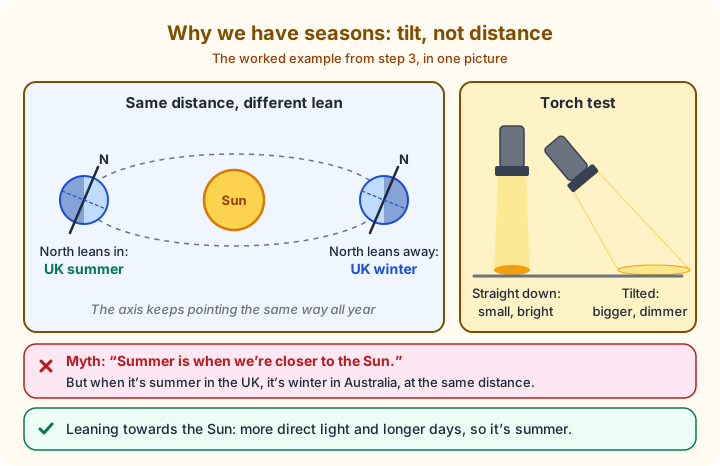
Seasons come from the Earth’s tilt, not its distance from the Sun; the torch test shows why more direct light warms more.
The ask it produces: the next question. "What would happen if the Earth wasn't tilted at all?" climbs to the Generative rung.
Then: loop and check later
If your second explanation still has a wobbly bit, go round again: find the gap, fix it, say it more simply. Usually two or three loops is enough.
Then come back to it in a few days and explain it again, from scratch. If it still flows, you've got it. If it doesn't, you've found what needs another look. Coming back after a gap is one of the most reliable ways to make learning stick. We cover the timing in explain it again next week: Feynman and spacing.
Why these steps work
When you explain from memory, you're doing retrieval practice: pulling information out of your head, which makes it easier to pull out next time. Researchers Roediger and Karpicke showed this in 2006: students who practised recalling a text remembered more of it a week later than students who just reread it. When you explain why and how, you're doing self-explanation, which a large 2018 review (Bisra and colleagues) found gives a solid boost to learning. And coming up with your own words, instead of copying, is linked to better memory too. That's called the generation effect.
Most of that research was with older students, but the idea is simple enough for anyone: your brain remembers what it has to work for.
How this connects to Learn by Asking
Learn by Asking says the quality of your questions decides how much you understand, and its Ask Ladder sorts questions into five rungs: Locating, Clarifying, Diagnostic, Generative and Reflective/Transfer. The four steps climb that ladder. Pick turns "seasons" into "why do we have seasons?" Explain is your first guess, said before you look. Stuck? digs Clarifying and Diagnostic questions out of "something about the tilt". Simpler ends with a Generative one: what if the Earth wasn't tilted? Each rung is in the Ask Ladder: five levels of questions.
Using the steps on aitutors.me
If you use aitutors.me, these four steps appear in Jotters as Pick · Explain · Stuck? · Simpler. You can drop a stuck pin on the exact words where you lost the thread, and underline jargon you couldn't explain. Then you can explain the topic to Heddy Pip, a curious listener who only asks questions. (A pip is a tiny seed. Every big idea grows from a small why?) But a blank page and a closed book work just as well.
FAQ
What are the four steps of the Feynman technique?
Pick one small idea. Explain it in plain words without your notes, as if to someone younger. Notice where you get stuck, then go back to the source and fix only that gap. Explain it again, more simply, with an everyday example. Repeat until it flows.
Do I have to say it out loud?
No, though saying it aloud tends to show gaps faster. Writing it on a blank page works too. What matters is that the explanation comes from your memory, not from copying your notes.
How long should one Feynman session take?
For one small idea, about ten to fifteen minutes. If it's taking much longer, the idea you picked is probably too big. Split it into smaller pieces and do one at a time.
Duke Harewood runs aitutors.me: Socratic AI tutors for KS3, plus a free GCSE map and flashcards for Years 10–11. Updated 20 October 2026.