The Feynman technique is a way of learning something by explaining it in plain, simple words, noticing exactly where your explanation breaks down, and then going back to fix that gap. It's named after the physicist Richard Feynman, who was famous for making very hard ideas sound simple. The idea at its heart is short enough to fit on a sticky note: if you can't explain it simply, you don't understand it yet.
This guide is for parents and for students in Years 7 to 9. It covers what the technique is, where it honestly comes from, the four steps, and why it works. At aitutors.me, whose motto is Learn by Asking, we think of the Feynman way as Learn by Asking when you're the one explaining.
The idea in one sentence
Here is the whole thing: explaining shows you what you don't know.
Think about giving someone directions to your house. In your head, the route feels obvious. Then you try to say it out loud and you hit a moment like, "Then you go past the... um... the shop with the... is it a left there?" That "um" is useful. It marks the exact spot where your knowledge of the route is fuzzy.
Learning works the same way. Reading your notes on photosynthesis can feel fine. Explaining photosynthesis to your little brother, without the notes, shows you within a minute which bits you actually understand and which bits you were just recognising.
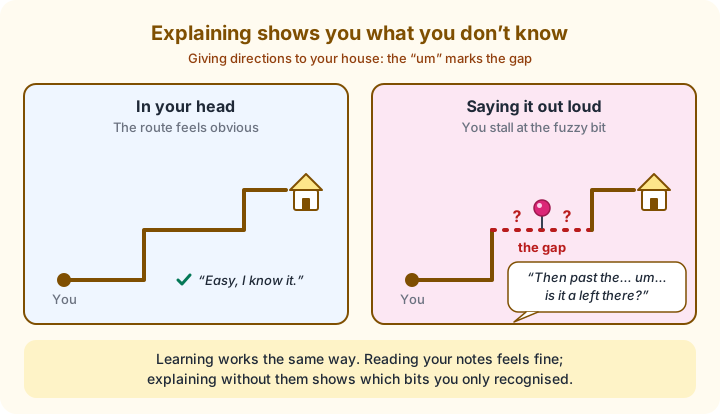
The stumble when you say it out loud is useful: it shows exactly where your knowledge is fuzzy.
Where the name comes from (the honest version)
Richard Feynman (1918–1988) was an American physicist. He shared the Nobel Prize in Physics in 1965 for work on quantum electrodynamics, taught at Caltech, and gave a famous series of lectures that became The Feynman Lectures on Physics. He was also known for explaining things with everyday objects instead of long words. You can read more in who was Richard Feynman?
Here is the part many articles skip. Feynman never wrote down a "Feynman technique". There is no book or lecture where he lists four steps. The four-step version you see online was put together much later by other writers, who looked at how he learned and taught and turned his habits into a recipe.
Does that matter? Not much. The summary is a fair one. Feynman really did distrust people who could only repeat the names of things. He really did keep asking "but why?" until an idea was clear. The steps capture that. It's just worth knowing that they are a tribute to his way of thinking, not his own instructions.
The four steps
Most versions use four steps. On aitutors.me we name them Pick, Explain, Stuck?, Simpler.
- Pick. Choose one idea. Not "all of chemistry". Something small, like "why ice floats" or "what a metaphor does".
- Explain. Explain it in plain words, as if to someone younger who has never heard of it. Say it aloud, or write it down. No copying from the book.
- Stuck? Notice where you stall, wave your hands, or reach for a big word you can't unpack. That's the gap. Go back to your notes, textbook or teacher and fix just that bit.
- Simpler. Explain it again, more simply, using an everyday example. Swap any jargon for plain words.
Then you repeat, until the explanation flows without the notes. We walk through all four with a full KS3 example in the four Feynman steps, explained simply.
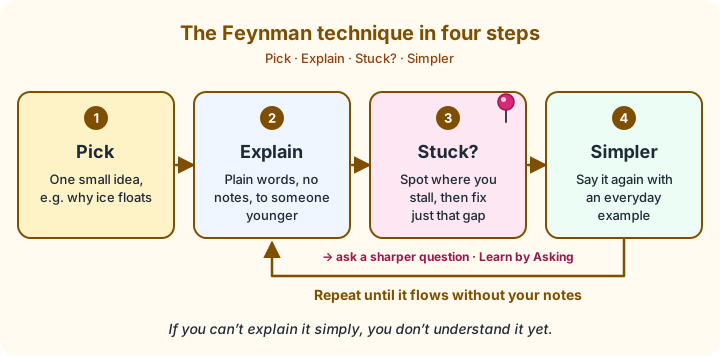
The four steps form a loop: after making it simpler, explain it again until it flows without notes.
Where children usually get stuck
A few things trip people up the first time:
- Picking too big a topic. "Explain the Second World War" is a book, not a Feynman session. Shrink it to one cause or one turning point.
- Reading the notes aloud. That's rereading with sound effects. The explaining has to come from memory.
- Treating "simple" as "babyish". A simple explanation is not a dumbed-down one. It is a clear one. Saying "plants make their own food from light, water and air" is simple and true.
- Skipping step three. Finding the gap feels uncomfortable, so it's tempting to gloss over it. But the gap is the whole point. It's where the learning happens.
Why it works, in one paragraph
When you explain, you have to pull ideas out of memory rather than just recognise them on a page. You also have to link them: this happens because of that. Researchers call the first part retrieval practice (remembering on purpose, which strengthens memory) and the second self-explanation (saying why and how in your own words). A 2018 review of many studies, by Bisra and colleagues, found that prompting learners to explain to themselves had a solid positive effect (g = 0.55, a moderate effect in education research). A major 2013 review by Dunlosky and colleagues rated practice testing as one of the most useful study techniques, and rereading and highlighting as some of the least useful. The Feynman technique leans on the useful kind. Many of these studies used university students, so the exact sizes may differ for a 12-year-old, but the direction is consistent. The full picture is in why explaining helps children learn.
What it looks like at home
You don't need anything special. A parent, a sibling, a pet or a teddy can be the listener. The listener's job is not to teach. It's to be curious and ask "why?" or "what does that word mean?"
A typical session takes five to ten minutes:
- Your child picks one thing from this week's lessons.
- They explain it to you, without notes.
- You ask one or two honest questions.
- They notice a gap, look it up, and explain that bit again.
If you'd like more on the parent's role, including what not to do, see how to use the Feynman technique at home. There are also some common mix-ups worth avoiding in six myths about the Feynman technique.
How this connects to Learn by Asking
Learn by Asking is aitutors.me's theory of learning: now that answers are easy to get, the skill that matters most is asking well. The Feynman way is Learn by Asking when you're the one explaining. Look again at the directions to your house. The "um" at the fuzzy turn is only a vague feeling. Step three, Stuck?, turns it into a sharp question you can actually answer: "Is it left or right after the shop?" That question is where the learning starts. Then, once you've made it simpler, the next question comes along, and the loop runs on: ask, explain, stuck, ask again. There's more in what is Learn by Asking?
How aitutors.me uses it
On aitutors.me, the Feynman steps are built into Jotters, where a child reads their own notes or worksheet with short explanations pinned beside the words. They can mark where they got stuck, then explain the topic to Heddy Pip, a curious listener who only ever asks questions. (A pip is a tiny seed. Every big idea grows from a small why?) The professors never hand over final answers. But the method itself needs no app at all, just a listener and a little honesty about where you got stuck.
FAQ
What is the Feynman technique in simple terms?
It's a way of checking whether you really understand something. You pick a topic, explain it in plain words as if to someone younger, notice where you get stuck or reach for jargon, go back to the source to fix that gap, and then explain it again more simply.
Did Richard Feynman invent the Feynman technique?
Not as a named, four-step method. Feynman was famous for explaining hard physics in plain language and for distrusting people who only knew the names of things. Later writers turned those habits into the tidy four-step "Feynman technique". The steps are a fair summary of how he worked, but he never wrote them down as a recipe.
What age is the Feynman technique suitable for?
Any child who can talk about what they are learning can use a version of it. It works especially well from about Year 7 upwards, when KS3 subjects start to fill up with technical words that are easy to repeat without understanding.
Duke Harewood runs aitutors.me: Socratic AI tutors for KS3, plus a free GCSE map and flashcards for Years 10–11. Updated 20 October 2026.