To use the Feynman technique at home, let your child teach you one small idea from their week, in their own words and without notes, while you play the curious listener who asks "why?" rather than the teacher who corrects. That's it. You don't need to know the topic. You don't need any equipment. You need five to ten minutes and a willingness to be the one who doesn't know.
This guide covers your role, a few simple routines, what to say, and the mistakes most parents make at first.
Your role: the curious listener
Most parents' instinct, when a child explains something, is to teach. We jump in, fill gaps, fix mistakes. It comes from love. But it takes the thinking away from the child.
Picture two kinds of passenger in a car while your child is learning to drive. One grabs the wheel every time they drift. The other says "What's that sign mean?" and "Which lane do you need?" Only the second one produces a driver.
In a Feynman session, you are that second passenger. Your job is to:
- listen properly, without looking at your phone;
- ask honest questions when something isn't clear;
- wait while your child thinks, even when it feels long;
- suggest checking, together, when something seems off.
You are not there to judge whether the explanation is good. Your child will usually notice the weak bits themselves, as long as you give them room.
You don't need to know the topic
This surprises a lot of parents. Many of us haven't thought about photosynthesis or quadratic sequences for thirty years. That's fine. It can even be an advantage.
If you don't know the topic, your questions will be real ones. "Wait, what's chlorophyll?" is a genuine question, so your child has to answer it properly. And when you both get stuck, you get to say "Let's look it up," which shows your child exactly the habit you want: not knowing something is normal, and checking the source is what you do next.
If you do know the topic well, play a little dumb. Ask the questions a beginner would ask. Hold back the answers.
A simple routine that works
Here's a routine that fits into a busy week:
- Pick one thing. "What's one thing you learned this week that you could teach me?" Keep it small: one idea, not a whole topic.
- No notes. Books closed. The explanation comes from memory. That's what makes it work.
- Listen first. Let them get through it without interrupting, even if it's messy.
- Ask one or two questions. "Why does that happen?" or "What does that word mean?" is usually enough.
- Spot the wobble. If they stall or go vague, say "That bit sounded tricky. Want to check it?"
- Check together. Open the book or notes, find just that bit, and close it again.
- Say it again. "Can you explain that part again, more simply?"
The whole thing usually takes five to ten minutes. If you'd like a version built around family meals, see the five-minute dinner-table teach-back.
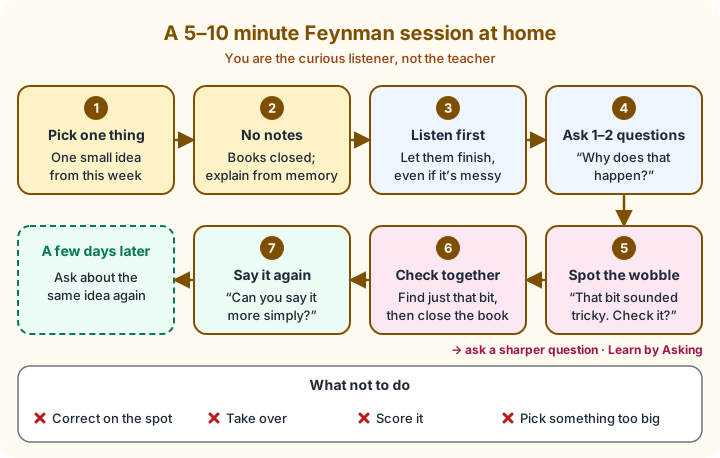
The whole routine fits into five to ten minutes, with you as the curious listener.
When to do it
The best times are short, relaxed moments that are already in your week:
- in the car on the way to a club,
- over a meal,
- while walking the dog,
- just after homework, while it's fresh.
Come back to it later. Ask about the same idea again a few days later: "Remember the thing about the seasons? Can you explain it again?" Coming back after a gap makes learning stick much better than going over it again straight away. A large 2006 review of spacing studies by Cepeda and colleagues found this pattern again and again.
What to say
A few phrases that help:
- "Can you teach me…?" (not "Do you know…?")
- "Say that again in different words."
- "What would happen if…?"
- "What's an example from real life?"
- "Which bit was hardest to explain?"
We've collected more in 10 questions to ask when your child explains.
What not to do
These are the common traps:
- Don't correct on the spot. "No, that's wrong" ends the thinking. Ask a question instead: "How does that fit with what you said earlier?"
- Don't take over. If you hear yourself giving a five-minute explanation, stop. Hand it back: "So how would you say that?"
- Don't score it. No marks out of ten, no "good" versus "bad" explanations. The goal is to find gaps, and a scored session makes children hide them.
- Don't do it when they're tired or upset. A Feynman session needs a bit of energy. Skip it rather than force it.
- Don't pick something too big. "Explain the whole of Year 8 science" is not fair. One idea.
- Don't compare siblings. Each child explains at their own level.
Why it works
When your child explains, they have to pull ideas out of memory and link them together, which research on self-explanation connects to deeper understanding. Chi and colleagues found this with 8th-grade students learning about the heart in 1994. And when your child knows they'll be teaching you, they tend to study differently: looking for the main ideas and the order they go in. That's called the protégé effect, and we explain it in the protégé effect: children learn by teaching.
It also builds metacognition: knowing what you know and what you don't. The Education Endowment Foundation rates teaching metacognition as one of the highest-impact approaches in schools, worth about seven months of extra progress on average. That's from school-based studies, not home routines, but the skill is the same one.
How this connects to Learn by Asking
Learn by Asking, aitutors.me's theory of learning, says asking well is the skill that matters most now that answers are easy to find. In this routine you do the asking and your child does the explaining, which shows them what a good question sounds like. Over time, hand the questions over. When your child stalls at the wobble in step 5, the aim is for them to say "I'm not sure about this bit, can we check?" rather than guess and move on. A lucky guess teaches very little; a question that leads to checking teaches a lot. See teaching your child to ask instead of guess.
If you use aitutors.me
Some evenings, you won't have the time or energy to be the listener. On aitutors.me, your child can explain a topic to Heddy Pip, a curious listener that only ever asks questions. (A pip is a tiny seed. Every big idea grows from a small why?) The professors never hand over final answers. Parents don't see a Jotters page, but your child's jots are part of their learning record in your data export. The routine above still works best with a real person who's interested, though, and that person can be you.
FAQ
Do I need to understand the topic to help my child with the Feynman technique?
No, and it can even help if you don't. Your job is to be a curious listener who asks honest questions, not a teacher who knows the answers. If you both get stuck, look it up together. That models exactly the habit you want.
How often should we do it?
Little and often beats long and rare. Two or three five-to-ten-minute sessions a week is plenty for most KS3 children. Coming back to the same idea a few days later is especially useful.
What should I do if my child explains something wrongly?
Don't correct them on the spot. Ask a question that makes them look again, such as "How does that fit with…?" or "Where did you read that?", then suggest checking the book together. Finding their own mistake teaches more than being told.
Duke Harewood runs aitutors.me: Socratic AI tutors for KS3, plus a free GCSE map and flashcards for Years 10–11. Updated 20 October 2026.