When your child explains something they've learned, the most helpful thing you can do is ask short, curious questions, like "Why does that happen?" or "Can you give me an example?", rather than correcting them. Questions keep your child doing the thinking. Corrections take it away. Below are ten questions that work well for KS3 children, with a note on when to use each.
Why questions work better than corrections
Picture your child explaining that "heavier things fall faster". It's a very common idea, and it's not right: without air in the way, a hammer and a feather fall at the same rate.
You could say, "No, that's wrong. They fall at the same speed." Your child nods. The conversation is over. They may remember your sentence. They probably won't understand it.
Or you could ask, "Hmm. So if I dropped a big book and a small book together, which would land first?" Now your child has to picture it, predict, and maybe test it. If they spot the problem themselves, it tends to stick far better.
That's the difference. A correction is a delivery. A question is an invitation to think. Research on self-explanation, where learners explain why and how in their own words, finds that this kind of active thinking leads to deeper understanding. In a well-known 1994 study, Chi and colleagues simply prompted 8th-grade students to explain each line of a text, and those students understood the topic better. Your questions are the prompts.
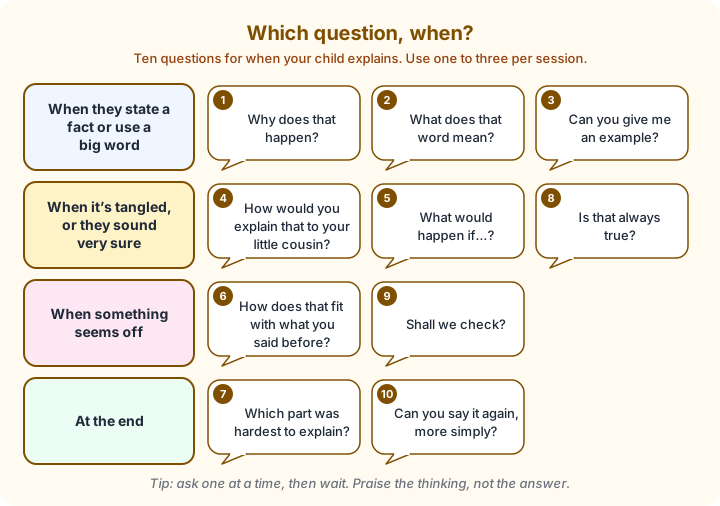
Match the question to the moment, and use only one to three in a session.
The 10 questions
1. "Why does that happen?"
Use it when: your child states a fact. "Plants need light." Why?
This is the most useful question on the list. It moves your child from what to why, which is where understanding lives. If they can answer it in their own words, they probably get it.
2. "What does that word mean?"
Use it when: your child uses a technical word, like photosynthesis, metaphor or denominator.
Children often use jargon as a hiding place. The word sounds right, so nobody checks. Asking for the meaning in plain words is the fastest way to find out if there's understanding underneath.
3. "Can you give me an example?"
Use it when: the explanation sounds abstract or textbook-ish.
An example shows whether the idea connects to real life. "A metaphor is when you say one thing is another" is fine. "Like 'the classroom was a zoo'" shows they can use it.
4. "How would you explain that to your little cousin?"
Use it when: the explanation is accurate but tangled.
This nudges your child to simplify: shorter sentences, plainer words, an everyday picture. It's the heart of the Feynman technique. (No little cousin needed. Any imagined younger child works.)
5. "What would happen if…?"
Use it when: your child seems confident and you'd like to stretch them.
"What would happen if the Earth wasn't tilted?" "What if the fraction's top number was bigger than the bottom?" A prediction question tests whether the idea is flexible or just memorised.
6. "How does that fit with what you said before?"
Use it when: you hear a contradiction, or a mistake you suspect.
This is the gentle alternative to "That's wrong." It points your child back at their own words and lets them find the clash. If they don't spot it, that's fine. Go to question 9.
7. "Which part was hardest to explain?"
Use it when: your child finishes, especially if it went smoothly.
Smooth explanations can hide gaps. This question invites your child to name the shaky bit themselves, which is a valuable skill. Knowing what you don't know is called metacognition, and the Education Endowment Foundation rates teaching it as one of the highest-impact approaches in schools.
8. "Is that always true?"
Use it when: your child states a rule. "Multiplying always makes things bigger."
Many KS3 mistakes come from rules that are usually true. (Multiplying by a half makes things smaller.) This question invites your child to hunt for exceptions. We go into more of these hidden mistakes in how explaining reveals hidden misconceptions.
9. "Shall we check?"
Use it when: you're not sure, they're not sure, or something seems off.
This is the most important question for you as a parent. It turns "Who's right?" into "Let's find out". Open the book, find the bit, close it again. It also models the habit you want: checking the source is normal, not embarrassing.
10. "Can you say it again, more simply?"
Use it when: your child has found and fixed a gap.
This closes the loop. Explaining the fixed version helps it stick, and it often comes out clearer the second time.
How to ask them
The words matter less than the tone. A few tips:
- Be genuinely curious. If you sound like an examiner, your child will hear a test.
- Ask one at a time. Then wait. Silence while they think is fine.
- Use one to three per session. More than that becomes an interrogation.
- Don't fill the gap yourself. If they're stuck, try question 9, not a mini-lecture.
- Praise the thinking, not the answer. "I like how you worked that out" beats "Correct!"
Where to use them
These questions work in any short teach-back moment: the car, the walk home, a few minutes after homework. If you'd like a full routine, see how to use the Feynman technique at home or the even shorter five-minute dinner-table teach-back.
On aitutors.me, the professors follow the same rule: they ask Socratic questions and never give the final answer, and Heddy Pip, the curious listener your child teaches, only ever asks questions. (A pip is a tiny seed. Every big idea grows from a small why?) But the best questioner in your child's life is still a parent who genuinely wants to know.
How this connects to Learn by Asking
Learn by Asking, aitutors.me's theory of learning, sorts questions into five rungs called the Ask Ladder, and these ten fit it neatly. Locating: "What does that word mean?" (2). Clarifying: "Why does that happen?" (1), the little-cousin question (4) and "Say it again, more simply" (10). Diagnostic: "How does that fit?" (6), "Which part was hardest?" (7) and "Shall we check?" (9). Generative: "What would happen if…?" (5) and "Is that always true?" (8). Reflective/Transfer: "Can you give me an example?" (3). If a session stays on the bottom two rungs, try one from higher up. In time, your child can ask these of themselves. See the Ask Ladder.
FAQ
What is the best question to ask when my child explains something?
"Why does that happen?" is the most useful single question. It pushes your child from repeating a fact to explaining a reason, which is where real understanding shows. If they can answer it in their own words, they probably understand the idea.
Why ask questions instead of just correcting mistakes?
A correction hands your child the answer and ends their thinking. A question keeps them thinking and lets them find the mistake themselves. Children tend to remember what they worked out more than what they were told.
How many questions should I ask?
Usually one to three. Too many questions turn a friendly chat into an interrogation. Pick the one that fits where your child seems shaky, and let the rest go.
Duke Harewood runs aitutors.me: Socratic AI tutors for KS3, plus a free GCSE map and flashcards for Years 10–11. Updated 20 October 2026.