A dinner-table teach-back is a five-minute routine where your child teaches you one thing they learnt at school, in their own words, while you listen and ask curious questions, and it turns an ordinary meal into a short dose of the study habits research rates most highly. No worksheets. No marking. Just one idea, explained out loud.
Most parents know how "What did you do at school today?" ends. "Nothing." This article gives you a better question, a few scripts, and some help for the evenings it doesn't go smoothly.
Why this tiny routine works
Two well-studied ideas sit underneath the teach-back.
Retrieval practice. The jargon means pulling something out of your memory, rather than putting it back in by reading again. In a well-known study, Roediger and Karpicke (2006) found that students who practised recalling a passage remembered noticeably more a week later than students who spent the same time rereading it. A big 2013 review by Dunlosky and colleagues rated practice testing as one of only two "high utility" study techniques. When your child explains something at dinner without notes, they are doing retrieval practice. They just don't call it that.
Learning by teaching. When children explain to someone, they have to organise the idea, not just recall bits of it. Nestojko and colleagues (2014) found that even expecting to teach helped students remember material in a more organised way.
Here's an everyday picture. Reading notes again is like looking at a map of a route. Explaining from memory is like walking the route without the map. You find out quickly which turns you really know.
The basic routine
Keep it simple enough that you'll actually do it.
- Pick the moment. Main course, not pudding. Phones away for five minutes.
- Ask for one thing. "Teach me one thing you learnt today. Something I might not know."
- Listen first. Let them get to the end without interrupting.
- Ask one or two curious questions. "Why does that happen?" "What's an example?"
- Ask where it got tricky. "Was there a bit that was hard to explain?"
- Say thanks, and stop. Five minutes. Leave them wanting more, not less.
That's the whole thing. The step most parents skip is step 5. It's the most useful one, because it shows your child which bit to look at again.
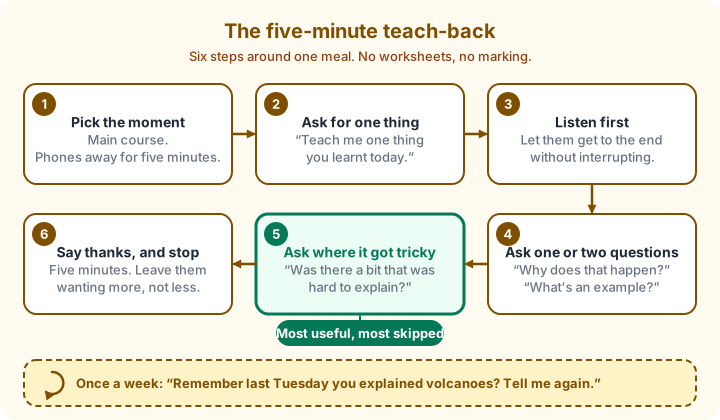
Five minutes, one idea, and the question most parents skip: “Was there a bit that was hard to explain?”
Scripts that help
Children often need a nudge to get started. Try one of these:
- "If you had to teach your Year 7 self one thing from today, what would it be?"
- "What's the most surprising thing you heard in a lesson this week?"
- "Pick any lesson today. Explain one idea from it to me like I'm nine."
- "What did your science teacher draw on the board today? Can you draw it on this napkin?"
When they're explaining, these keep it going without turning into a quiz:
- "Wait, what does that word mean?"
- "So what would happen if...?"
- "How do you know that's true?"
- "Is that like [everyday thing]?"
For a longer list, see 10 questions to ask when your child explains.
What to say when it goes wrong
It won't always be lovely. Here's what to do in the usual sticky moments.
"I don't remember anything." Narrow it down. "OK, just one subject. What did you do in maths?" Or offer a choice of two. Remembering is the hard part, and that's the point. If nothing comes, try again tomorrow. No fuss.
The explanation is wrong. Resist the urge to correct. Ask a question that lets them notice: "Hmm, so would that work for a feather too?" If it's still wrong, say "That might be worth checking in your book". You've found a gap. That's a win.
They get frustrated and stop. Say "That's a really useful stuck bit. Let's leave it." End on something positive. Don't turn dinner into a lesson.
A sibling jumps in with the answer. Gently: "Let's give your brother a chance first." Then let the sibling have a turn tomorrow.
You don't understand it either. Perfect. Say so. "I lost you at the bit about enzymes." Your honest confusion is the best feedback they'll get.
Where families usually get stuck is consistency. The first week is fun. By week three it's forgotten. Tie it to one fixed meal, say Tuesday and Thursday dinner, and it tends to stick.
Bring it back next week
One extra trick makes a big difference. Once a week, ask your child to re-teach something from a previous teach-back. "Remember last Tuesday you explained volcanoes? Tell me again."
This is spacing, coming back to an idea after a gap. A large review by Cepeda and colleagues (2006) found that spreading out practice leads to better long-term memory than cramming it together. Some forgetting in between is fine. In fact it helps, because the effort of remembering strengthens the memory. We explain this in explain it again next week: Feynman and spacing.
Keeping it light
A few ground rules that protect the routine:
- No marks, no scores, no "you should know this".
- Your child can pass. "Not tonight" is allowed now and then.
- You can take a turn. Teach them something from your day. It shows explaining is normal, not a test.
- Keep it short. If it's still going at ten minutes and everyone's enjoying it, fine. If not, stop at five.
For more ideas on making this part of family life, see how to use the Feynman technique at home.
How this connects to Learn by Asking
Learn by Asking is aitutors.me's idea that asking well, not collecting answers, is what drives learning. One of its warnings is Question Debt: every question a child swallows in class, out of embarrassment or because the lesson moved on, doesn't vanish. It builds up until a later topic stops making sense. The teach-back is a small, regular repayment. Step 5, "Was there a bit that was hard to explain?", is the question that brings a swallowed confusion to the surface while it's still cheap to fix. Five minutes on a Tuesday pays down a little debt before it compounds. Read more in Question Debt: what it is and why it compounds.
Where aitutors.me fits
Your child can also practise teach-back on aitutors.me, explaining a topic to Heddy Pip, a curious listener who only asks questions. (A pip is a tiny seed. Every big idea grows from a small why?) The professors use Socratic questions and never give the final answer. But the dinner table is still the best place for it. Nothing replaces you being genuinely curious about what your child knows.
FAQ
What is a teach-back?
A teach-back is when your child explains something they've learnt to you, in their own words, as if you didn't know it. You listen and ask curious questions. It turns "What did you do at school?" into a short, useful act of recall and explaining.
What if I don't understand the topic my child is explaining?
That's actually ideal. Your job is to be the curious listener, not the expert. If you don't follow, say so honestly: "I lost you at the bit about ions." That tells your child exactly where their explanation needs work.
How often should we do a dinner-table teach-back?
Two or three evenings a week is plenty. Keep it to about five minutes and stop while it's still enjoyable. A short routine that happens often beats a long one that feels like homework.
Duke Harewood runs aitutors.me: Socratic AI tutors for KS3, plus a free GCSE map and flashcards for Years 10–11. Updated 20 October 2026.