Explaining an idea once tells your child whether they understand it today, but explaining it again after a gap of days is what makes it stick, because spaced practice, coming back to an idea over time, beats cramming for long-term memory. The Feynman way is brilliant at finding gaps. Spacing is how you stop the idea leaking away afterwards.
If your child has ever understood something perfectly on Monday and drawn a blank in a test three weeks later, this article is for you. It explains why that happens, what the research says, and a simple rhythm you can use at home.
Understanding is not the same as remembering
Here's an everyday picture. Imagine your child learns a new route to a friend's house. They walk it once with you and get it right. Great. Now ask them to walk it alone in a month. There's a good chance they'll take a wrong turn.
They did understand the route. They just haven't remembered it for long enough. Learning has two jobs: making sense of something, and keeping it. The Feynman technique is mostly about the first job. Spacing does the second.
Why we forget, and why that's not all bad
Memories fade fastest in the first few days after learning, then more slowly. Psychologists have studied this pattern since the 1880s. It's often drawn as a "forgetting curve", a line that drops steeply at first and then levels off.
Here's the useful twist. Every time your child pulls an idea back out of memory, especially when it takes a bit of effort, the memory gets stronger and fades more slowly next time. So a little forgetting between sessions isn't a failure. It's what makes the next recall worthwhile.
Think of a path through long grass. Walk it once and the grass springs back. Walk it again a few days later and it stays flatter. Walk it every week and it becomes a proper path.
What the research says
Spacing. The jargon is distributed practice (spread out) versus massed practice (all at once, or cramming). A large review by Cepeda and colleagues (2006) combined hundreds of comparisons from many studies. Spreading practice out consistently led to better long-term recall than doing the same amount in one block. The review also found that the best gap depends on how long you need to remember: for a test weeks away, gaps of days work better than gaps of minutes.
Retrieval. Roediger and Karpicke (2006) showed that practising recall helps memory more than rereading. Dunlosky and colleagues (2013) rated both practice testing and distributed practice as "high utility", the top grade in their review. Rereading and highlighting were rated low.
Honest limits: much of this research used word lists, facts or short passages, often with university students. It is strong and consistent, but applying it to explaining a whole topic is a sensible step, not one that has been directly tested.
Put the two together
The Feynman way plus spacing is simple: explain the idea, then explain it again later, from memory.
The second explanation does two jobs at once:
- It's retrieval practice. Your child has to pull the idea back out without notes.
- It's an honesty check. If it comes out muddled, the first understanding was shakier than it felt. That's useful to know now, not in the exam.
You'll often notice the second explanation is shorter and clearer. That's a good sign. The idea is becoming your child's own.
For more on why rereading doesn't do this job, see why rereading feels like learning but isn't.
A simple 1-3-7 rhythm
You don't need a complicated schedule. Here's one that's easy to remember:
- Day 0. Learn it and explain it (the first Feynman round).
- Day 1. Explain it again, from memory. Two minutes.
- Day 4 (three days later). Explain it again.
- Day 11 (seven days later). Explain it again.
If an explanation is shaky at any step, go back to the 1-day step. If it's solid three times in a row, you can let it go for a while and bring it back before a test.
This isn't a magic formula. The research doesn't say 1-3-7 is better than 2-4-8. It's just an easy way to make the gaps grow, which is the part that matters.
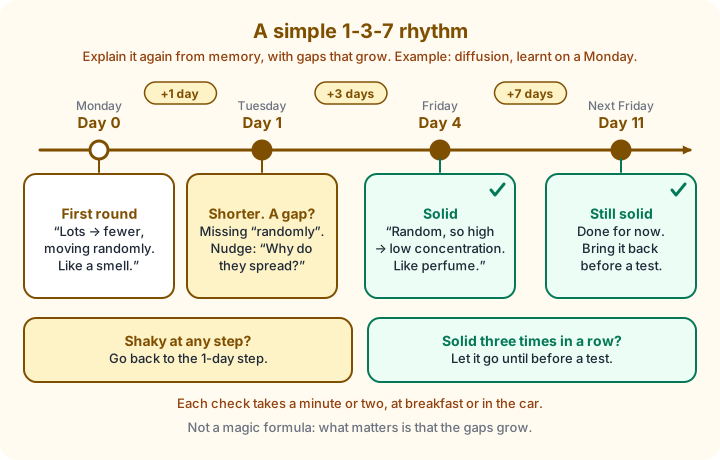
Explaining again after growing gaps turns today’s understanding into long-term memory.
Where families usually get stuck: remembering what's due. Keep a short list on the fridge, or use a calendar reminder. Or ask your child to write each idea on a flashcard. Cards make spacing almost automatic. See turn your explanations into flashcards.
What a spaced explanation looks like
Say your Year 8 child learnt about diffusion on Monday.
- Monday: "Particles move from where there are lots of them to where there are fewer, because they're always moving randomly. Like a smell spreading across a room."
- Tuesday: "Diffusion is... particles spreading out. From high to low concentration. Because they move about." (Shorter. Missing "randomly". Worth a nudge: "Why do they spread?")
- Friday: "Particles move randomly, so they spread from high concentration to low. Like perfume across a room." (Solid.)
- Next Friday: Still solid. Done for now.
Notice how little time this takes. Each check is a minute or two at breakfast or in the car.
Spacing the tricky bits
Not every idea needs the same attention. The best things to space are the bits your child got stuck on, and the misconceptions, wrong ideas that feel right, like "heavier things fall faster". These tend to creep back. Research on misconceptions (Tippett, 2010, reviewing refutation-text studies) suggests naming the wrong idea and correcting it directly helps. Coming back to that correction more than once is common sense.
If your child is revising for end-of-year tests, spacing is the backbone of a good plan. See revise for end-of-year tests the Feynman way.
How this connects to Learn by Asking
Learn by Asking is aitutors.me's idea that asking well is what drives learning. One simple habit from it fits spacing perfectly: a question journal. Each time an explanation wobbles, your child writes down the question it raised, in one line, with the date. In the diffusion example, Tuesday's entry would be "Why do the particles spread at all?" Those questions are what to come back to on day 4 and day 11, rather than the whole topic. Over a term, the journal becomes an exact list of what to revisit. Read more in keeping a question journal.
Where aitutors.me fits
On aitutors.me, Cards are flashcards with spaced review built in. In Jotters, the Watch out jots, short notes naming a common mistake, come back after 1, 3 and 7 days. A Watch-out only leaves once your child taps "I get it now" three times in a row. It's the same rhythm as above, without needing a list on the fridge.
FAQ
What is spaced practice?
Spaced practice means coming back to the same idea several times with gaps in between, instead of studying it all in one go. A large review of many studies found that spreading practice out leads to better long-term memory than cramming the same amount of time together.
Why should my child explain the same thing again if they understood it the first time?
Because understanding today and remembering in three weeks are different things. Memories fade fast at first. Explaining again after a gap makes your child dig the idea back out, and that effort is what makes it last. It also shows whether the first understanding was real.
What is the 1-3-7 rhythm?
It's a simple schedule: explain an idea again 1 day after learning it, then 3 days after that, then 7 days after that. If it's still shaky at any step, go back to the 1-day step. It isn't a magic formula, just an easy way to make the gaps grow.
Duke Harewood runs aitutors.me: Socratic AI tutors for KS3, plus a free GCSE map and flashcards for Years 10–11. Updated 20 October 2026.