Rereading feels like learning because the words become familiar, and the brain mistakes "I recognise this" for "I know this", but research shows that recalling and explaining with the book closed leads to far better memory than reading the same pages again. If your child revises by rereading and highlighting and is then surprised by the test, this is very likely why.
The good news is that the fix is simple, and it doesn't take extra time.
The feeling that fools everyone
Picture a friend's face. You'd recognise it instantly in a crowd. Now try to draw it from memory: the exact shape of the eyebrows, where the freckles sit. Most of us can't. Recognising something and recalling it are different skills.
Rereading trains recognition. On the second or third read, the sentences slide by easily. Each line feels familiar. Your child thinks, "Yes, I know this." That smooth, easy feeling is what researchers call fluency, and the trap is called the illusion of fluency: mistaking how easily something reads for how well it's known.
But a test doesn't ask your child to recognise their notes. It asks them to produce answers from a blank page. That's recall. And rereading barely practises it.
What the research says
Rereading and highlighting: "low utility"
In 2013, a team of psychologists led by John Dunlosky reviewed the evidence on ten popular study techniques. They looked at how well each worked across different ages, subjects and types of test.
Two of the most popular techniques, rereading and highlighting, were rated low utility. Not useless, but weak for the time they take.
Two techniques were rated high utility:
- Practice testing: trying to recall information, for example with flashcards, quizzes or a blank page.
- Distributed practice: spreading study out over days and weeks instead of cramming. (A large 2006 review by Cepeda and colleagues showed how strong this spacing effect is.)
Recalling beats rereading, a week later
The best-known experiment comes from Roediger and Karpicke (2006). University students read short science passages. Some then reread them. Others closed the text and wrote down everything they could remember.
On a test five minutes later, rereading did slightly better. That's the trap: in the short term, rereading looks like it's working.
But on tests two days and a week later, the recall group remembered clearly more. Pulling the information out of memory had made it stronger. Rereading had only made it feel familiar.
Even more striking: students who mostly reread tended to feel more confident about how much they'd remember. The fluency illusion fooled them.
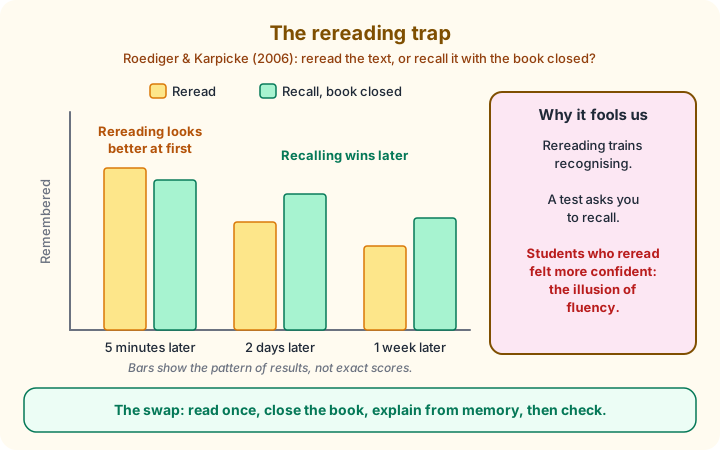
Rereading wins on a test five minutes later, but recalling wins two days and a week later.
These studies were with university students, so the exact numbers may differ for a Year 8. But the pattern has been found many times, with many ages and materials.
Why explaining beats rereading
The Feynman technique is a kind of recall with an extra layer. When your child explains a topic with the book closed, three things happen:
- They have to recall, not just recognise. That's retrieval practice.
- They have to connect ideas: this happens because of that. That's self-explanation, which we cover in why explaining helps children learn.
- They find the gaps. A gap that's invisible while rereading becomes obvious the moment you try to explain. The "um" is the information.
Richard Feynman put it well in a 1974 talk at Caltech, "Cargo Cult Science": "The first principle is that you must not fool yourself—and you are the easiest person to fool." Rereading is one of the easiest ways for a student to fool themselves. Explaining is one of the quickest ways to stop.
Where children get stuck
Swapping rereading for recall is uncomfortable at first. Expect these reactions:
- "But I don't know it yet!" That's fine. Trying to recall something you half-know is still useful, and then you check. Researchers even find that pretesting, having a go before you've learned something, can help later learning (Richland, Kornell and Kao, 2009).
- "This is harder." Yes. That's a good sign. The effort is part of what builds memory.
- "Rereading makes me feel calmer." Fair. A quick read can settle nerves. Just follow it with closed-book recall.
A simple swap your child can make tonight
You don't need to change everything. Change one step:
Instead of: read the notes, read them again, highlight, close the book, feel ready.
Try:
- Read the notes once, carefully.
- Close the book.
- Explain the main idea out loud or on a blank page, from memory.
- Open the book and check. What did you miss? What was wrong?
- Close it again and explain just those bits.
- Come back in a few days and do steps 2 to 5 again.
It takes about the same time as rereading twice. It just uses the time better.
A tip for parents: you can be the closed book. Ask your child to explain the topic to you before they open their notes, then let them check what they missed. You don't need to know the answers yourself. Your job is simply to listen and ask "why?" when something sounds vague.
If your child likes flashcards, they can turn the bits they missed into cards. We explain how in turn your explanations into flashcards. For a full plan before exams, see revise for end-of-year tests the Feynman way.
How this connects to Learn by Asking
Learn by Asking, aitutors.me's theory of learning, names a trap called the Answer Trap: getting an answer and treating it as the end, rather than the start of the next question. Rereading is its close cousin. Reading the answer again feels like knowing it, just as the rereaders in Roediger and Karpicke's study felt more confident than they should have. But no question was asked, so nothing was tested. The swap above breaks the trap: closing the book and explaining makes your child ask "what did I miss?" before they open it again. Read more in the Answer Trap explained.
How aitutors.me fits
On aitutors.me, Jotters asks children to recall rather than reread. Each "Ask me" jot sits behind a "Say it first" cover, so your child has a go at saying the idea before they look. "Get it" checks the idea stuck with three questions, and wrong answers link back to the jot that explains it. Children can also turn their jots into Cards for spaced review. No study has tested aitutors.me itself; we built it this way because of the research above.
FAQ
Is rereading notes a waste of time?
Not entirely, but it's one of the least effective ways to revise. A major 2013 review by Dunlosky and colleagues rated rereading and highlighting as "low utility". A quick read before testing yourself is fine; rereading as the whole revision plan is not.
What is the illusion of fluency?
It's the feeling that you know something because it looks familiar and reads smoothly. Familiar words on a page are easy to recognise, so the brain mistakes recognition for understanding. The test is whether you can recall or explain it with the book closed.
What should my child do instead of rereading?
Close the book and try to recall or explain the topic from memory, then check what they missed. That is called retrieval practice, and research rates it among the most effective study techniques. Spreading it out over days works even better.
Duke Harewood runs aitutors.me: Socratic AI tutors for KS3, plus a free GCSE map and flashcards for Years 10–11. Updated 20 October 2026.