To revise the Feynman way, you start each topic with a blank page, explain it from memory as if teaching someone younger, mark where you get stuck, fix only those parts, then test yourself and come back to the topic a few days later. It is harder than re-reading your notes. That's exactly why it works. This guide gives you a two-week plan for KS3 end-of-year tests.
It's written for you if you are in Year 7, 8 or 9 and your tests are coming up.
Why not just re-read your notes?
Re-reading feels like learning. The words look familiar, so your brain says "I know this". But recognising something on the page is not the same as being able to produce it in a test with the book closed.
In 2013, a team of psychologists led by John Dunlosky reviewed ten popular study techniques. They rated re-reading and highlighting as low utility: they don't help much. Two techniques came out on top as high utility: practice testing (testing yourself) and distributed practice (spreading revision out over time). For the full story, see why rereading feels like learning but isn't.
There's a well-known experiment behind the testing part. Roediger and Karpicke (2006) had students study short texts. Some re-read them; others practised recalling them. A week later, the students who practised recalling remembered much more, even though re-reading had felt more effective at the time. Those were university students, but the pattern has been found many times since.
A blank-page Feynman explanation is a kind of self-test. You are pulling the idea out of your memory and putting it into your own words.
The Feynman revision loop (25 minutes per topic)
Each revision session follows the same four steps. People call these the "Feynman technique", though the physicist Richard Feynman never wrote them down as a method himself. Later writers summarised them from the way he worked: he only trusted that he understood something if he could explain it simply.
- Pick (2 minutes). Choose one topic, small enough to explain in a few minutes. "Photosynthesis", not "all of biology".
- Explain (8 minutes). Close your book. On a blank page, explain the topic as if teaching a ten-year-old. Use plain words, examples, a quick diagram.
- Stuck? (5 minutes). Open your notes. Compare. Put a mark next to anything you got wrong, missed or waffled through. These are your stuck points.
- Simpler (10 minutes). Re-learn only the stuck points. Then explain those parts again, more simply. Finish with three or four quick questions from your textbook or a revision guide.
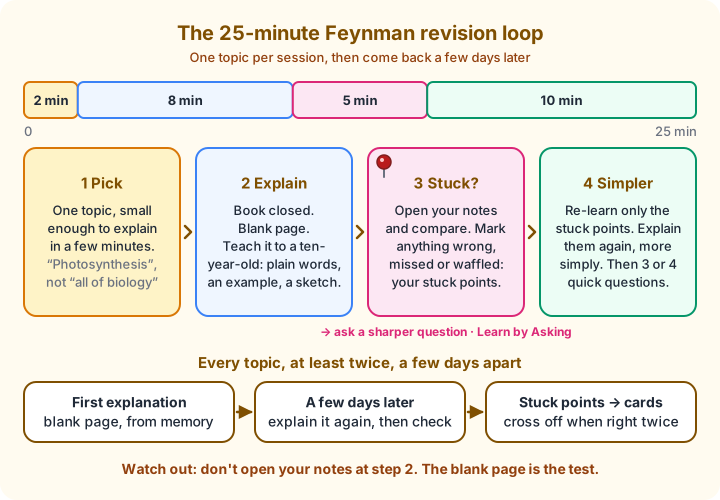
The blank page is the test, and every topic gets explained at least twice, a few days apart.
Watch out: the most tempting mistake is to open your notes at step 2 "just to get started". Don't. The blank page is the test. An empty page tells you something useful, too.
The two-week plan
This plan assumes about 45–60 minutes a day, which is two topics a day with a short break. Adjust the subjects to your own timetable.
Week 1: First explanations
| Day | Topic A | Topic B |
|---|---|---|
| Mon | Maths: fractions | Science: cells |
| Tue | English: a set text's main character | History: a key event and its causes |
| Wed | Geography: a process (e.g. rivers) | Maths: algebra basics |
| Thu | Science: forces | Languages: key vocabulary set |
| Fri | Review: re-explain Monday's topics on a blank page, without notes | |
| Sat | Science: particles / states of matter | History: a second key event |
| Sun | Rest, or a light 15-minute review of Tuesday's topics |
Week 2: Come back and close the gaps
| Day | Focus |
|---|---|
| Mon | Re-explain Wed and Thu topics from memory. Only check notes afterwards. |
| Tue | Re-explain Saturday's topics. Make flashcards from your stuck points. |
| Wed | Mixed questions across maths and science. Mark any new stuck points. |
| Thu | Mixed questions across English, history and geography. |
| Fri | Flashcards on every stuck point so far. Re-explain the two hardest topics. |
| Sat | One blank page per subject: write everything you know in 5 minutes each. |
| Sun | Light review only. Sleep well. |
Notice what this plan does. Every topic gets explained at least twice, a few days apart. That's distributed practice. A large 2006 review by Cepeda and colleagues pulled together hundreds of memory experiments and found that spacing practice out leads to better long-term memory than cramming it all into one session. For more on spacing, see explain it again next week: Feynman and spacing.
What to do with your stuck points
Your stuck points are gold. They are a list of exactly what you don't know yet, which is the only thing worth revising.
- Keep a stuck list. One page per subject. Every time you mark a stuck point, add it to the list.
- Turn each one into a question. "Why do we flip when dividing fractions?" "What's the difference between dissolving and melting?"
- Make it a flashcard. Question on the front, your own short explanation on the back. See turn your explanations into flashcards for how to write good ones.
- Cross it off only when you get it right twice, on different days.
Three common revision traps
- Making beautiful notes. Copying notes neatly in coloured pens feels productive. It's mostly re-reading with a pen. Use the time to explain instead.
- Revising what you already know. It feels great to go over your strongest topic. Your stuck list is where the marks are.
- One giant session the night before. Cramming can help a little for the next morning, but you forget it quickly. Two weeks of short, spaced sessions works far better.
How this connects to Learn by Asking
The Feynman way is Learn by Asking when you're the one explaining. Revision is where Learn by Asking pays off most: turn your notes into questions, then answer them before you look. Your stuck list already does this. "Why do we flip when dividing fractions?" asks why something works. "Where do I keep mixing up dissolving and melting?" points at your own mistake. The hardest questions ask where else an idea applies. Answer them closed-book a few days later, and anything you miss becomes tomorrow's question. See turning notes into questions for exam revision.
Using Jotters and Cards
If you use aitutors.me, two features fit this plan. In Jotters, upload your own class notes or a revision sheet. Short jots appear beside the words they explain, and you can add your own. The "Get it" check asks three questions, and a wrong answer links straight back to the jot that explains it. Watch-out jots come back after 1, 3 and 7 days, which lines up nicely with a two-week plan. When you are ready, "Make cards from my jots" turns them into Cards, flashcards with spaced review. And if you'd like to practise explaining out loud, Heddy Pip will listen. (A pip is a tiny seed. Every big idea grows from a small why?) Heddy only ever asks questions.
You don't need any app for the plan above. A notebook, a timer and a blank page are enough.
FAQ
How do I revise using the Feynman technique?
Pick one topic, close your book, and explain it on a blank page as if teaching someone younger. Mark every place you get stuck. Go back to your notes for just those places, then explain again more simply. Finish by testing yourself with a few questions, and come back to the topic a few days later.
How long before end-of-year tests should I start revising?
About two weeks is a good, realistic window for KS3 end-of-year tests. It gives you time to cover each subject and, more importantly, to come back to each topic more than once. Spreading revision out works better than cramming the night before.
Is re-reading my notes a good way to revise?
It feels good but works poorly. A major review of study techniques rated re-reading and highlighting as low utility. Testing yourself and spacing your revision were rated high utility. Re-read only the bits you got stuck on, then test yourself again.
Duke Harewood runs aitutors.me: Socratic AI tutors for KS3, plus a free GCSE map and flashcards for Years 10–11. Updated 20 October 2026.