The best flashcards come from your own explanations: each card asks one question about something you once got stuck on, and the back holds a short answer in your own words. Copying notes onto cards is slow and doesn't help much. Turning your Feynman stuck points into questions gives you a small pack of cards that targets exactly what you don't know yet.
This guide is for you if you are in Year 7, 8 or 9 and want your flashcards to actually work.
Why flashcards work (when they're done right)
Flashcards work because of something called retrieval practice. That means pulling an answer out of your memory, rather than looking at it. Each time you do, the memory gets stronger.
In a well-known experiment, Roediger and Karpicke (2006) asked students to study short texts. Some students re-read the text; others practised recalling it. A week later, the recall group remembered much more. They were university students, but the result has been repeated many times with younger learners too. A major 2013 review of study techniques (Dunlosky and colleagues) rated practice testing as one of only two "high utility" techniques. Re-reading and highlighting were rated "low utility". See why rereading feels like learning but isn't.
But there's a catch. Flashcards only work as retrieval practice if you say the answer before you flip. If you look at the front, flip straight away and think "yeah, I knew that", you're re-reading with extra steps.
Why your own explanations make better cards
There's an old finding in memory research called the generation effect. In 1978, Slamecka and Graf showed that people remember words better if they generate them themselves (for example, completing a word from a clue) than if they simply read them. Creating something in your own head leaves a stronger trace.
This is why making your own cards helps. Choosing the question and writing the answer in your own words is a small act of generation. And when the cards come from your Feynman stuck points, they are aimed at your real gaps.
A quick reminder: the Feynman steps (pick a topic, explain it simply, find where you get stuck, simplify) are a later summary of how the physicist Richard Feynman worked, not a method he wrote down himself. Flashcards fit neatly onto the end of them. For a two-week plan that uses both, see revise for end-of-year tests the Feynman way.
From explanation to card: a worked example
Meet Zara. She has just explained photosynthesis and respiration on a blank page. When she checked her notes, she found two stuck points:
- She wrote "plants do photosynthesis, animals do respiration". (Wrong: plants do both.)
- She couldn't say where in the cell respiration happens.
Here's how she turns them into cards.
Bad card
Front: Photosynthesis Back: (a whole paragraph copied from the textbook, including the word equation, chloroplasts, chlorophyll, stomata, and limiting factors)
The front isn't a question, so there's nothing to retrieve. The back has six ideas. She'll glance at it, feel vaguely familiar, and move on.
Good cards
Front: Do plants respire? When? Back: Yes, all the time, day and night, in every living cell. In daylight, photosynthesis is usually faster, so overall they give out oxygen.
Front: Where in a cell does respiration happen? Back: In the mitochondria.
Front: Why isn't respiration the same as breathing? Back: Breathing moves air in and out of the lungs. Respiration is a chemical reaction in cells that releases energy from glucose.
Each card has one idea. Each front is a real question. Each back is short and in her own words. The third card targets the exact mistake she made, which is the most valuable kind.
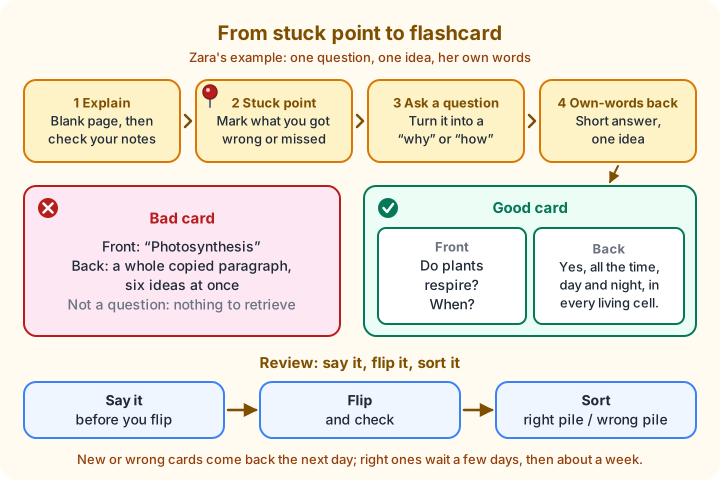
One question, one idea, your own words, and say the answer before you flip.
Seven rules for good cards
- One idea per card. If the back has "and also…", split it.
- Ask a question on the front. Not a single word. "Why…?", "How…?", "What's the difference between…?" work well.
- Answer in your own words. If you can't, you've found another stuck point. Go back and explain it first.
- Make cards from stuck points. You don't need a card for what you already know cold.
- Add a "watch out" card for every mistake you made. "Is sugar in tea melting or dissolving?" is a great card if you once said "melting".
- Include a picture when it helps. A tiny sketch of particles or a labelled diagram on the back can be quicker than words.
- Keep them short enough to answer in under 30 seconds. Long answers belong in an explanation, not a card.
How to review: say it, flip it, sort it
Here's a simple routine for a 10-minute session:
- Read the front.
- Say the answer out loud (or in your head, fully). Don't flip yet.
- Flip and check.
- Sort. Right and easy goes in one pile. Wrong or shaky goes in another.
- Go through the "wrong" pile again before you stop.
Then space it out. A big 2006 review by Cepeda and colleagues found that spreading practice over time leads to better long-term memory than doing it all at once. A simple rhythm:
- New cards: review the next day.
- Got it right? Wait a few days, then about a week.
- Got it wrong? Back to the next day.
For more on why this timing works, see explain it again next week: Feynman and spacing.
Watch out: don't keep reviewing only the cards you get right because it feels good. The "wrong" pile is where you are learning.
How this connects to Learn by Asking
The Feynman way is Learn by Asking when you're the one explaining. The review routine has one of Learn by Asking's rules built in: the First-Guess Rule, which says commit to a guess before you look, even one that might be wrong. Step 2, say the answer before you flip, is exactly that. If Zara says "plants only respire at night" and then flips to "all the time, day and night", the correction lands on her real mistake. Flipping straight away only lets her feel she knew it. That is why the "wrong" pile teaches the most. See the First-Guess Rule.
Cards and "Make cards from my jots"
On aitutors.me, Cards are flashcards with spaced review built in, so the timing above is handled for you. If you use Jotters on your own notes, the short jots beside your text (and the ones you add yourself) can become cards with "Make cards from my jots". Because the jots sit beside the exact words they explain, the cards come straight from the places you were working on. And when a "Get it" question goes wrong, it links back to the jot, which is often the best card to make next.
You can do all of this with a pack of index cards and two elastic bands. The rules are the same.
FAQ
What makes a good flashcard?
One idea per card, a question on the front that makes you think (often a "why" or "how"), and a short answer on the back in your own words. Good cards come from things you actually got stuck on, not from copying a whole page of notes.
Should I write flashcards myself or use ready-made ones?
Writing your own usually helps more, because making the card is itself a bit of learning: you have to decide what matters and put it in your own words. Ready-made cards are fine for checking vocabulary, but your own stuck points are the best source.
How often should I review flashcards?
Spread it out. Review a new card the next day, then a few days later, then about a week later. Cards you keep getting right can wait longer; cards you get wrong come back sooner. Short, spaced sessions beat one long session.
Duke Harewood runs aitutors.me: Socratic AI tutors for KS3, plus a free GCSE map and flashcards for Years 10–11. Updated 20 October 2026.