Explaining helps children learn because it forces them to connect ideas and notice what they don't understand, and research on the "self-explanation effect" shows this leads to deeper understanding than reading alone. It isn't a cure-all, and it works best with a quick check against the source. But it is one of the better-supported study habits a child can build, and it costs nothing.
This article explains what the research found, in plain terms, and where its limits are.
What researchers mean by "self-explanation"
Self-explanation is the jargon. Here it is simply: it means a learner saying to themselves, in their own words, why a step happens or how one idea links to the next.
Compare two children reading the same sentence in a science textbook: "The heart pumps blood to the lungs, where it picks up oxygen."
- Child A reads it, nods, and moves on.
- Child B stops and thinks: "So the blood has to go to the lungs first, before going round the body. That must be because it's used up its oxygen. So there are two loops."
Child B is self-explaining. They've turned one sentence into a connection with what they already know, and they've made a small prediction. That extra work is what seems to make the difference.
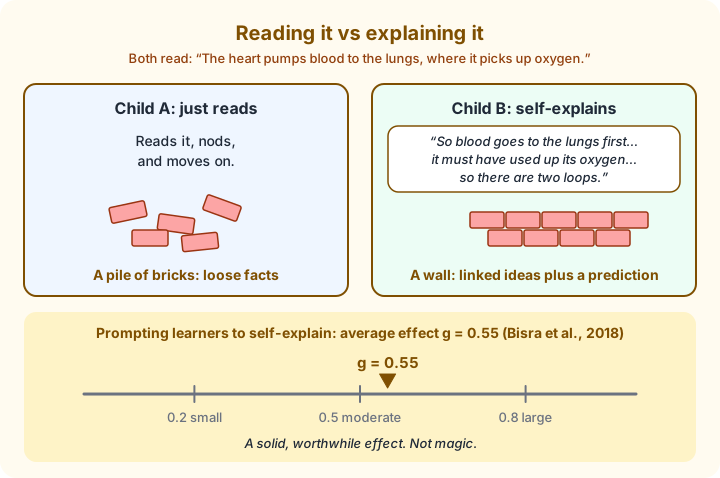
Self-explaining turns one sentence into linked ideas, and research puts its average effect in the moderate range.
The Feynman technique is, in large part, self-explanation done out loud, with a listener and a deliberate hunt for gaps.
The studies that started it: Chi and colleagues
The modern research began with psychologist Michelene Chi.
1989: physics students. Chi and her colleagues watched university students studying worked examples in physics (mechanics problems, like blocks on slopes). Some students did well on later problems and some didn't. The difference wasn't how long they studied. The stronger students were the ones who explained the examples to themselves more: why each step was taken, what it meant, where it came from. The weaker students mostly reread the steps.
That was an observation, not an experiment. It could have been that stronger students simply explained more because they were stronger. So the next question was: if you ask students to explain, do they learn more?
1994: 8th graders and the heart. In a second study, Chi's team gave 8th-grade students (roughly Year 9 in England) a textbook passage about the human circulatory system. One group was prompted to explain each sentence aloud after reading it. The other group read the same passage twice.
The prompted group understood the circulatory system better afterwards, especially on harder questions that needed them to reason, not just recall. And within that group, the students who explained the most were more likely to end up with a correct overall picture of how blood moves around the body.
This study matters for parents because the children were around KS3 age, and the topic is one your child will meet in KS3 biology.
What the bigger picture says
Single studies can mislead. So researchers combine many studies in a meta-analysis: a study of studies, which works out the average effect.
In 2018, Bisra and colleagues did this for self-explanation. Across a large number of experiments, prompting learners to self-explain produced an average effect of g = 0.55.
What does that number mean? Here it is simply: g is a measure of how far apart two groups end up, on a common scale. In education research, effects around 0.2 are small, around 0.5 are moderate, and 0.8 or more are large. So 0.55 is a solid, worthwhile effect. Not magic. Worth doing.
A separate big review, by Dunlosky and colleagues in 2013, rated ten common study techniques. It rated self-explanation as "moderate utility": promising, with good evidence, but needing more research in real classrooms. It rated practice testing (recalling on purpose) as "high utility", and rereading and highlighting as "low utility". Explaining from memory combines self-explanation with recall, which is one reason the Feynman approach does well. More on that in why rereading feels like learning but isn't.
Why explaining works: three simple reasons
- It links ideas. Explaining forces "because" and "so" into your child's thinking. Linked ideas are easier to remember and use than loose facts. It's like the difference between a pile of bricks and a wall.
- It shows the gaps. You can't explain a step you don't understand without noticing. The stumble is the information. We cover this in knowing what you don't know: Feynman and metacognition.
- It's active. Producing words takes more effort than recognising them. That effort, uncomfortable as it is, is part of what makes memory stick.
The honest limits
It's worth being clear about what the research doesn't show:
- Many studies used older students. Chi's 1994 study is a happy exception, but plenty of the evidence comes from university students in short lab sessions. Effects for an 11-year-old over a school year may be smaller or larger. We don't know precisely.
- Quality matters. Saying "I get it" is not self-explanation. The benefit comes from genuine why and how statements. Some children need prompts to get there.
- Children can explain things wrongly. A confident wrong explanation can feel like understanding. That's why the Feynman steps include going back to the source. Explaining is a way of finding mistakes, not a replacement for good teaching.
- It doesn't replace practice. In maths especially, children still need to do problems. Explaining why a method works helps those problems make sense.
What this means at home
You don't need to run an experiment. A few small habits bring the research into family life:
- After homework, ask "What was the main idea? Can you tell me why it works?"
- When your child says "I don't get it", ask them to explain the part they do get. The gap usually appears right after it.
- When an explanation goes wrong, say "Let's check", not "That's wrong".
The protégé effect, where children learn more by preparing to teach someone else, is a close cousin of self-explanation. We cover it in the protégé effect: children learn by teaching.
On aitutors.me, a child can explain a topic to a curious listener called Heddy Pip, which only asks questions. The subject's professor reads that explanation as evidence of what the child understands; no score is shown to the child. No study has tested aitutors.me itself. We built it this way because of the research above.
How this connects to Learn by Asking
Learn by Asking, aitutors.me's theory of learning, says the questions a learner asks matter more than the answers they're handed. Self-explanation is that idea turned inwards: asking yourself "why does this work?" and then answering. Look at Child B in the heart example. Child B quietly asks why the blood would go to the lungs first, and the answer, "it must have used up its oxygen", is the learning. Child A asked nothing, so nothing connected. The prompts in Chi's 1994 study did this on purpose: explaining each sentence meant asking why it was true. How far the research backs the wider idea is covered in is Learn by Asking backed by research?
FAQ
What is the self-explanation effect?
It's the finding that learners who explain to themselves why and how something works, line by line or step by step, understand it better than learners who just read or study it. A 2018 meta-analysis by Bisra and colleagues found an average effect of g = 0.55, which is a moderate, worthwhile effect in education research.
Does explaining work for children, or only adults?
One of the best-known studies, by Michelene Chi and colleagues in 1994, used 8th-grade students (roughly Year 9 in England) learning about the circulatory system. The students prompted to explain each sentence understood it better. Many other studies used university students, so effect sizes for younger children are less certain.
What if my child explains something wrongly?
That's useful, not a failure. A wrong explanation shows exactly where the misunderstanding is. The key is that the child then checks the source and fixes it. Explaining without ever checking can let mistakes settle in, so build in a "let's look it up" step.
Duke Harewood runs aitutors.me: Socratic AI tutors for KS3, plus a free GCSE map and flashcards for Years 10–11. Updated 20 October 2026.