The protégé effect is the finding that children often learn more when they study in order to teach someone else, or when they actually do the teaching, than when they study just for themselves. A protégé is someone you look after and teach. The surprising part is who benefits: not only the person being taught, but the one doing the teaching.
This is one of the main reasons the Feynman technique works. Here's what the research found, in plain words, and how to use it at home.
A familiar example
Think of an older sibling showing a younger one how to tie their shoelaces. To do it, they have to slow down. They have to split it into steps. They have to notice the bit where the little one keeps going wrong and find another way to show it.
By the end, the older child understands shoelaces better than before. Not because they learned anything new about laces, but because teaching made them organise what they knew.
School topics work the same way. A child who has to teach "why ice floats" has to find the main idea, put things in order, and answer "but why?" That work is where the learning happens.
Study 1: just expecting to teach helps
In 2014, Nestojko and colleagues ran a simple experiment. Adults read a passage. Some were told they'd be tested on it. Others were told they'd have to teach it to someone else.
Here's the clever bit: nobody actually taught. Everyone took the same test.
The people who expected to teach remembered more of the passage, especially the main points. Their recall was also better organised: grouped into sensible chunks rather than a jumble.
Why? Probably because when you expect to teach, you read differently. You look for the big ideas and the order they go in. You ask yourself what a learner would need. That's a more active way to read.
What this means for your child: "Read this so you can explain it to me later" may be a better instruction than "read this for your test".
Study 2: actually teaching helps more over time
Fiorella and Mayer (2013) went one step further. University students learned a short lesson on a physics topic (the Doppler effect: why a siren sounds higher as it comes towards you and lower as it goes away). Then they were split into groups:
- some studied it expecting a test,
- some studied it expecting to teach it,
- some expected to teach it and then actually did, by explaining it to a camera as a short video lesson.
Expecting to teach helped on a test straight afterwards. But the group who actually taught did best on a test a week later. Explaining it out loud seems to have made the learning last.
That fits with the wider research on self-explanation, which we cover in why explaining helps children learn. Teaching is self-explanation with an audience.
Study 3: working harder for someone else
The name "protégé effect" comes from a 2009 study by Chase, Chin, Oppezzo and Schwartz. They worked with 8th-grade students (roughly Year 9 in England) learning science using computer characters called teachable agents.
Here's the idea simply: a teachable agent is a cartoon pupil on the screen. The child teaches it by building a map of how ideas connect. Then the agent "takes a quiz" using only what it was taught. If it gets answers wrong, that's because of a gap in what the child taught.
Two findings stand out:
- Children tried harder for their agent than for themselves. They spent more time and effort learning when the work was "for" the character than when the same work was for their own learning.
- Lower-achieving students gained the most. Teaching was not just a treat for the top set. The children who usually found science hardest benefited most.
Why would children try harder for a cartoon? One idea is that failing is less painful when it's the agent's mistake rather than your own. The agent gets the question wrong, not you. That takes the sting out of getting things wrong, and makes it easier to go back and fix it.
That has a lot to say about anxious or reluctant learners. We look at it more closely in Feynman for shy or anxious children.
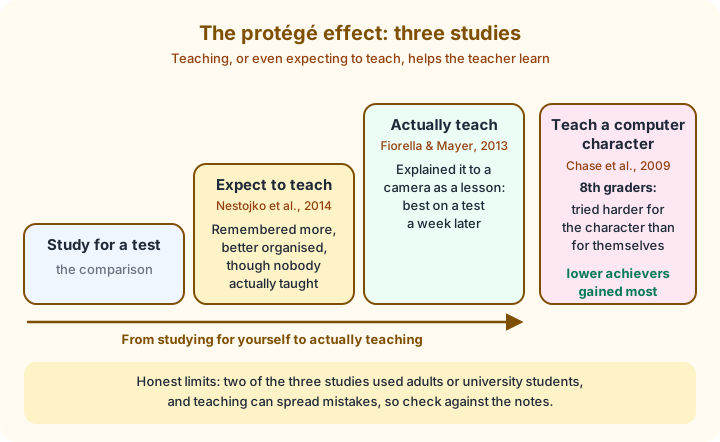
Across three studies, teaching, or even preparing to teach, helped the teacher learn.
The honest limits
- Two of these three studies used adults or university students, in short sessions. The teachable-agent study used 8th graders, which is closer to KS3, but it is still one study with one piece of software.
- Teaching can spread mistakes. If a child teaches something wrongly and nobody checks, the mistake can feel more certain afterwards. Build in a check against the textbook or notes.
- It takes more time than reading. It's worth it for important ideas, not every single fact.
How to use the protégé effect at home
You don't need software. You need a pupil and a reason to teach.
- Be the pupil, not the examiner. Ask "Can you teach me this?" rather than "Do you know this?" Then be genuinely curious. Ask "why?" Get things slightly wrong on purpose and let your child correct you.
- Say it before the reading. "When you've read this chapter, I'd love you to teach me the main idea." That sets up the expecting-to-teach effect.
- Use siblings carefully. An older child teaching a younger one can work well, as long as it's short and nobody is made to feel small.
- Let toys and pets count. A younger child, or a shy one, may find teaching a teddy much easier than teaching a parent.
- Keep it tiny. Five minutes over dinner is plenty. We've written a whole routine for this in the five-minute dinner-table teach-back.
On aitutors.me, the pupil can be Heddy Pip, a curious listener your child teaches. Heddy Pip only ever asks questions; it never corrects or scores. (A pip is a tiny seed. Every big idea grows from a small why?) The subject professor reads the explanation as evidence of understanding. No study has tested aitutors.me itself; the design simply borrows the idea from the research above.
How this connects to Learn by Asking
Learn by Asking, aitutors.me's theory of learning, puts the question at the centre of learning. The protégé effect shows that a good question often comes from the pupil. When a parent asks "but why does ice float?", or the little one keeps getting the shoelace loop wrong, the teacher has to find a gap and fill it. In the 2009 study the teachable agents did this without saying a word: every wrong quiz answer was, in effect, a question about what the child had taught. That's why your job at home is to ask, not to correct. The link to Socrates is explored in how Learn by Asking relates to the Socratic method.
FAQ
What is the protégé effect?
It's the finding that people often learn more when they study in order to teach someone else, or when they actually teach, than when they study only for themselves. The name comes from a 2009 study in which 8th graders worked harder to learn when they were teaching a computer character than when learning for themselves.
Does my child need a real person to teach?
No. In the teachable-agent research the "pupil" was a computer character, and simply expecting to teach improved recall in another study. A parent, sibling, pet, toy or notebook can stand in. What matters is that your child organises the idea clearly enough to pass on.
Which children benefit most from learning by teaching?
In Chase and colleagues' 2009 study with 8th graders, lower-achieving students gained the most from teaching a computer agent. That's one study, so treat it as encouraging rather than certain, but it suggests teaching is not only for confident, high-attaining children.
Duke Harewood runs aitutors.me: Socratic AI tutors for KS3, plus a free GCSE map and flashcards for Years 10–11. Updated 20 October 2026.