Shy or anxious children can use the Feynman technique just as well as confident ones, because the learning comes from putting an idea into their own words, not from performing in front of anyone, so a toy, a pet, a notebook or a patient listener works fine. The method is often pictured as standing up and teaching the class. It doesn't need to look like that at all.
If your child goes quiet when you say "tell me what you learnt today", this article is for you. It explains why the audience is optional, gives you gentle ways to start, and covers what to do when it doesn't go to plan.
Why the audience was never the point
The Feynman technique, as it is usually summarised, has four steps: pick an idea, explain it simply, notice where you get stuck, then go back and make it simpler. (Feynman didn't write these steps himself. They are a later summary of his habits by other writers.)
Look closely and you'll see no step says "in front of people". The useful part is what happens inside your child's head while they explain. They have to choose words, put ideas in order and find the joins. That's where the gaps show up.
Research on self-explanation, where learners explain material to themselves, found a moderate average benefit across many studies (Bisra and colleagues, 2018, g = 0.55). The key word is themselves. Nobody else needs to be listening.
Think of it like singing in the shower. Plenty of people who'd never sing on a stage know every word when nobody's watching. The words are just as real. The pressure is gone.
The protégé effect, without the pressure
The protégé effect is the finding that people often learn more when they prepare to teach, or actually teach, someone else. Put simply: having a "student" makes you try harder to understand.
A few studies help here:
- Nestojko and colleagues (2014) found that students who simply expected to teach a passage remembered it better and more clearly organised than students who expected a test. They never actually had to teach.
- Fiorella and Mayer (2013) found that actually explaining the material, here on video, added a further, longer-lasting benefit over just preparing.
- Chase and colleagues (2009) studied "teachable agents": computer characters that 8th graders taught. Children put more effort into learning for their agent than for themselves, and lower-achieving students gained the most.
That last study is the encouraging one for shy children. The "student" was a character on a screen. It didn't judge. Children still worked harder for it. You can read more in the protégé effect: children learn by teaching.
(Honest note: these studies were mostly with older students or in short lab tasks, and none looked at anxious children specifically. They suggest the listener doesn't have to be a person. They don't promise a result.)
Six safe listeners
Pick whichever feels least scary to your child.
- A soft toy. Old-fashioned and surprisingly effective. A toy can't laugh or correct.
- A pet. Dogs are excellent listeners. Cats less so, but they're harmless.
- A notebook. Writing an explanation "for a younger cousin" counts. Writing is explaining.
- A voice memo. Your child records, listens back alone, and decides if anyone else hears it.
- A younger sibling. Only if the relationship is easy, and only for things they know well.
- A patient listener that only asks questions. More on this below.
Software developers have a version of this called "rubber duck debugging". They explain their code line by line to a rubber duck on the desk. The duck says nothing, but explaining out loud helps them spot the bug. Your child can do the same with photosynthesis.
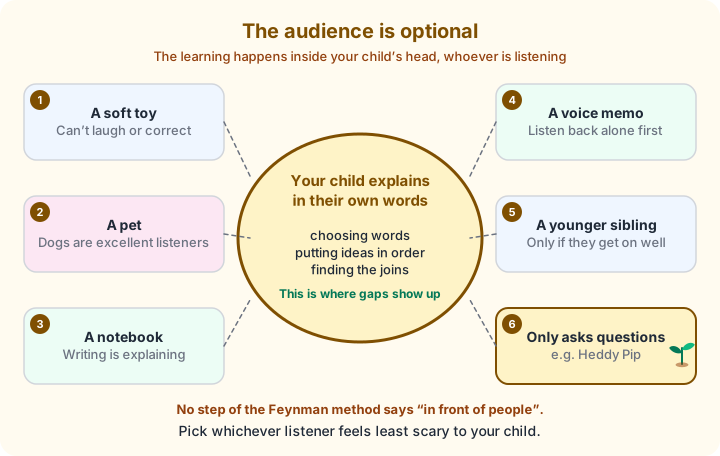
Any of these six listeners works, because the learning comes from putting the idea into words, not from performing.
How to start gently
Where anxious children usually get stuck is the first try. If it feels like a test, they'll freeze. So make the first one almost impossible to fail.
- Start with something they already know. A favourite game's rules, how to make toast, a football team's tactics. Let them feel what explaining is like with no risk.
- Shrink the task. Not "explain the water cycle". Just "explain what evaporation means".
- Leave the room. "I'll be in the kitchen. Tell your bear about it, and let me know if you want me to hear the end."
- Let writing count. Some children think better on paper. A five-line explanation in a notebook is a full Feynman round.
- Make stuck the goal. Say: "See if you can find one bit that's tricky to explain. That's the bit we want." Now getting stuck is success, not failure.
We cover more family routines in how to use the Feynman technique at home.
What to say when it goes wrong
Sometimes your child will stop, go red, and say "I can't do this".
- Don't push. Say "That's fine. That was a real stuck point. Shall we look at that bit together later?"
- Don't correct the explanation. If you jump in with the right answer, you become the audience they were afraid of.
- Notice effort, not fluency. "You explained the first half really clearly" is honest and true.
- Try a different listener next time. Maybe the notebook beats the bear.
As confidence grows, you can try something a bit more social, like the five-minute dinner-table teach-back. There's no rush.
A word on anxiety
Some shyness is just personality. Some worry is bigger than that. If anxiety about school or learning is affecting your child's sleep, eating or daily life, talk to their school or your GP. A study habit is not a substitute for proper support.
How this connects to Learn by Asking
Learn by Asking is aitutors.me's idea that asking good questions is what drives learning. One part of it, the Curiosity Reserve, says a child's willingness to ask isn't fixed. It runs down with tiredness and worry, and fills back up with rest and feeling safe. That is why the safe listeners in this article matter. A bear or a notebook can't make anyone feel stupid, so the quiet question "wait, how does that bit work?" gets asked instead of swallowed. Every stuck point your child finds in private is a question asked with nothing to lose. Read more in the Curiosity Reserve: why tired kids stop asking.
Where aitutors.me fits
On aitutors.me, a child can explain a topic to Heddy Pip, a curious listener who only ever asks questions. Why the name? A pip is a tiny seed. Every big idea grows from a small why? Heddy Pip never marks or corrects, and no score is shown to the child. The subject's professor reads the explanation as evidence of understanding, quietly, in the background. For a shy child, that can be a gentle first step before explaining to a person.
FAQ
Does my child have to explain to a person for the Feynman technique to work?
No. The benefit comes from your child putting the idea into their own words and noticing where they get stuck. A toy, a pet, a notebook, a voice memo or a patient listener that only asks questions all work. A human audience is optional.
My child freezes when asked to explain. What should I do?
Lower the stakes. Take yourself out of the room, shrink the task to one small idea, and let them write instead of speak. Start with something they already know well so the first try feels like a win. Build up slowly.
Is explaining to a toy just a gimmick?
It sounds silly, but the idea behind it is serious. Research on learning by teaching, such as studies of teachable agents, suggests that having someone or something to explain to can make children try harder, and the explaining itself is what helps. A toy simply removes the fear of being judged.
Duke Harewood runs aitutors.me: Socratic AI tutors for KS3, plus a free GCSE map and flashcards for Years 10–11. Updated 20 October 2026.