Metacognition is the skill of knowing what you understand and what you don't, and the Feynman way builds it by asking your child to explain an idea in plain words, so that every place they get stuck becomes a clear signal of what to learn next. It sounds like a grand word. It is really a small, honest habit: checking yourself before a test does it for you.
If your child has ever said "I know this, I just can't explain it", they have bumped into the edge of metacognition. This article explains what it is, why the research rates it so highly, and how the Feynman approach turns it into something your child can do at the kitchen table.
What metacognition actually means
The jargon first. Meta means "about", and cognition means "thinking". So metacognition is thinking about your own thinking.
Here is an everyday picture. Imagine your child is packing for a school trip. One way is to throw things in a bag and hope. The other is to stop, look at the list, and notice "I haven't packed a coat". Metacognition is the second way, applied to learning. It has three parts:
- Planning. "What do I need to understand by Friday?"
- Monitoring. "Do I really get this, or does it just look familiar?"
- Evaluating. "That went badly. What will I do differently next time?"
The middle step, monitoring, is where most children slip. And it is the one the Feynman way trains most directly.
Why the research takes it seriously
The Education Endowment Foundation (EEF) is an independent UK charity that summarises school research for teachers. Its Teaching and Learning Toolkit estimates that metacognition and self-regulation approaches add about +7 months' additional progress over a school year, at low cost. That puts it near the top of the whole Toolkit.
Two honest notes. First, that figure comes mostly from studies of teachers explicitly teaching these strategies in class. It is an average across many approaches, not a promise for one child. Second, nobody has tested "the Feynman technique" as a named programme against it. What we can say is that the Feynman way practises exactly the monitoring skill those studies teach.
The trap: feeling sure is not the same as knowing
The hardest part of monitoring is that our feelings lie to us. When your child rereads a page about photosynthesis, the words start to feel familiar. Familiar feels like understood. It isn't.
Psychologists call this an illusion of fluency. Put simply: the page is easy to read, so the brain decides the idea is easy to know. A large review by Dunlosky and colleagues (2013) rated rereading and highlighting as "low utility" for this reason. They make children feel ready without making them ready. We go deeper on this in why rereading feels like learning but isn't.
Richard Feynman named the trap himself. In his 1974 "Cargo Cult Science" address at Caltech he told students that the first principle is that you must not fool yourself, and that you are the easiest person to fool. That line is about science. It is also the best one-sentence definition of metacognition a teenager will ever hear.
How explaining turns a feeling into evidence
Explaining out loud is a test you cannot fake. You either can say how blood gets from the lungs to the toes, or you can't.
Research on self-explanation backs this up. A 2018 meta-analysis by Bisra and colleagues combined dozens of studies and found a moderate average benefit (g = 0.55) when learners were prompted to explain material to themselves. (That number describes an average effect across studies. Many were with older students, so treat it as a strong hint, not a guarantee.) You can read more in why explaining helps children learn.
The magic is not in the talking. It is in what the talking reveals. When your child explains, three kinds of signal appear:
- The stall. They stop mid-sentence. Something is missing between this step and the next.
- The borrowed word. They use a term like "osmosis" but can't say what it means in ordinary words.
- The hand-wave. "And then it just... happens." That "just" is hiding a gap.
Each one is data. It points to a specific thing to go back and learn.
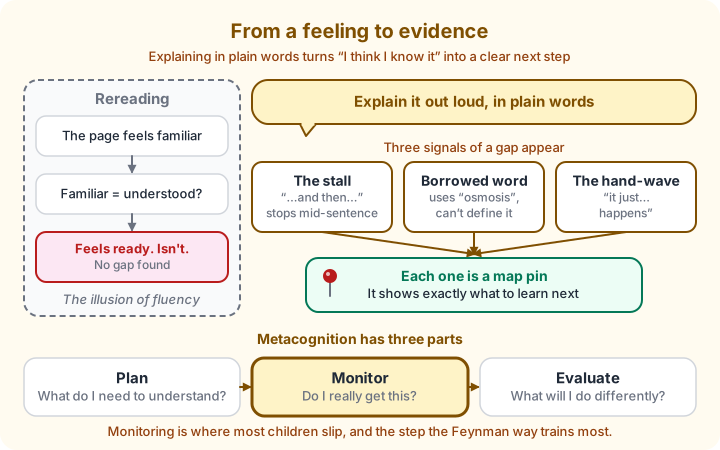
Explaining turns a feeling of knowing into evidence: every stall, borrowed word or hand-wave marks the next thing to learn.
Stuck points as data, not failure
This is the mindset shift that matters most for parents. A stuck point is not a sign your child is bad at science. It is a map pin saying "learning happens here".
Think of a satnav. It cannot plan a route until it knows where you are. A child who says "I get lost right after the bit about chlorophyll" has just given their own satnav a location. Now they can plan.
The Feynman way, as it is usually summarised, has four steps: pick an idea, explain it simply, notice where you get stuck, then go back and make it simpler. (Feynman never wrote these four steps down himself. They are a later summary of his habits by other writers.) Step three is pure metacognition. We walk through the steps with a KS3 example in the four Feynman steps, explained simply, and give stuck points their own article in where you get stuck is where you learn.
What you can do at home
You don't need to know the subject. You need to ask the right questions and stay curious.
- Ask for the explanation, not the answer. "Can you tell me how that works?" beats "Did you finish your homework?"
- Ask where it got hard. "Which bit was the trickiest to explain?" Write the answer down together.
- Praise the finding, not the fluency. "Good spot, so that's the bit to look at" teaches your child that gaps are welcome.
- Close the loop. Next day, ask them to explain only the stuck bit. If it flows now, they've just felt their own progress.
- Avoid rescuing. If you explain it for them, you take away the useful moment of being stuck.
Where children usually get stuck with this is the honesty step. Saying "I don't get it" feels risky, especially to a child who is used to being the one who knows. Keep the tone light and private. No marks, no audience.
How this connects to Learn by Asking
Learn by Asking is aitutors.me's idea that, now answers are everywhere, the skill that counts is asking well. It calls that skill question literacy: knowing what is actually worth asking, which you can only do once you can see your own gap. That is exactly what the monitoring step gives your child. "I know this, I just can't explain it" is a fog. "I get lost right after the bit about chlorophyll" is a question they can take to a teacher, a book or an AI. Explaining comes first, and the good question follows. Read more in prompt literacy vs question literacy.
Where aitutors.me fits
On aitutors.me, the subject professors use Socratic questions and never hand over the final answer, so your child has to do the explaining. In Jotters, the new reading feature, a child can drop a stuck pin on the exact line where they lost the thread, and work through the Feynman steps: Pick · Explain · Stuck? · Simpler. When they explain a topic to Heddy Pip, a curious listener who only asks questions, the professor reads it as evidence of understanding. No score is shown to the child. The point is the honest check, not a grade.
You can do all of this with a pencil and a patient question, too. The habit matters more than the tool.
FAQ
What is metacognition in simple terms?
It's thinking about your own thinking. A child with good metacognition can tell the difference between "I've seen this before" and "I could explain this to someone", and they know what to do next when they find a gap. It's the skill of checking yourself honestly.
How does the Feynman technique build metacognition?
Explaining something out loud in plain words is a test you can't fake. The moment your child stalls, reaches for a word they can't define, or says "it just does", they have found a gap. That stuck point tells them exactly what to go back and learn, which is metacognition in action.
Is the EEF's +7 months figure about the Feynman technique?
No. The Education Endowment Foundation's Toolkit estimates about +7 months' additional progress for metacognition and self-regulation approaches in general, mostly taught by teachers in schools. It did not test the Feynman technique itself. The Feynman way is one practical habit that fits the same idea.
Duke Harewood runs aitutors.me: Socratic AI tutors for KS3, plus a free GCSE map and flashcards for Years 10–11. Updated 20 October 2026.