Getting stuck isn't failing, it's finding: the exact moment you can't explain the next step shows you the edge of what you understand, and that edge is where real learning happens. If you mark that spot, go back to the source for just that bit, and try again, you'll learn faster than if you'd sailed through without a bump.
That might sound like something adults say to make you feel better. It isn't. This article explains why it's true, how to spot your stuck points, and what to do with them.
Why stuck is good news
Think about a video game. The levels you breeze through don't make you better. The boss you lose to six times does. Each time, you learn a bit more about what it does. By the seventh go, you've got it.
Learning works the same way. When something feels easy, your brain isn't working very hard, so not much changes. When you hit a wall, your brain has to build something new. That building work is learning.
Here's the catch. Most students treat a stuck point like a wrong turn. They skip it, reread the page, or ask someone for the answer. All three throw away the most useful moment of the session.
What the research says
A few studies help explain why struggling helps.
- The generation effect. Slamecka and Graf (1978) found that people remember words better when they have to produce them (for example, filling in a missing letter) than when they simply read them. Making your brain do the work helps it remember.
- Pretesting. Richland, Kornell and Kao (2009) asked people to try answering questions before reading a text. They often got them wrong. But afterwards they remembered the material better than people who had just spent extra time studying it. Having a question in your head made the answer stick.
- Self-explanation. A big 2018 review by Bisra and colleagues found that explaining things to yourself helps learning, with a moderate average effect. Explaining is how you find the stuck points in the first place.
To be fair: most of these studies were with university students, and the tasks were short. But the pattern is consistent. Effort and the odd wrong answer, followed by checking, beat easy reading.
How to spot that you're stuck
Sometimes it's obvious. Often it's sneaky. When you explain a topic out loud or on paper, watch for these three signs:
- The long pause. You stop mid-sentence. Something's missing between this step and the next.
- The word you can't explain. You say "osmosis" or "denominator" and then realise you couldn't explain it to a ten-year-old. See how to explain anything to a ten-year-old.
- "It just does." Or "basically", or "and then it happens". These little phrases are covers for a gap.
The sneakiest of all is the feeling of knowing. You read your notes and think "yep, I know this". That feeling isn't proof. The only proof is explaining it without looking.
What to do when you're stuck: four moves
1. Mark the exact spot
Not "I don't get photosynthesis". Be precise: "I can explain that leaves take in carbon dioxide, but I can't explain where the oxygen comes from." Put a mark in the margin or a sticky note on the page.
2. Write the question
Turn the stuck point into one short question. "Where does the oxygen come from?" A clear question is half an answer. This is the pretesting idea at work.
3. Go back to the source, for just that bit
Go to your textbook, your class notes or your worksheet. Find the part that answers your question. Read only that. Don't reread the whole chapter. You're a detective looking for one clue, not re-watching the whole film.
4. Close it and explain again
Close the book. Explain the whole idea again, including the bit that was stuck. If it flows now, you've learned something. If not, go round again, or ask a teacher with your exact question. Teachers love precise questions.
These moves are the "Stuck?" and "Simpler" steps of the Feynman method. See the four Feynman steps, explained simply.
A worked example
Say you're in Year 8, learning about the water cycle. You explain:
"Water evaporates from the sea because the Sun heats it. It goes up as water vapour. Then it... turns into clouds. Then it rains."
Stop. "Turns into clouds" is a cover. Stuck point: how does invisible vapour become a cloud?
You check your textbook. The answer: as vapour rises, the air gets colder, so the vapour condenses into tiny droplets of water. Lots of droplets together make a cloud.
Explain again:
"The Sun heats the sea, and some water evaporates into invisible water vapour. Warm air rises. Higher up it's colder, so the vapour cools and condenses into tiny droplets. Lots of droplets make a cloud. When droplets join up and get heavy, they fall as rain."
That's a much better explanation. And you'll remember "condenses" far longer because you went looking for it.
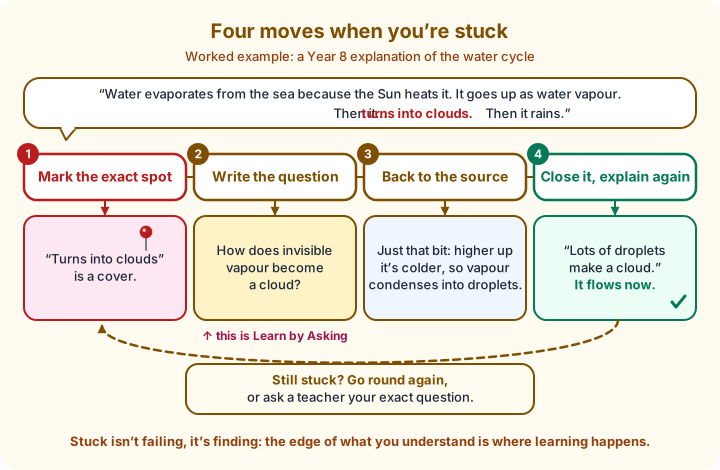
Mark it, ask it, check just that bit, then explain again: the stuck point becomes the thing you learn.
Keep a stuck list
Here's a habit worth trying. Keep a page at the back of your exercise book called "Stuck list". Every time you hit a stuck point, write the question there. When you fix it, tick it off.
Before a test, your stuck list becomes the perfect revision list. It's every hard bit, already found. This is a form of metacognition: thinking about your own thinking. The Education Endowment Foundation, which reviews UK school research, rates metacognition strategies highly. Read more in knowing what you don't know: Feynman and metacognition.
Where students usually get stuck (about getting stuck)
- Feeling embarrassed. Nobody else needs to see your stuck list.
- Fixing everything at once. One stuck point per session is fine.
- Asking for the answer too fast. Try the source first. The searching is part of the learning.
How this connects to Learn by Asking
Learn by Asking is aitutors.me's idea that asking well, not getting answers, is what makes learning stick. Getting stuck is where it starts. Move 2 in this article, write the question, is the whole idea in miniature: "turns into clouds" is a vague feeling, and "How does invisible vapour become a cloud?" is a sharp question you can actually chase. The trick is to ask for the next step rather than the answer. Try "What does this word mean?", "Is my method right, even if my answer isn't?" or "What's a simpler version I could try first?" For six questions like these, see questions to ask when you're stuck.
Where aitutors.me fits
On aitutors.me, Jotters has a stuck pin. You drop it on the exact line of your worksheet where you lost the thread, and work through the Feynman steps: Pick · Explain · Stuck? · Simpler. The professors ask questions to help you find your way, but they never just give you the answer. That's on purpose. Getting there yourself is what makes it stick.
FAQ
Is getting stuck a sign I'm bad at a subject?
No. Everyone gets stuck, including top students and scientists. Being stuck means you've reached the edge of what you understand. That edge is exactly where learning happens. Noticing your stuck points and going back to them is one of the most useful things you can do.
What should I do when I get stuck explaining something?
Mark the exact spot, write down what you can't explain in one short sentence, then go back to your notes or textbook for just that bit. Read it, close it, and try explaining again. Don't reread the whole chapter.
Does trying before I've been taught really help?
Research suggests it can. In studies of pretesting, people who tried to answer questions before reading a text, and often got them wrong, remembered more afterwards than people who simply studied for longer. Having a question in your head makes the answer stick.
Duke Harewood runs aitutors.me: Socratic AI tutors for KS3, plus a free GCSE map and flashcards for Years 10–11. Updated 20 October 2026.