To explain anything to a ten-year-old, keep every important idea, swap each piece of jargon for plain words, say one idea per sentence, and use an everyday example, and if you can't do that yet, you've just found the part you don't fully understand. That's the whole trick. The rest of this article shows you how to do each step.
Why a ten-year-old? Because they're clever enough to follow a real explanation, but they won't let you get away with fancy words. If you say "photosynthesis converts light energy into chemical energy", a ten-year-old will say "what does that mean?" And that's the question that tests you.
Why this works on you, not just them
When you explain something simply, the person who learns most is often you.
Scientists call this self-explanation: putting ideas into your own words to make sense of them. In one study, Chi and colleagues (1994) asked 8th graders (about Year 9 age) to explain a text about the heart and blood to themselves as they read. The ones who explained more understood more. A big review in 2018 by Bisra and colleagues, combining many studies, found the same pattern: explaining helps learning. (Most of those studies were with older students, so think of it as a strong clue rather than a promise.)
Here's an everyday picture. Reading your notes is like watching someone else ride a bike. Explaining is getting on the bike yourself. You find out fast whether you can actually do it.
Simple is not the same as dumbed down
This is where most people get stuck, so let's sort it out first.
- Dumbed down means leaving out important bits, or saying something that isn't true. "Plants eat sunlight" is dumbed down. It's catchy, but wrong.
- Simple means keeping all the important bits, but saying them in plain words. "Plants use the energy in light to turn water and carbon dioxide from the air into sugar, which is their food" is simple. Every important idea is still there.
A good simple explanation is still correct. It just isn't wearing a jargon costume.
Richard Feynman, the physicist this method is named after, was famous for this. His Feynman Lectures on Physics (which you can read free online from Caltech) explained hard ideas in plain, lively language without cheating on the science.
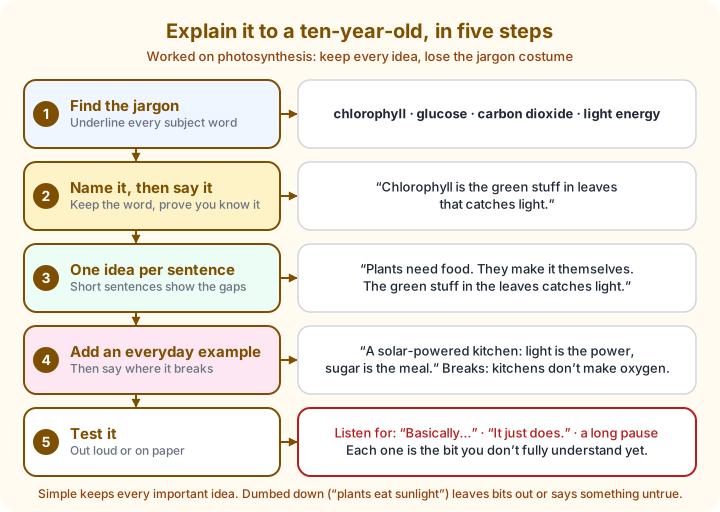
Each step strips away a hiding place, so whatever you can't yet say simply is the part to go back and learn.
Step 1: Find the jargon and name it
Jargon means the special words a subject uses. They're useful, because they're short. But they can hide whether you understand.
Go through your explanation and underline every subject word. For photosynthesis that might be: chlorophyll, glucose, carbon dioxide, light energy.
Now for each one, ask: "Could I explain this word to a ten-year-old?" If not, that's your first gap.
Step 2: Swap it for plain words
Don't delete the jargon. Name it, then say it simply.
- "Chlorophyll is the green stuff in leaves that catches light."
- "Glucose is a kind of sugar. It's the plant's food."
- "Carbon dioxide is a gas in the air. We breathe it out."
Notice the pattern: name it, then say it. That way you keep the proper word (which you'll need in exams) and you prove you know what it means.
Step 3: One idea per sentence
Long sentences hide gaps. Short sentences show them.
Compare:
"Photosynthesis is the process by which green plants use chlorophyll to absorb light energy and convert carbon dioxide and water into glucose and oxygen."
with:
"Plants need food. They make it themselves. They take in water through their roots. They take in carbon dioxide from the air. The green stuff in the leaves catches light. The plant uses that light's energy to turn the water and carbon dioxide into sugar. Oxygen is left over, and goes out into the air."
The second one is longer. But each sentence does one job. If you can't write one of those sentences, you've found exactly where your understanding runs out.
Step 4: Add an everyday example
Ideas stick better when they connect to something you already know. For photosynthesis:
"It's a bit like a solar-powered kitchen. Light is the power. Water and air are the ingredients. Sugar is the meal."
That's an analogy: a comparison between something new and something familiar. Research by Richland, Zur and Holyoak (2007) found that good teachers don't just use comparisons. They make them easy to follow, for example by drawing them or making sure the familiar thing really is familiar.
But every comparison breaks somewhere. Kitchens don't make oxygen. Say so: "It's not perfect, because..." That honesty shows real understanding. We go deeper in how to build analogies that make ideas click.
Step 5: Test it
Now actually explain it, out loud or on paper. To a younger sibling, a friend, a pet or just your empty room.
Listen for these warning signs:
- "Basically..." followed by more jargon.
- "It just does." That's a gap.
- A long pause. Something's missing between the last step and the next.
When you hit one, don't panic. That's the point. Go back to your notes or textbook, find that one bit, and try again. We explain why getting stuck is good news in where you get stuck is where you learn.
Where people usually get stuck
- Trying to explain everything at once. Pick one small idea. "How do plants make food?" not "Explain biology".
- Skipping the plain-words step. It feels babyish. It isn't. It's the hard bit.
- Being too proud to say "I'm not sure". The best learners say it all the time.
These steps fit into the bigger four-step Feynman method: pick, explain, stuck?, simpler. See the four Feynman steps, explained simply.
How this connects to Learn by Asking
Learn by Asking is aitutors.me's idea that asking good questions is what drives learning. It sorts questions into five rungs called the Ask Ladder, and the bottom rung, Locating, is "What does this word actually mean?" That's exactly what a ten-year-old asks when you say "photosynthesis", and it's the question Step 1 trains you to ask yourself first. Underline "chlorophyll", ask what it means, and you've climbed the first rung. Once every word is located, you're ready for the higher rungs, like "Why does this step work?" See the Ask Ladder: five levels of questions.
Where aitutors.me fits
On aitutors.me, Jotters can pin a Say it simply jot beside a hard line in your own worksheet, and underlines the jargon so you can try saying it in plain words. You can also explain a topic to Heddy Pip, a curious listener who only asks questions, kind of like a very patient ten-year-old. (A pip is a tiny seed. Every big idea grows from a small why?) No scores, just a chance to see what you really know.
FAQ
Why explain something to a ten-year-old?
Because a ten-year-old won't let you hide behind big words. To explain something simply, you have to know what actually happens, step by step. If you can't do that yet, you've found exactly what you need to learn next.
Isn't a simple explanation just a dumbed-down one?
No. Dumbed down means leaving out the important bits or saying something untrue. Simple means keeping the important bits and saying them in plain words. A good simple explanation is still correct. It just isn't wrapped in jargon.
Can I still use technical words in an exam?
Yes, and you should. Exams reward the correct terms. The point of explaining simply is to make sure you know what those terms mean. Once you do, using them in an exam answer becomes easy and accurate.
Duke Harewood runs aitutors.me: Socratic AI tutors for KS3, plus a free GCSE map and flashcards for Years 10–11. Updated 20 October 2026.