A good analogy makes an idea click by linking something new to something you already know well, matching how the two things work rather than how they look, and it's only finished when you've said where the comparison breaks. Done well, an analogy turns a page of jargon into a picture you can carry round in your head.
Analogies are a big part of the Feynman way. Richard Feynman was known for explaining hard physics with vivid, everyday comparisons in his lectures. This article shows you how to build your own, how to test them, and how to avoid the ones that cause more trouble than they solve.
What an analogy is
The jargon first. An analogy is a comparison that explains something new (the target) using something familiar (the source).
"The heart is a pump" is an analogy. The target is the heart. The source is a pump. It works because a pump and a heart do the same job: they push liquid round a system of pipes.
You use analogies all the time without noticing. "My brain is full." "She's a walking dictionary." In learning, they do serious work. They give a new idea something to hang on.
Why they help
Here's an everyday picture. Imagine moving to a new town. At first every street is strange. Then someone says "the high street is laid out just like the one at home, with the station at the bottom". Suddenly you can find your way. You didn't learn the whole town. You borrowed a map you already had.
Analogies do that for ideas. Your brain doesn't have to build from scratch. It borrows a structure it already knows.
But there's a catch, and research shows it. In 2007, Richland, Zur and Holyoak studied videos of maths lessons in the US, Hong Kong and Japan. Teachers in all three countries used analogies. But teachers in Hong Kong and Japan more often gave students cognitive supports to follow them. Put simply, they made analogies easier to use: they picked a source students already knew well, kept it visible on the board, drew the two side by side, and used gestures to point from one to the other. The researchers suggested that without those supports, students might miss the point of the comparison or take away the wrong idea.
The lesson for you: an analogy isn't just a nice sentence. It needs building.
Good analogies vs bad ones
A good analogy:
- Matches how it works, not how it looks. "An atom is like a tiny solar system" looks right (stuff going round a middle) but gets the important bits wrong. Electrons don't follow neat orbits like planets.
- Uses something you really know. Comparing a cell to a factory only helps if you have a picture of what a factory does.
- Helps you predict. A good analogy lets you ask "so what would happen if..." and get a sensible answer.
A bad analogy:
- Matches only on the surface.
- Uses a source that's just as confusing as the target.
- Leads you to a wrong prediction without warning.
How to build one: four steps
1. Say what the target does
Write one plain sentence about the job your idea does. "Electric current is a flow of charge round a circuit. The battery pushes it."
2. Find something familiar that does the same job
Ask: "What in everyday life flows round a loop and gets pushed?" Water in a central heating system. The boiler pump pushes water round the pipes and radiators and back again.
3. Map the parts
Match the bits, side by side:
| Circuit | Heating system |
|---|---|
| Battery | Pump |
| Wires | Pipes |
| Current | Flow of water |
| Bulb | Radiator (where energy is given out) |
If you can draw this as a picture, even better. That's one of the supports good teachers use.
4. Say where it breaks
This is the step most people skip, and it's the most important.
"The water analogy works because the flow is the same all the way round, and isn't used up. But it breaks because a broken pipe leaks water everywhere, while a broken wire just stops the current. And water in pipes is pushed by pressure, which isn't quite the same as voltage."
When you can say where your analogy breaks, you've proved you understand both sides. That's the Feynman way: not just a pretty explanation, but an honest one.
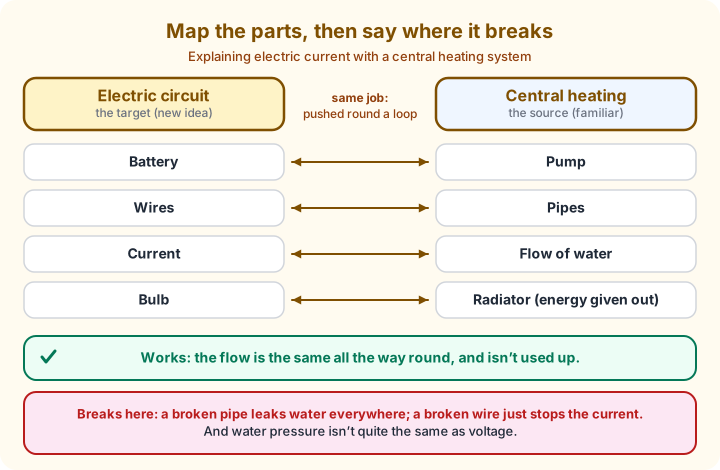
Mapping the parts makes the analogy useful; saying where it breaks proves you understand both sides.
Analogies can cause misconceptions too
A misconception is a wrong idea that feels right. Some come straight from bad analogies. If you think of current as something the bulb "eats", you'll believe current gets used up, which it doesn't.
Research on fixing misconceptions (for example a 1993 meta-analysis by Guzzetti and colleagues) suggests it helps to name the wrong idea and say clearly why it's wrong. So when you use an analogy, add your "it breaks here" line. You're doing your own correcting in advance.
Some analogies to try (and break)
- Diffusion is like a crowd leaving a concert. People spread from a packed space to emptier ones. Breaks: people choose where to go. Particles just move randomly.
- Enzymes are like a lock and key. Each one fits a particular molecule. Breaks: real enzymes can change shape slightly as they work.
- Fractions are like slices of pizza. Breaks: harder to picture 7/3 of a pizza, or dividing by a fraction.
- A cause in history is like a domino. Breaks: real events have many causes at once, not one neat line.
For chemistry examples, see the Feynman technique for KS3 chemistry.
Where students usually get stuck
- Grabbing the first comparison. Try two or three, then pick the one that predicts best.
- Mixing up the analogy with the real thing. In an exam, explain the science. Use the analogy as a helper, not the answer.
- Thinking analogies are "babyish". They aren't. Simple isn't the same as dumbed down. See six myths about the Feynman technique and how to explain anything to a ten-year-old.
How this connects to Learn by Asking
Learn by Asking is aitutors.me's idea that asking good questions is what drives learning. Its Ask Ladder has five rungs of question, and analogies live near the top. "So what would happen if a pipe broke?" is a Generative question: you change one thing and predict. "Where else does this flow-round-a-loop idea work?" is a Reflective/Transfer question: you carry the idea somewhere new. Building an analogy makes you ask both. And step 4, saying where it breaks, answers a question most people never think to ask. See the Ask Ladder: five levels of questions.
Where aitutors.me fits
On aitutors.me, Jotters can pin an Example or Picture it jot beside a hard line in your worksheet. Where the idea is a process, the picture moves. You can add your own jots too, so it's a good place to write your analogy and its "breaks here" line right next to the words it explains.
FAQ
What is an analogy?
An analogy is a comparison that explains something new by linking it to something you already know. "The heart is a pump" is an analogy. It works because the way a pump pushes water round is similar to the way the heart pushes blood round.
What makes an analogy good or bad?
A good analogy matches how things work, not just how they look, uses something you know well, and helps you predict what happens next. A bad one matches on the surface only, or uses something you don't really know, so it adds confusion instead of removing it.
Why should I say where an analogy breaks?
Because every analogy breaks somewhere, and if you don't say where, you might carry the wrong bit into your exam answer. Saying "this works because... but it's different because..." shows you really understand both things.
Duke Harewood runs aitutors.me: Socratic AI tutors for KS3, plus a free GCSE map and flashcards for Years 10–11. Updated 20 October 2026.