The Feynman technique is a simple, useful way to learn by explaining, but six common myths get in the way: that it's just talking, that it's only for clever children, that it needs a listener, that simple means dumbed down, that Feynman invented the four steps, and that it can replace practice. None of them is true. Here's what is.
If you're new to the method, start with what is the Feynman technique?. If you've tried it and it didn't seem to work, one of these myths may be the reason.
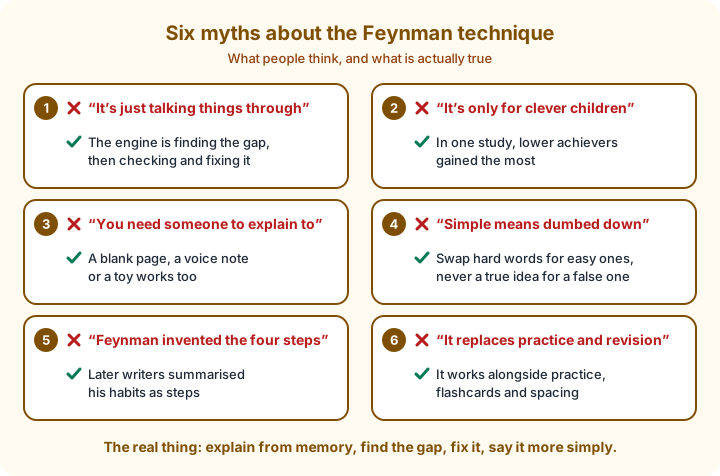
Each of the six myths has a simple truth behind it.
Myth 1: "It's just talking things through"
The truth: talking is only one of four steps, and on its own it isn't the most useful one.
Picture a satnav. Talking through a topic is like the satnav saying where you are. Useful, but the real value comes when it says "you've gone wrong here" and gives you a new route.
The Feynman technique works the same way. The important part is step three: noticing exactly where your explanation went vague or wrong, then going back to your notes or textbook to fix that bit. Then you explain again, more simply.
A child who chats happily about photosynthesis for five minutes, never notices a mistake and never checks anything, has had a nice chat. They haven't done the Feynman technique. In fact, explaining something wrongly with confidence can make the wrong version feel more certain.
Watch out for: sessions where nothing ever gets looked up. If there's no "Hang on, let me check", the method is missing its engine.
Myth 2: "It's only for clever children"
The truth: the evidence points the other way, if anything.
It's easy to imagine the Feynman technique as something for confident, chatty high achievers. But think about what it actually asks: find the bit you don't understand. Every child has those bits. Children who find school hard simply have more of them to find, which means more to gain.
In a 2009 study by Chase and colleagues, 8th-grade students (around Year 9) learned science by teaching a computer character. The lower-achieving students gained the most. That's one study, so it isn't proof. But it suggests that explaining is not a reward for being good at school. It's a tool for getting better at it.
Watch out for: a child who says "I'm not clever enough for this". Shrink the topic. Explaining one tiny idea well is a real win.
Myth 3: "You need someone to explain it to"
The truth: a listener helps, but it isn't required.
A real person asking "why?" is great. But plenty of good Feynman sessions happen with:
- a blank page and a pen,
- a voice note on a phone,
- a pet, a toy, or an empty chair.
What matters is that the explanation comes from memory and that you're honest about where it wobbles. Some research even suggests that simply expecting to teach changes how you study. In a 2014 study by Nestojko and colleagues, people who expected to teach remembered more, even though they never actually taught.
This matters a lot for shy children, who may find explaining to a parent nerve-racking. We cover that in Feynman for shy or anxious children.
Myth 4: "Simple means dumbed down"
The truth: simple means clear, not wrong.
This is the myth that worries teachers most, and fairly so. "Explain it to a ten-year-old" can sound like "leave out the hard parts". It shouldn't.
Compare these two explanations of why metals conduct electricity:
- Dumbed down: "Metals are just good at electricity."
- Simple: "In a metal, some tiny charged particles called electrons can move about freely. When you connect a battery, they all drift along together, and that flow is the current."
The second one is still short. It still uses plain words. But it's true, and it has a reason in it. That's the target.
A useful rule: you may swap a hard word for an easy one, but you may not swap a true idea for a false one. More on this in how to explain anything to a ten-year-old.
Myth 5: "Feynman invented the four steps"
The truth: he didn't write them down. Other people did, later.
Richard Feynman (1918–1988) was a Nobel-winning physicist and a famously clear teacher. He was suspicious of people who could recite the names of things without understanding them. He liked explaining ideas from the ground up.
But there's no book or lecture where Feynman lists "Step 1, Step 2, Step 3, Step 4". The tidy method came later, from writers who studied how he learned and summarised it. It's a fair summary of his habits, and it's still worth using. It just isn't his recipe. You can read his real story in who was Richard Feynman?
Why does this matter? Partly honesty. And partly because it's a nice lesson in itself: Feynman would have wanted you to check the source, not just repeat a label.
Myth 6: "It replaces practice and revision"
The truth: it works alongside them, not instead of them.
Explaining builds understanding: the why. But children also need:
- practice questions, especially in maths and science, to get fluent at using ideas;
- retrieval practice, like flashcards and quizzes, to keep facts easy to recall;
- spacing: coming back to topics after a few days or weeks.
A major 2013 review by Dunlosky and colleagues rated practice testing and spaced practice as "high utility" study techniques. Self-explanation was rated "moderate": good, but not a whole revision plan on its own.
Think of it like football. Explaining the offside rule helps you understand the game. You still need to practise passing.
So what is true?
Here's the short version. The Feynman technique is a small, honest habit: explain from memory, find the gap, fix it, say it more simply. It suits every kind of learner. It doesn't need an audience. And it fits inside a normal week of homework and revision.
On aitutors.me, the Feynman steps (Pick · Explain · Stuck? · Simpler) sit inside Jotters, alongside flashcards and spaced Watch-out reminders, because no single method does the whole job.
How this connects to Learn by Asking
Learn by Asking, aitutors.me's theory of learning, says the real work of learning is asking a good question, not hearing yourself talk. That's the answer to Myth 1. A five-minute chat about photosynthesis with no "hang on" in it has produced no questions, so nothing gets checked. The engine of a Feynman session is the moment a vague bit becomes a question you can look up: "Wait, where does the plant's food actually come from?" Talking is how you find that question; the question is what sends you to check. A messy session that ends in "Hang on, let me check" has done the real work. More in what is Learn by Asking?
FAQ
Is the Feynman technique just talking things through?
No. Talking is only one step. The method's real work is noticing where your explanation breaks down, going back to the source to fix that exact gap, and explaining again more simply. Talking without checking can leave mistakes in place.
Did Richard Feynman create the four-step Feynman technique?
No. Feynman never wrote down a four-step method. Later writers summarised his habits, such as plain explanations, asking why, and distrusting mere names, into the steps people use today. It's a fair summary, but it's a summary.
Can the Feynman technique replace practice questions?
No. Explaining builds understanding, but children still need practice questions, especially in maths and science, and spaced recall over time. The Feynman technique works best alongside practice, not instead of it.
Duke Harewood runs aitutors.me: Socratic AI tutors for KS3, plus a free GCSE map and flashcards for Years 10–11. Updated 20 October 2026.