Richard Feynman (1918–1988) was an American physicist who shared the 1965 Nobel Prize in Physics, taught at Caltech, and became famous for explaining very hard ideas in plain, everyday words. The "Feynman technique" that students use today is named after him. But the best reason to know about him isn't the technique. It's the way he thought, which is something any curious 12-year-old can borrow.
A quick life story
Feynman grew up in Far Rockaway, a seaside part of New York City. As a boy he fixed radios for neighbours and liked taking things apart to see how they worked. He studied at MIT and then Princeton.
During the Second World War he worked at Los Alamos on the project that built the first atomic bombs. Afterwards he taught at Cornell and then, for most of his career, at the California Institute of Technology (Caltech).
His big scientific work was on quantum electrodynamics. That's a mouthful, so here it is simply: it's the science of how light and electrically charged particles, like electrons, push and pull on each other. He invented a way of drawing these interactions as simple little pictures, now called Feynman diagrams. Physicists still use them. In 1965 he shared the Nobel Prize for this work with Sin-Itiro Tomonaga and Julian Schwinger, who had reached similar results by different routes.
He was also, by all accounts, fun. He played bongo drums, learned to pick the locks on filing cabinets for a joke, and wrote about all of it in his bestselling book "Surely You're Joking, Mr. Feynman!".
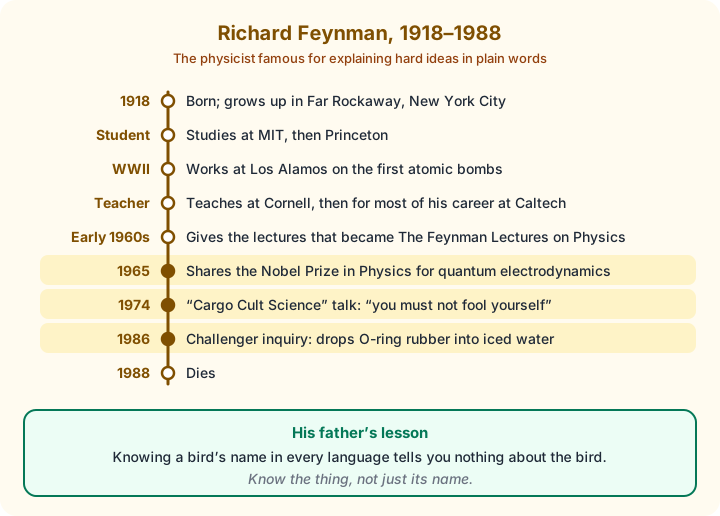
Feynman’s life in nine moments, and the lesson from his father that runs through all of it.
The bird story: names are not knowledge
The story most people remember comes from his book What Do You Care What Other People Think? When Feynman was a child, another boy asked him the name of a bird. Feynman didn't know. The other boy told him, and teased him about it.
But Feynman's father, Melville, had already taught him something different. His father would name a bird in several languages, then point out that knowing all those names told you nothing about the bird itself. Feynman recalled the lesson as: "You can know the name of that bird in all the languages of the world, but when you're finished, you'll know absolutely nothing whatever about the bird." The useful thing was to watch the bird and see what it was doing.
This is the seed of the whole Feynman way. A child can write "photosynthesis", "metaphor" or "tectonic plate" on a worksheet without understanding any of them. Knowing the word is not the same as knowing the thing. It's the same gap a reader falls into when they recognise every term in their notes but can't explain how any of it works.
The teacher who made physics plain
In the early 1960s, Feynman taught the introductory physics course for first- and second-year students at Caltech. The lectures were recorded and turned into The Feynman Lectures on Physics, which are now free to read online. They are famous for starting with ordinary things, such as a drop of water or a spinning top, and building upwards.
Feynman believed that if he couldn't explain an idea at a beginner's level, it meant the idea wasn't properly understood yet, even by experts. That's a striking thing for a Nobel winner to say. It means that struggling to explain something isn't a sign you're slow. It's a sign you've found something worth thinking harder about.
Challenger: a glass of iced water
In January 1986 the space shuttle Challenger broke apart shortly after launch, and all seven crew members died. Feynman was asked to join the commission investigating why.
The cause had to do with rubber rings, called O-rings, that sealed joints in the rocket boosters. The morning of the launch had been very cold. During a televised hearing, Feynman took a piece of the O-ring material, squeezed it in a clamp, and dropped it into a glass of iced water. When he took it out, it didn't spring back. Cold rubber had lost its bounce, so it couldn't seal the gap properly.
Engineers had already raised concerns about the seals in the cold. But Feynman's demonstration made the problem plain to everyone watching, in under a minute, with no jargon. In his own appendix to the official report he wrote that "nature cannot be fooled". That's the Feynman way in action: show the idea simply, and let it speak.
"You must not fool yourself"
In 1974 Feynman gave a talk to graduating Caltech students called "Cargo Cult Science". In it he said: "The first principle is that you must not fool yourself—and you are the easiest person to fool."
That line matters for learning. It's very easy to fool yourself that you understand a topic because the notes look familiar. Explaining it, out loud, to someone else, is one of the quickest ways to stop fooling yourself. We say more about this in why rereading feels like learning but isn't.
What a KS3 child can take from him
Feynman was unusually gifted. Your child doesn't need to be. What made his way of thinking powerful was a set of habits, and habits can be practised:
- Know the thing, not just its name. After learning a new word, ask: what does it actually do?
- Keep asking why. One more "why?" often turns a memorised fact into a real idea.
- Use everyday examples. A glass of iced water explained a space disaster. A kitchen or a football pitch can explain most of KS3.
- Be honest about the gaps. "I don't get this bit yet" is not a failure. It's the start of learning.
These are exactly the habits that the popular Feynman technique tries to bottle. One honest note: Feynman didn't write down that four-step method himself. Later writers summarised his habits that way, which we cover in six myths about the Feynman technique. If you'd like to practise his plain-words habit, try how to explain anything to a ten-year-old.
On aitutors.me, the same spirit shows up in a small way: the subject professors ask questions instead of handing over answers, and a curious listener called Heddy Pip asks your child "why?" about what they've just learned. But you don't need us to borrow Feynman's habits. You need a curious question and the patience to follow it.
How this connects to Learn by Asking
Learn by Asking is aitutors.me's name for the idea that, now answers are everywhere, asking well is the skill that counts. Feynman never used the phrase, but the bird story shows the habit. "What's that bird called?" is a Locating question: it gets you a name, and the other boy stopped there. Feynman's father pointed him towards a better kind of question, a Clarifying one: what is the bird doing, and why? Knowing the thing, not just its name, starts with questions like that. A child who keeps asking "why?" after learning a new word is doing the same. More in why asking matters more than answers in the AI era.
FAQ
Who was Richard Feynman?
Richard Feynman (1918–1988) was an American physicist who shared the 1965 Nobel Prize in Physics for work on quantum electrodynamics. He taught at Caltech, gave the lectures that became The Feynman Lectures on Physics, and was famous for explaining difficult ideas in plain words.
What is Richard Feynman famous for?
Among scientists, for his work on how light and matter interact and for Feynman diagrams. Among everyone else, for his lively books, his teaching, and a moment in 1986 when he dropped a piece of rubber seal into iced water to show why the Challenger space shuttle failed.
What can children learn from Richard Feynman?
Three habits: know the thing, not just its name; keep asking why until it makes sense; and be honest with yourself about what you don't yet understand. None of these needs special talent. They are habits anyone can practise.
Duke Harewood runs aitutors.me: Socratic AI tutors for KS3, plus a free GCSE map and flashcards for Years 10–11. Updated 20 October 2026.