The Feynman technique works in KS3 chemistry when you picture the particles first, then explain in plain words what those particles are doing. Chemistry happens at a scale far too small to see. That makes it easy to use the right words (dissolve, melt, react) without any picture behind them. Explaining out loud, with a quick particle sketch, shows you straight away whether the picture is there.
This guide is for you if you are in Year 7, 8 or 9. Our worked example is a classic: what happens when you stir sugar into tea?
Particles first, words second
Almost every KS3 chemistry topic sits on top of one idea, the particle model:
- Everything is made of tiny particles.
- In a solid, particles are packed close together in fixed positions. They vibrate but don't move around.
- In a liquid, particles are still close together but can slide past each other.
- In a gas, particles are far apart and move quickly in all directions.
If you can't say what the particles are doing, you don't yet have a chemistry explanation. You have a description of what you saw.
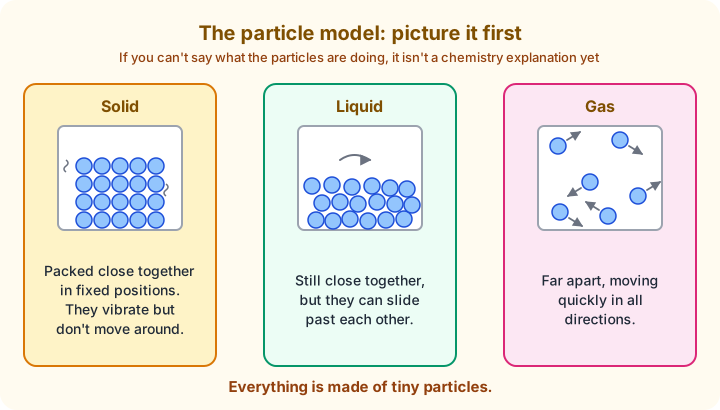
Before you use a chemistry word, say what the particles are doing.
The physicist Richard Feynman was a great believer in this. In The Feynman Lectures on Physics, he said that if one sentence of science had to be passed on to the next generation, it should be that everything is made of atoms, little particles that move around constantly. (He said it at more length, but that's the gist.) The popular "four-step Feynman technique" was put together later by other writers from his habits, not by him. But his habit of building everything up from a simple picture fits chemistry perfectly.
A worked example: does sugar melt in tea?
Meet Aisha. Her homework asks: Explain what happens when sugar is stirred into hot tea.
Step 1 – Pick
Aisha writes: Sugar in tea.
Step 2 – Explain
She explains to her dad: "The sugar melts in the hot tea. It goes into liquid and disappears, so you can't see it any more. It's quicker in hot tea because heat melts things."
Step 3 – Stuck?
Her dad asks: "If it melted, would it melt in cold water too? And where did it go?"
Aisha is not sure. "It melts slower in cold water? And it… goes away?"
She has two stuck points:
- She is using "melt" for something that isn't melting.
- She thinks the sugar disappears.
Both are very common. They are worth catching now, because the GCSE course builds on this idea.
Step 4 – Simpler
Aisha goes back to her textbook and draws particles.
Melting first. Melting is when one substance changes from a solid to a liquid because it is heated. The particles gain energy, vibrate more, and break free of their fixed positions. Picture ice in a warm room. Ice melts into water. One substance, two states.
Could tea be hot enough to melt sugar? No. Sugar has to be heated far hotter than boiling water before it melts, which is why melting sugar for caramel is done in a pan on the hob, not in a mug.
Now dissolving. Dissolving involves two substances:
- The solute is the thing that dissolves (sugar).
- The solvent is the liquid it dissolves in (the water in the tea).
- Together they make a solution.
Sugar particles break away from the sugar crystal and spread out between the water particles. Each bit is far too small to see. That's why the tea looks clear but tastes sweet.
Here is a plain-words picture. Melting is like a class standing in neat rows who are told they can move about. Same people, more freedom. Dissolving is like a group of visitors arriving at a busy station and spreading out among the crowd. You can't spot them any more, but they are all still there.
Where did the sugar go? Nowhere. If you put 10 g of sugar into 200 g of water, the solution weighs 210 g. Mass is conserved. And if you leave sugary water in a saucer for a few days, the water evaporates and sugar crystals are left behind.
Why is it faster in hot tea? Because in hot water the particles move faster. Water particles hit the sugar crystal more often and with more energy, so sugar particles break away more quickly. Heat speeds up dissolving. It doesn't turn it into melting.
Now Aisha can explain it in three sentences:
"The sugar dissolves, it doesn't melt. Sugar particles break off the crystal and spread out between the water particles, too small to see, so the mass stays the same. Hot tea makes it happen faster because the particles move faster."
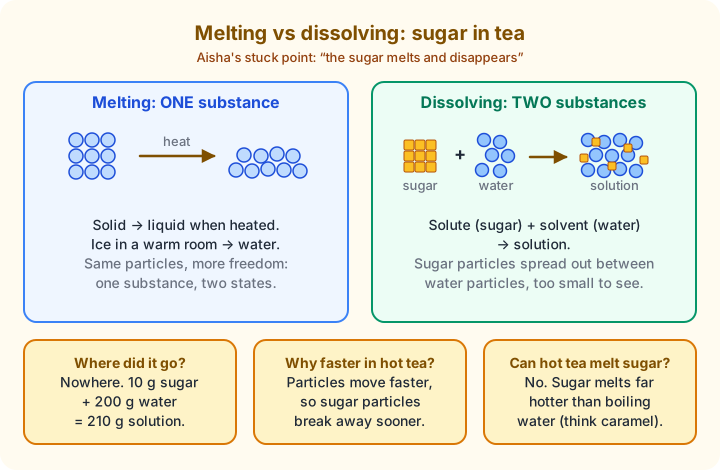
Sugar in tea dissolves; it doesn't melt, and none of it disappears.
Watch out: "it disappeared" is a red flag in chemistry. Atoms don't vanish. When something seems to disappear, ask: "Where did the particles go?" More on mistakes like this in how explaining reveals hidden misconceptions.
A quick particle checklist for any chemistry topic
When you explain anything in KS3 chemistry, run through these four questions:
- What are the particles? Atoms, molecules, ions?
- Where are they, and how are they arranged?
- What changes? Do they move apart, join up, swap partners?
- Is anything new made? If yes, it's a chemical change. If no (like dissolving or melting), it's a physical change.
Question 4 is a big one. Dissolving and melting are both physical changes: no new substance is made. Burning is a chemical change: new substances form.
If you can answer all four without jargon, try saying it to a younger child. See how to explain anything to a ten-year-old.
What the research says
Explaining to yourself as you study, called self-explanation, has a medium-sized benefit on learning across many studies. A 2018 review (Bisra and colleagues) put the average effect at about g = 0.55. Chemistry is a good subject for it because it has so many invisible processes.
Science research also shows that misconceptions like "sugar melts" are sticky. Telling students the right answer often isn't enough. A 2010 review by Tippett found that refutation texts, which name the wrong idea and explain directly why it's wrong, help in science. That's what Aisha did for herself: she said the wrong idea out loud, then explained why it was wrong.
How this connects to Learn by Asking
The Feynman way is Learn by Asking when you're the one explaining. In chemistry, the Learn by Asking question to ask first is "what are the particles actually doing?", before any word or equation. Aisha had the words ready ("it melts", "it disappears") but no picture behind them. Her dad's "where did it go?" became that particle question, and drawing the answer showed sugar particles spreading out between water particles, with the mass staying the same. Once you know the word "dissolves", the trap is to stop there. Keep asking what the particles are doing. See questions before the equation.
Curie, the chemistry professor
On aitutors.me, Professor Curie is the chemistry tutor. Curie builds the particle picture with you before any equation and never just states the formula. In Jotters, a "Picture it" jot can show particles moving as something dissolves, beside the exact sentence in your notes, and a "Watch out" jot can flag the melt/dissolve mix-up. Physics uses the same particle model for changes of state, so you might also like the Feynman technique for KS3 physics.
FAQ
What is the difference between dissolving and melting?
Melting involves one substance changing from solid to liquid when it is heated. Dissolving involves two substances: the particles of a solute (like sugar) separate and spread out between the particles of a solvent (like water), making a solution. Sugar in tea dissolves; it does not melt.
Does sugar disappear when it dissolves?
No. The sugar particles are still there, just spread out too small to see. You can taste it, and the mass is conserved: 10 g of sugar in 200 g of water makes 210 g of solution. If you let the water evaporate, the sugar is left behind.
How do I use the Feynman technique in chemistry?
Before you explain any chemistry idea, draw or picture the particles. Then explain what the particles are doing in plain words. If you can't say what happens to the particles, you have found your stuck point, and that's the bit to go back and learn.
Duke Harewood runs aitutors.me: Socratic AI tutors for KS3, plus a free GCSE map and flashcards for Years 10–11. Updated 20 October 2026.