The Feynman technique works in KS3 physics when you predict what will happen before you see it, then explain in plain words why your prediction was right or wrong. Physics is full of ideas that clash with everyday experience. Your gut says one thing; the world does another. Predicting first drags your gut feeling into the open, where you can test it.
This guide is for you if you are in Year 7, 8 or 9. Our worked example is about forces: why does a ball you kick slow down and stop?
Predict, observe, explain
Science teachers have a three-step routine called predict-observe-explain (POE):
- Predict. Before the experiment, say what you think will happen, and why.
- Observe. Watch what really happens.
- Explain. If your prediction was wrong, explain the gap.
POE and the Feynman steps fit together neatly. The popular "Feynman technique" (pick, explain, find where you get stuck, simplify) is a later summary of the physicist Richard Feynman's habits, written by other people rather than by him. But Feynman loved this kind of test. In 1986, investigating the Challenger space shuttle disaster, he dipped a piece of the shuttle's rubber O-ring material into a glass of iced water during a televised hearing. He showed it lost its springiness in the cold. One simple experiment explained what pages of reports had not.
For the full four steps, see the four Feynman steps, explained simply.
Why predicting first helps
Making a guess before you know the answer seems odd. What if you are wrong? That's the point. Research on pretesting (Richland, Kornell and Kao, 2009) found that students who tried to answer questions before studying a text remembered the material better afterwards, even when their first attempts were wrong. Those students were at university, so the size of the effect may differ for you. But the idea is simple: a wrong guess gets your brain ready to notice the right answer.
A worked example: why does a ball slow down?
Meet Tom. His class is studying forces and motion.
Step 1 – Pick (and predict)
Tom's teacher asks: You kick a football along flat grass. Why does it slow down and stop? Before the demo, Tom writes his prediction and reason.
Step 2 – Explain
Tom says: "When you kick the ball, you give it force. The force is inside the ball and it keeps it moving. Slowly the force runs out, and when it's all used up, the ball stops."
This feels completely right. Most people think this way. It was even roughly what many thinkers believed for centuries before Galileo and Newton.
Step 3 – Stuck?
The teacher props a board on a pile of books to make a ramp. She lets the same toy car go from the same height on the ramp three times. Each time it rolls off onto a different surface: carpet, a wooden floor, and a smooth plastic sheet. The class measures how far it travels on each with a tape measure. The car goes furthest on the smooth plastic and the shortest distance on the carpet.
She asks Tom: "If the force was inside the car and ran out, why did the same car go further on the smoother surface?"
Tom is stuck. "Maybe the plastic… gave it more force?"
This is the stuck point. Tom's idea of "a force inside the ball or car, running out" can't explain what he just saw. He circles that phrase on his page. You can read more about why this moment is so valuable in where you get stuck is where you learn.
Step 4 – Simpler
Tom goes back to his textbook and starts from a plain definition.
A force is a push or a pull by one thing on another. Every force needs two things: the thing pushing and the thing being pushed. So, a quick test: name the "something" doing the pushing.
- While Tom's foot touches the ball: the foot pushes the ball forward.
- Once the ball leaves his foot: what pushes it forward? Nothing. The foot isn't touching it any more.
- What pushes on the ball while it rolls? The grass rubs against it (friction), and the air pushes against it (air resistance). Both push backwards, against the motion.
So the ball doesn't slow down because a force "runs out". It slows down because backward forces act on it.
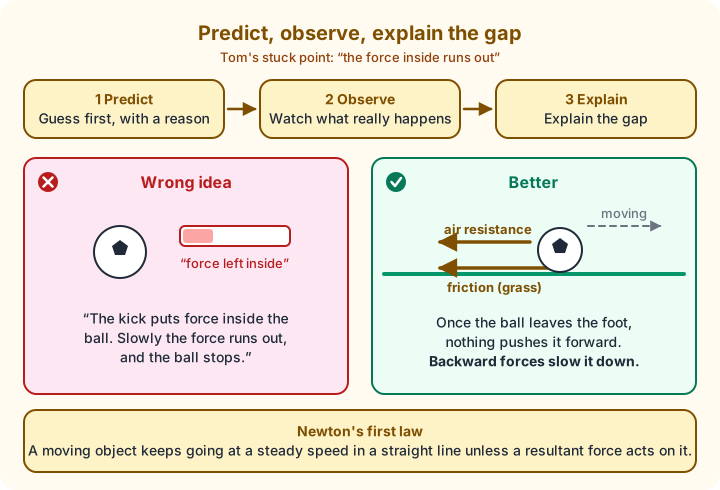
A force is a push or pull by something on something: name what is pushing.
Why does the car go further on the smooth plastic? A smooth surface gives much less friction than carpet. A smaller backward force slows it down more gently. You can repeat this at home with a toy car, a ramp made from a board and a few books, and a tape measure. Just make sure you let the car go from the same height each time.
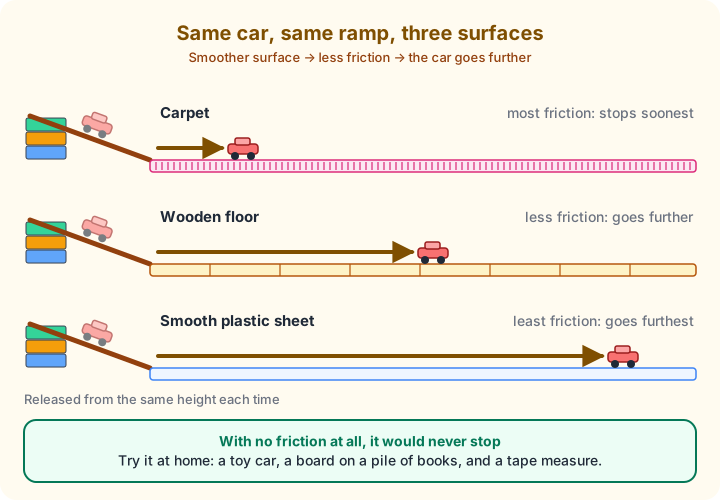
Same car, same height, three surfaces: the smoother the surface, the further it goes.
Now picture a world with no friction and no air at all. Nothing pushes backwards. The car would just keep going at the same speed in a straight line. That is Newton's first law: an object keeps moving at a steady speed in a straight line unless a resultant force acts on it.
Tom can now explain it in plain words:
"Once the ball leaves my foot, nothing is pushing it forward. Friction from the grass and air resistance push backwards, so it slows down. On a smoother surface there's less friction, so it goes further. With no friction at all, it would never stop."
Add energy. Tom's teacher asks one more thing: where does the ball's energy go? When it's moving, it has energy in its kinetic store. Friction transfers that energy to the thermal store of the ball, the grass and the air, warming them by a tiny amount. The energy isn't used up or destroyed. It spreads out into the surroundings. "Used up" is another phrase worth circling.
Watch out: the sentence "it needs a force to keep moving" is the classic physics misconception. A moving object needs a force to change its motion (speed up, slow down or turn), not to keep moving. There is more on catching mistakes like this in how explaining reveals hidden misconceptions.
Three physics phrases that hide stuck points
Listen for these in your own explanations:
- "The force runs out." Forces aren't stored inside objects. Name what is pushing.
- "Energy is used up." Energy is transferred between stores, not destroyed.
- "Heavier things fall faster." Without air resistance, all objects fall with the same acceleration. With air resistance, shape and size matter too, which is why a feather drifts.
Each one sounds like physics, which is what makes them sneaky.
How this connects to Learn by Asking
The Feynman way is Learn by Asking when you're the one explaining. In physics, Learn by Asking means pairing every question with a guess and a reason: "I think X will happen, because Y." A bare "why does it stop?" can be answered without ever touching what you believe. Tom wrote his prediction and reason before the demo, so his real idea, a force inside the ball that runs out, was out in the open, and the ramp test could aim straight at it. The reason matters more than the prediction. See the question before the prediction.
Newton, the physics professor
On aitutors.me, Professor Newton is the physics tutor. Newton runs predict-observe-explain with you: you make your guess first, before seeing the result, and then Newton asks questions about the gap rather than handing you the reason. If you're revising from a worksheet, Jotters can pin a "Watch out" jot beside "force keeps it moving" and an "Ask me" jot that hides a question behind a "Say it first" cover, so you predict before you peek. The particle model also links physics with chemistry; see the Feynman technique for KS3 chemistry.
FAQ
Why does a rolling ball slow down?
Because forces act against its motion: friction from the ground and air resistance. Once your foot leaves the ball, nothing is pushing it forward. The backward forces make it slow down. On a smoother surface the friction is smaller, so a toy car rolling off the same ramp goes further on a smooth plastic sheet than on carpet.
What is predict-observe-explain?
It's a way of learning science in three steps. You predict what will happen before you see it, observe what really happens, then explain any gap between the two. The gap is where your understanding needs work, which makes it a natural partner for the Feynman technique.
Does a moving object need a force to keep it moving?
No. This is one of the most common physics misconceptions. A moving object keeps moving at the same speed in a straight line unless a resultant force acts on it. In everyday life, friction and air resistance are almost always acting, which is why things seem to need a push to keep going.
Duke Harewood runs aitutors.me: Socratic AI tutors for KS3, plus a free GCSE map and flashcards for Years 10–11. Updated 20 October 2026.