A misconception is a wrong idea that feels right, and the quickest way to find one is to ask your child to explain why something happens, because the explanation exposes the picture in their head that a right answer can hide. A child can tick the correct box on a quiz and still believe something quite different underneath. Explaining is how that hidden belief comes out.
This matters because misconceptions are stubborn. They don't fade just because a teacher said the right thing once. This article shows what they look like at KS3, why explaining finds them, and what the research says about changing them.
What a misconception is, in plain words
The jargon first. A misconception is an idea that is wrong but makes sense to the person who holds it. It isn't a gap, where something is simply missing. It is a full, working explanation that happens to be wrong.
Here is an everyday picture. Imagine you've been taking a "short cut" to school for months. It feels quicker. You've never timed it. One day a friend shows you it's actually two minutes longer. Your old route wasn't random. It had a reason. It was just the wrong reason. Misconceptions are like that short cut. They come from real experience, which is exactly why they stick.
Common KS3 misconceptions
Almost every child holds some of these at some point. They are not signs of a weak student. Many adults still hold them.
- "Heavier things fall faster." In everyday life a feather falls slowly, so it seems obvious. The real reason is air resistance, not weight.
- "Plants get their food from the soil." Plants take water and minerals from soil, but they build most of their mass from carbon dioxide in the air, using light.
- "Dissolving is the same as melting." Sugar "disappearing" in tea looks like melting. But melting needs heat and one substance. Dissolving is one substance spreading out between the particles of another.
- "Electric current gets used up in a circuit." Bulbs use energy, not current. The current is the same all the way round a simple series circuit.
- "Multiplying always makes a number bigger." True for whole numbers. Not true for 6 × 0.5.
- "Summer is when the Earth is closest to the Sun." The seasons come from the tilt of the Earth's axis, not from distance.
Notice that each one has a sensible everyday reason behind it. That is what makes them so tricky.
Why right answers can hide wrong ideas
Tests often check the what. "Which falls first?" A child who has learnt "they land together" can write that down while still privately believing weight matters. The test sees a tick. The misconception stays.
Explaining checks the why. Ask "why do they land together?" and you'll hear the real picture. "Because... the heavy one is pulled harder but... hmm." That pause is the misconception showing its face.
Research on self-explanation supports this. In a 1994 study, Chi and colleagues asked 8th graders (about Year 9 age) to explain each line of a text about the human circulatory system to themselves. The children who explained more built better mental models, and their explanations revealed where their picture of blood flow was wrong. Talking it through let them notice the clash between what the text said and what they believed. We cover more of this research in why explaining helps children learn.
What the research says about fixing them
Finding a misconception is half the job. The other half is replacing it.
A refutation text is a short explanation that does three things in order:
- Names the common wrong idea. "Many people think heavier objects fall faster."
- Says clearly that it is wrong.
- Gives the better explanation, ideally with a reason the old idea seemed sensible.
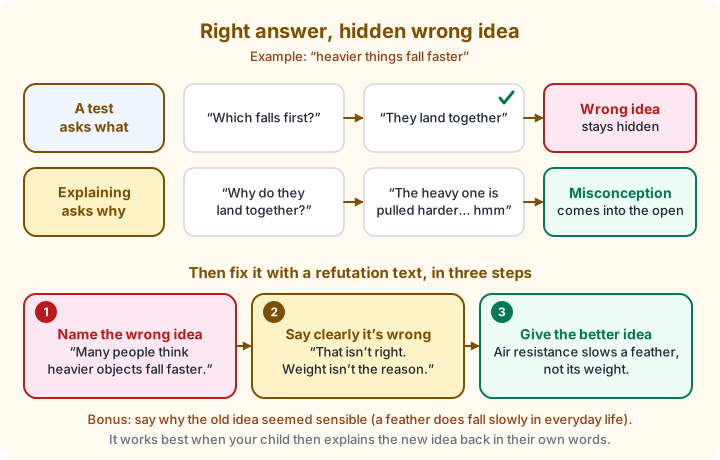
A tick can hide a misconception; asking “why” brings it out, and naming then refuting it helps it change.
A 1993 meta-analysis by Guzzetti and colleagues compared ways of teaching for conceptual change in science reading. Refutation texts came out as one of the more effective approaches. A later review by Tippett (2010), covering two decades of studies, reached a similar conclusion: naming the misconception and directly refuting it tends to work better than simply presenting the right idea.
Honest limits: many of these studies used older students and short reading tasks, and a single refutation won't always undo years of everyday experience. It helps most when the child also gets to explain the new idea back in their own words.
How the Feynman way catches misconceptions
The Feynman approach asks your child to explain an idea simply, as if to someone younger. That simplicity is a trap for misconceptions, in a good way.
When you strip out the jargon, you can't hide behind words like "gravity" or "photosynthesis". You have to say what actually happens. And when you say what actually happens, your real picture comes out.
Try it. Ask: "Explain to me, like I'm nine, why a plant gets bigger." If the answer is "it sucks up food from the ground", you've found it. No marking needed. Just a curious follow-up: "So where does all that wood in a tree come from? Is the ground getting lower?"
Where children usually get stuck: they defend the old idea. That's normal. Don't argue. Ask one more question, then let them check a reliable source. A misconception the child disproves themselves tends to stay disproved. For more questions like this, see 10 questions to ask when your child explains.
Three things to try this week
- Ask a "why" question at dinner. One per evening. Physics questions work well: "Why does a ball stop rolling?" See the Feynman technique for KS3 physics for more.
- Listen for everyday hunches. "Because it's heavier." "It gets used up." "It just does." Those are your clues.
- Name, refute, explain. When you both find the right idea, say it the refutation way: "Lots of people think X. Actually it's Y, because Z."
How this connects to Learn by Asking
Learn by Asking, aitutors.me's idea that asking well matters more than getting answers, has a lot to say about the moment after a wrong answer. Most children glance at the right answer and move on. The better move is to ask where their reasoning left the road. In this article's example, the child who says a plant "sucks up food from the ground" doesn't need the correct sentence handed over. They need your follow-up, "So where does all that wood come from?", and then their own question: "Which bit of my picture was wrong?" A tick hides that question. An explanation brings it out. For five questions to use at that moment, see questions to ask after getting something wrong.
Where aitutors.me fits
On aitutors.me, the professors probe with Socratic questions rather than giving answers, so misconceptions tend to surface in conversation. In Jotters, one kind of jot is Watch out: a short note pinned beside a line that names a common mistake about that idea, refutation style. Watch-outs come back after 1, 3 and 7 days, and leave once your child says "I get it now" three times in a row. It's the same principle as above, just pinned beside the page your child is reading.
FAQ
What is a misconception?
A misconception is a wrong idea that makes sense to the person holding it. It is usually built from everyday experience, like "heavy things fall faster" or "plants eat soil". Because it feels sensible, it survives lessons unless someone brings it into the open and tests it.
Why doesn't just teaching the right answer fix a misconception?
Because the old idea doesn't go away on its own. A child can learn the right sentence for the test and keep the old picture in their head. Research on refutation texts suggests it helps to name the wrong idea, say clearly why it's wrong, and then give the better explanation.
How can I spot a misconception if I don't know the subject?
Ask your child to explain why, not what. Listen for "because it's heavier", "it gets used up", or "it just does". You don't need to know the right answer. You only need to notice when the explanation rests on an everyday hunch, then suggest your child checks that bit.
Duke Harewood runs aitutors.me: Socratic AI tutors for KS3, plus a free GCSE map and flashcards for Years 10–11. Updated 20 October 2026.