aitutors.me builds the Feynman way into every part of KS3 tutoring: the subject professors ask questions instead of giving answers, Jotters pins plain-words explanations beside your child's own pages, and Heddy Pip, a listener who only asks questions, lets your child explain a topic back so the professor can see what they truly understand. The rule underneath all of it is simple. Your child does the explaining. The software asks.
aitutors.me is a UK AI tutoring service for Key Stage 3 (Years 7 to 9). Underneath it all is aitutors.me's motto, Learn by Asking, and the Feynman way is simply Learn by Asking when your child is the one explaining. This article explains how the Feynman way shapes it, what each part does, and, honestly, what the research does and doesn't tell us.
The Feynman way, in one paragraph
Richard Feynman, the Nobel-prize-winning physicist, was famous for explaining hard ideas in plain words, and for distrusting anyone who knew the name of something but not how it worked. The popular "Feynman technique" is a later summary of his habits by other writers, usually in four steps: pick an idea, explain it simply, notice where you get stuck, and make it simpler. Feynman didn't write those steps down himself. But they capture something real: explaining is how you find out whether you understand. For the full story, see what is the Feynman technique?
Rule one: the professors never give the answer
aitutors.me has seven subject professors: Professor Pi (maths), Quill (English), Darwin (biology), Curie (chemistry), Newton (physics), Harari (history) and Mercator (geography). Each uses Socratic questions. The jargon means teaching by asking a series of questions that lead the learner to reason it out, rather than telling them.
They never give the final answer. That can feel slow. It is deliberate.
Here's why. In a 2025 study published in PNAS, Bastani and colleagues gave high-school students an AI chatbot during maths practice. With an unguarded chatbot, practice scores went up, but later exam scores, taken without the AI, fell by 17%. Students had leaned on it for answers. A guarded version, designed to give hints rather than answers, removed most of that harm. We cover this study in when AI gives the answers, children learn less.
Another 2025 study, by Kestin and colleagues in Scientific Reports, found that a carefully designed AI tutor helped university physics students learn more, in less time, than an active-learning class. The design mattered. It followed good teaching practice rather than just answering.
Neither study tested aitutors.me. They do show why "never give the answer" is the right starting rule.
Rule two: explain beside the page, not instead of it
Jotters is the newest of our three core features, next to Cards (flashcards with spaced review) and Clips (short video clips on a topic). Its tagline is "Read it. Jot it. Get it."
Here's how it works:
- Read it. Your child uploads their own file: a PDF, photos of a worksheet, Markdown, a text file or pasted notes. There are also ready-made Jotters for every subject.
- Jot it. The AI pins short jots beside the words they explain, like a patient tutor writing in the margin. Your child adds jots of their own.
- Get it. Three questions check that the idea stuck. A wrong answer links straight back to the jot that explains it. Then your child can tap "Make cards from my jots" to keep it.
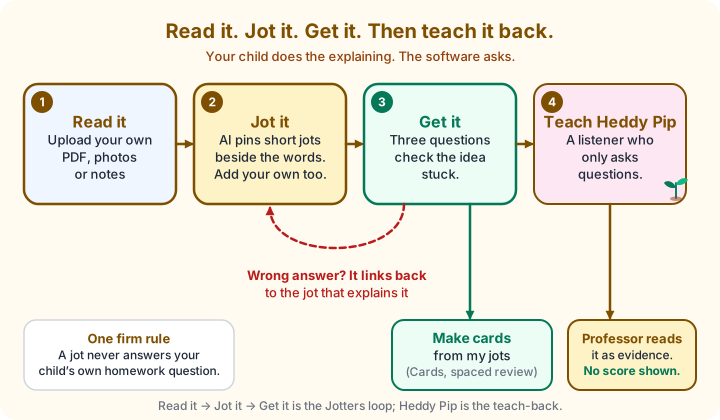
In Jotters the AI explains beside the page, the questions check it stuck, and teaching Heddy Pip shows what your child truly understands.
There are five kinds of jot, and each one is a Feynman move:
- Say it simply. The idea in plain words, jargon named and then explained.
- Picture it. A picture of the idea. Where the idea is a process, the picture moves.
- Example. A concrete case.
- Watch out. Names a common mistake. Watch-outs come back after 1, 3 and 7 days and leave after three "I get it now" in a row.
- Ask me. A question behind a "Say it first" cover, so your child explains before peeking.
One firm rule: a jot never answers your child's own homework question. It explains the page. The thinking stays with your child.
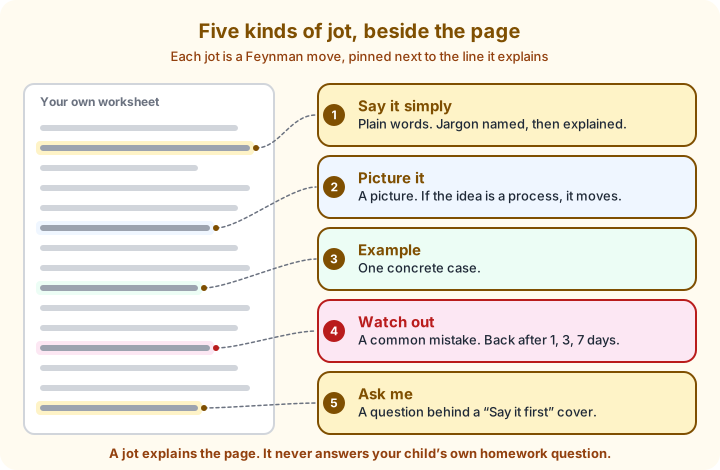
Five jot kinds sit beside the words they explain, so the explanation and the text are read together.
For the research behind margin notes, see Feynman notes: jot beside the text, don't copy it.
Rule three: the Feynman steps are built in
Inside Jotters, the four Feynman steps sit right on the page: Pick · Explain · Stuck? · Simpler. Two small tools help:
- The stuck pin. Your child marks the exact line where they got lost. That stuck point becomes the next thing to work on.
- The jargon underline. Technical words are underlined, a gentle nudge to say them in plain words.
Where children usually get stuck is step three. Admitting "I'm stuck" feels like failing. Making it a button turns it into a normal part of learning.
Rule four: Heddy Pip only asks questions
The Feynman way is at its best when you explain to someone. So your child can teach a topic back to Heddy Pip.
Why the name? A pip is a tiny seed. Every big idea grows from a small why?
Heddy Pip never explains and never corrects. It only ever asks questions: "What does that word mean?" "What would happen if...?" This leans on the protégé effect, the finding that people often learn more when they teach. In one study of "teachable agents", 8th graders tried harder when teaching a computer character than when learning for themselves, and lower achievers gained the most (Chase and colleagues, 2009).
The subject's professor reads the teach-back as evidence of understanding. No score is shown to the child. Explaining should feel like thinking aloud, not sitting a test.
What parents see
There is no Jotters page for parents. That's deliberate: a notebook works best when it feels like your own. Your child's jots are part of their learning record, though, so they are included in the parent's data export.
What we don't claim
We built aitutors.me on research about self-explanation (a meta-analysis by Bisra and colleagues, 2018, found an average effect of g = 0.55), learning by teaching, retrieval practice and spacing (Cepeda and colleagues, 2006). Many of those studies were with older students, and none of them tested aitutors.me or Jotters. The method is well supported. Our version of it still has to earn its place with each child.
You can also do almost all of this without us. A pencil, a margin and a curious parent asking "why?" is the Feynman way too.
How this connects to Learn by Asking
Learn by Asking is aitutors.me's motto and its theory of learning: now that any chatbot can produce an answer, the skill that counts is asking well. Every rule above follows from it. The professors ask instead of tell, so your child does the reasoning. The stuck pin turns a vague "I'm lost" into a precise question about one line. The Ask me jot says "Say it first", so your child guesses before looking. And Heddy Pip only asks, so explaining becomes the way your child finds the next thing to ask. Ask, explain, get stuck, ask again. For the full argument, see why aitutors.me's tutors are built around Learn by Asking.
FAQ
Does aitutors.me ever give my child the answer?
No. The subject professors use Socratic questions and never give the final answer. In Jotters, a jot explains the words on the page but never answers your child's own homework question. The aim is that your child does the thinking.
What is Heddy Pip?
Heddy Pip is the curious listener your child explains a topic to. It only ever asks questions. The name comes from a small idea: a pip is a tiny seed, and every big idea grows from a small why? The subject's professor reads the explanation as evidence of understanding, and no score is shown to your child.
Can parents see their child's Jotters?
There is no Jotters page for parents. Your child's jots are part of their learning record, so they are included when you download your data export. This keeps the notebook feeling private to your child while the record stays with the family.
Duke Harewood runs aitutors.me: Socratic AI tutors for KS3, plus a free GCSE map and flashcards for Years 10–11. Updated 20 October 2026.