When an AI tool hands children the answers, they can look as if they're doing better while actually learning less: in a 2025 study published in PNAS, students who practised maths with an unrestricted chatbot scored 17% lower on a later exam than students who had no AI at all. The same study found that a version of the AI with guardrails, which gave hints instead of answers, removed most of the harm. So the question for parents isn't "AI or no AI?" It's "What kind of AI, used how?"
The study every parent should know about
In 2025, Hamsa Bastani and colleagues published a large field experiment in high school maths classes, run in real schools, not a lab. Students practised maths in one of three ways:
- No AI: the normal approach, with notes and textbooks.
- An unguarded chatbot: a standard AI chatbot, similar to the ones anyone can use, which would happily give answers and full solutions.
- A guarded AI tutor: the same technology, but set up to give hints and guidance rather than answers.
Then all students sat an exam without any AI.
Here's what happened:
- During practice, both AI groups did better than the no-AI group. The chatbot made the practice problems feel easier, and scores went up.
- On the exam, the unguarded chatbot group did 17% worse than the no-AI group. The help during practice had turned into harm when the help was taken away.
- The guarded tutor group avoided most of that harm. Hints, rather than answers, made the difference.
The researchers' reading of this was simple: many students used the chatbot as a crutch. They asked for the answer, copied it, and moved on. The practice looked successful, but the thinking had been done by the machine.
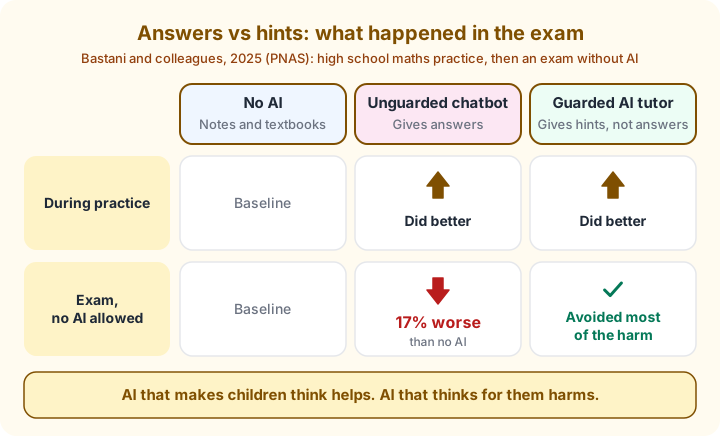
Both AI groups looked better in practice, but only the chatbot that gave answers hurt the exam score.
Why answers harm learning
Think about learning to ride a bike with stabilisers. Stabilisers make every ride look great. But they stop you learning to balance, which is the whole skill. Take them off, and you wobble.
An AI that hands out answers is a set of stabilisers for the brain. The child gets the right answer on screen, but skips the bit that builds memory and understanding: the struggle to work it out.
This links to some of the best-established research on learning:
- Recall builds memory. Pulling information out of your own head strengthens it. Roediger and Karpicke showed in 2006 that students who recalled a text remembered more a week later than students who reread it. Getting an answer from AI is closer to rereading than recalling.
- Feeling fluent isn't the same as knowing. When an answer is right there, everything feels easy, so children overestimate what they know. That's the same trap we describe in why rereading feels like learning but isn't.
- Explaining finds the gaps. If the AI explains, the child doesn't. The gaps stay hidden until the test.
But good AI tutoring can help
It would be easy to read the Bastani study as "AI is bad for children". That isn't what it shows, and other research points the other way when the design is right.
- Kestin and colleagues (2025), in a study at Harvard published in Scientific Reports, compared an AI tutor built on good teaching principles with an active-learning physics class taught in person. Students using the AI tutor learned more, in less time, and reported feeling more engaged. Those were university students, so we shouldn't assume the same for a Year 7, but it shows that AI designed to teach, rather than to answer, can work well.
- VanLehn (2011) reviewed decades of research on computer tutoring before today's chatbots. He found that tutoring systems which guided students step by step, giving feedback on each step rather than just the final answer, came close to the effectiveness of human tutors.
The pattern across all three: AI that makes children think helps. AI that thinks for them harms.
What guardrails look like
When you look at any AI tool your child uses, check for these:
- It doesn't give final answers to homework. It asks questions, gives hints, or points back to the relevant idea.
- It asks your child to explain. "How did you get that?" or "Why does that step work?"
- It gives hints in steps. A small nudge first, a bigger one only if needed.
- It says when something's wrong, without fixing it for them. "Check your second line" beats a corrected solution.
- It can't be easily talked round. If typing "just tell me the answer" works, there are no real guardrails.
A simple test for parents
You don't need to understand the technology. Try this:
After your child uses an AI tool for homework, close the laptop and ask: "Can you explain to me how you solved number three?"
- If they can explain the steps and why they work, the tool is probably helping.
- If they can only tell you the answer, or say "the AI did it", the tool is doing the thinking.
This is the Feynman technique used as a check. If you can't explain it, you don't know it yet. Our guide for students, use an AI tutor the Feynman way, without cheating, shows them how to use AI to question them instead.
How this connects to Learn by Asking
Learn by Asking, aitutors.me's theory of learning, gives this harm a name: the Answer Trap. It means getting an answer and treating it as the end of the job, when it should be the start of the next question. The students in the Bastani study who asked the chatbot for the answer, copied it and moved on were caught in exactly that trap. The guarded tutor kept them out of it by replying with hints, which left a real question for the student to work on. Your "explain number three" test checks for the same thing. More in the Answer Trap explained.
The rule we built aitutors.me on
On aitutors.me, the never-give-the-answer rule is the foundation. The subject professors, from Professor Pi for maths to Mercator for geography, ask Socratic questions and never give the final answer. In Jotters, a jot never answers the child's own homework question. And when a child teaches back to Heddy Pip, Heddy Pip only ever asks questions. We describe how it fits together in how AI Tutors uses the Feynman way.
To be clear: the studies above did not test aitutors.me. We designed it this way because of what they found.
FAQ
Does using AI for homework harm children's learning?
It can. In a 2025 study by Bastani and colleagues, published in PNAS, students who practised maths with an unrestricted AI chatbot did better on practice problems, but 17% worse on a later exam without it, than students with no AI. The harm came from the AI handing over answers.
Is all AI tutoring bad for learning?
No. In the same study, a version of the AI with guardrails, which gave hints instead of answers, removed most of the harm. A 2025 Harvard physics study by Kestin and colleagues found a carefully designed AI tutor helped students learn more, in less time. Design matters more than the technology.
How can I tell if an AI tool is helping my child learn?
Ask your child to explain, without the tool, how they solved a problem it helped with. If they can, the tool is probably helping. If they can only show you the answer, it's probably doing the thinking for them. Look for tools that ask questions and refuse to give final answers.
Duke Harewood runs aitutors.me: Socratic AI tutors for KS3, plus a free GCSE map and flashcards for Years 10–11. Updated 20 October 2026.