To use an AI tutor without cheating, flip the roles: instead of asking it for the answer, ask it to question you, and explain your own thinking to it until you find the gap. The AI becomes a curious listener, not a homework machine. That's honest, and it's also the version of AI that helps you learn.
This guide is for you if you are in Year 7, 8 or 9 and have wondered whether using AI for homework is OK.
First, the honest bit
Every school has its own rules about AI. Some ban it for homework; some allow it for certain tasks. Check your school's rules first. Nothing in this guide is a way round them.
Here is the simple line: if the AI does the thinking and you hand in what it wrote, that's cheating. If you do the thinking and the AI asks questions or points at where you went wrong, that's studying.
Why getting the answer from AI hurts your learning
This isn't just about rules. It's about what happens in your head.
In a 2025 study published in PNAS, Hamsa Bastani and colleagues gave secondary school maths students access to AI while they practised. One group used a standard chatbot. Another used a version designed as a tutor, which gave hints instead of answers. A third group had no AI.
During practice, the chatbot group did much better. Then came an exam without AI. The chatbot group scored 17% lower than students who had never had AI at all. The tutor version, which held back the answers, removed most of that harm.
Why? Because the chatbot did the hard part. Students copied answers, felt successful, and skipped the thinking that builds memory. Doing well in practice and actually learning are not the same thing. There's more on this study in when AI gives the answers, children learn less.
The good news: AI built the right way can help a lot. In another 2025 study (Kestin and colleagues, Scientific Reports), university physics students who used a carefully designed AI tutor learned more, in less time, than students in an active-learning class. An older review by Kurt VanLehn (2011) found that step-by-step tutoring systems can come close to the benefit of a human tutor. The difference between harm and help is whether the AI does your thinking or makes you think.
The Feynman way: you explain, the AI listens
The physicist Richard Feynman believed you don't really understand something until you can explain it simply. The popular "Feynman technique" built from his habits (pick, explain, find where you're stuck, simplify) was written up by later authors rather than by him. But it gives you the perfect way to use AI:
- You pick the topic.
- You explain it.
- The AI asks questions until you get stuck.
- You go back to your notes and simplify.
The AI never writes the explanation. You do.
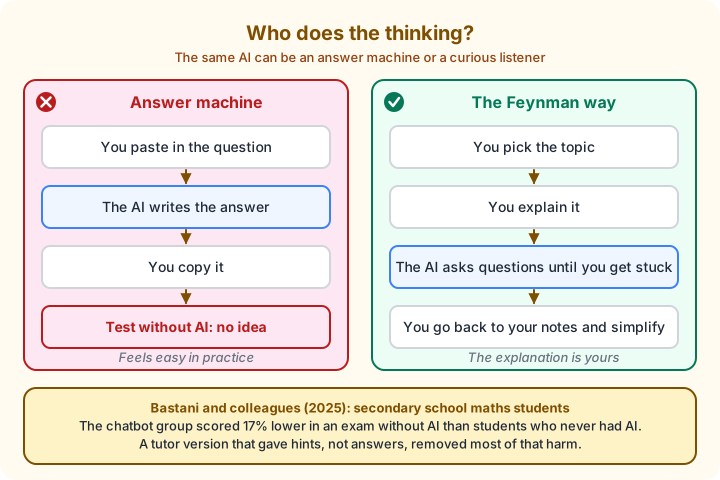
If the AI does the thinking, it's cheating; if you do the thinking, it's studying.
There's research behind this, too. Studies of learning by teaching (for example Fiorella and Mayer, 2013) found that students who explained material to others learned it better than students who only studied it. Explaining to an AI isn't quite the same as teaching a person, but the same thing is happening: you have to organise the idea in your own words. Read more in the protégé effect: children learn by teaching.
A worked example: good and bad prompts
Meet Ollie. His homework asks: Explain why a ball rolling on grass slows down.
The cheating way
Ollie: Explain why a ball rolling on grass slows down. AI: (writes a full, neat paragraph about friction and air resistance)
Ollie copies it. Next week, in a test, a question asks why a toy car rolls further on a smooth floor than on carpet. He has no idea, because he never did the thinking.
The Feynman way
Ollie: I'm learning about forces. Don't give me the answer. I'll explain why a ball on grass slows down, and you ask me one question at a time to find the gaps. Ollie: The ball slows down because the force from my kick runs out. AI: Interesting. While the ball is rolling, what is pushing on it? Ollie: Um… nothing? My foot isn't touching it. AI: So if nothing pushes it forward, what could be making it slow down?
Ollie is stuck, and that's good. He goes to his notes, reads about friction, and comes back:
Ollie: The grass rubs against it. That's friction, and it pushes backwards. AI: What do you think would happen on a smooth floor instead of grass?
Now Ollie is doing the thinking. The explanation he writes for his homework is his own, and he'll remember it.
Prompts you can use
Copy these, and change the topic:
- "Don't give me the answer. Ask me one question at a time about [topic]."
- "Here's my explanation of [topic]. Which part is unclear or wrong? Point to it, but don't fix it."
- "Give me a hint, not the answer. Only one step."
- "Ask me to explain this to a ten-year-old, then tell me where I used jargon."
- "Quiz me on [topic] with five questions. Wait for my answer before telling me if it's right."
Watch out: even a good prompt can drift. If the AI starts writing your answer for you, stop it: "Please don't write it. Just ask me a question."
Signs you're using AI the wrong way
- You can't explain the answer without looking at the screen.
- You pasted in the exact homework question.
- It felt really easy.
- You'd struggle to answer a slightly different question.
If any of those are true, close the chat, take a blank page, and try explaining it yourself.
How this connects to Learn by Asking
The Feynman way is Learn by Asking when you're the one explaining. With an AI tool, Learn by Asking has a simple shape: Ask-Try-Ask. Ask a specific question, try the work yourself, then ask a sharper follow-up you could only ask after trying. Ollie's first message is the Ask: not "explain this", but "ask me one question at a time". Explaining, getting stuck and reading about friction are the Try. A good second Ask would be his own: "if friction slows it down, would the ball roll further on ice?" Pasting in the homework question skips the Try completely. See the Ask-Try-Ask cycle.
How aitutors.me builds this in
aitutors.me is a UK AI tutoring service for KS3. It was built around the "don't give the answer" rule, so you don't have to fight the AI to make it work this way. Each subject professor (Professor Pi for maths, Newton for physics, Quill for English and so on) uses Socratic questions and never gives the final answer. Heddy Pip is a curious listener you explain topics to. (A pip is a tiny seed. Every big idea grows from a small why?) Heddy only ever asks questions. In Jotters, jots explain the words in your own notes, but a jot never answers your homework question. More in how AI Tutors uses the Feynman way.
Whatever AI you use, the rule is the same: you do the thinking.
FAQ
Is it cheating to use AI for homework?
It depends on how you use it, and on your school's rules, so check those first. If the AI does the thinking and you hand in its answer, that is cheating, and it also stops you learning. If you use it to question you, check your explanation, or point you to the step you got wrong, it can help you learn.
Does using AI make you learn less?
It can. In a 2025 study, secondary school students who practised maths with an unguarded chatbot did better during practice, but scored 17% lower on a later exam taken without it. A version designed to give hints rather than answers removed most of that harm. How the AI is used matters more than whether it is used.
What should I ask an AI tutor?
Ask it to ask you questions. Try: "Don't give me the answer. Ask me one question at a time to check whether I understand this." Or: "Here's my explanation. Which part is unclear or wrong? Don't fix it, just point to it." Then do the thinking yourself.
Duke Harewood runs aitutors.me: Socratic AI tutors for KS3, plus a free GCSE map and flashcards for Years 10–11. Updated 20 October 2026.