Feynman notes are short jots, written in your own plain words, placed right beside the words they explain, and they work better than copying or highlighting because they make you explain the idea instead of just moving it from one page to another. Think of them as a patient tutor writing in your margin, except the tutor is you.
If you've ever spent an hour making beautiful notes and then couldn't remember any of it, this article is for you. It explains why copying doesn't work, why where you put a note matters, and five kinds of jot you can start using tonight.
The problem with copying
Copying out the textbook feels like work. Your hand hurts. The page fills up. It looks like studying.
But your brain can copy words without thinking about them, a bit like a photocopier. A photocopier copies a recipe perfectly. It still can't cook.
Highlighting has the same problem. In 2013, Dunlosky and colleagues reviewed ten popular study techniques. They rated highlighting and rereading as low utility, meaning they don't help much compared with other methods. They make a page look studied without checking that you understand it. We go deeper in why rereading feels like learning but isn't.
What does work is explaining. Research on self-explanation, saying ideas in your own words to make sense of them, found a moderate average benefit across many studies (Bisra and colleagues, 2018). A jot is a tiny self-explanation, written down.
Why "beside" matters
Here's the second idea, and it has a jargon name: spatial contiguity. Spatial means "to do with space". Contiguity means "being next to". Put simply: things that belong together should sit together.
Imagine a map where the place names are listed on the back instead of printed on the map. You'd keep flipping over, losing your place, trying to match them up. Annoying, and slow. That's what separate notes do. Your notes are in one book, the text is in another, and your brain wastes effort jumping between them.
A meta-analysis by Ginns (2006) combined many studies and found that people learn better when related information, such as a diagram and its labels, is placed close together rather than apart. Richard Mayer's work on multimedia learning (2021) makes the same point. Most of this research is about diagrams and text on a screen or page, often with older students. But the principle carries over neatly: a note beside the line it explains is easier to use than a note in another book.
Five kinds of jot
Here are five jots worth knowing. Each one is a different way of explaining.
1. Say it simply
Rewrite a hard sentence in plain words. Name the jargon, then explain it.
Text: "Osmosis is the diffusion of water across a partially permeable membrane." Jot: "Osmosis = water moving through a skin that only lets some things through. Water goes from where there's more water to where there's less."
2. Picture it
Draw a tiny sketch: an arrow, a diagram, a cartoon. If the idea is a process, show the steps with arrows. Research comparing animations with still pictures found a modest benefit for animation when showing processes (Höffler and Leutner, 2007), so if you're picturing something that moves, show the movement, even with arrows.
3. Example
Give one real, specific case.
Jot: "Like when a raisin swells up in water."
4. Watch out
Warn your future self about a common mistake. These are gold before a test.
Jot: "Watch out: osmosis is only about water moving. Not salt, not sugar."
5. Ask me
Write a question about the line, and cover the answer. A folded sticky note works. Later, try to answer before you peek.
Jot: "Why does a slug shrivel if you put salt on it?" (answer under the flap)
That last one turns your notes into a quiz. Answering questions from memory is retrieval practice, which Dunlosky's review rated high utility.
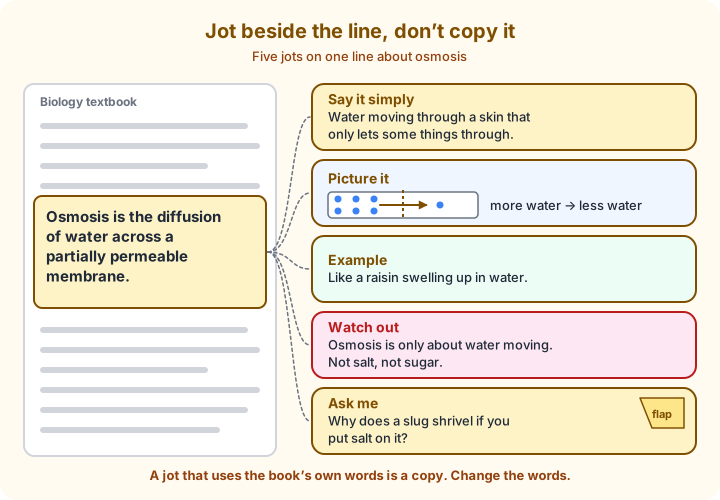
Five ways to explain one line, each written right next to it, so you never have to flip between book and notes.
How to jot: a quick routine
- Read a short section (a paragraph or two). Don't jot yet.
- Find the one line that matters most. Underline it.
- Add one or two jots beside it, in your own words. Pick whichever of the five kinds fits.
- Mark anything you can't explain with a question mark. That's a stuck point. See where you get stuck is where you learn.
- Close the book and explain the section out loud, using only your jots as hints.
Less is more. Five good jots on a page beat fifty highlighted lines.
Where students usually get stuck
- Writing jots that just repeat the text. If your jot uses the same words as the book, it isn't a jot. It's a copy. Change the words.
- Jotting everything. Pick the lines that matter.
- Never coming back. Jots help most when you use them again. Turn your best ones into flashcards. See turn your explanations into flashcards.
How this connects to Learn by Asking
Learn by Asking is aitutors.me's idea that asking good questions is what drives learning. Look again at the Ask me jot: it is a question, not a note. "Why does a slug shrivel if you put salt on it?" makes you answer before you peek. The question marks from step 4 of the routine are questions too. Put them together and your margin becomes a question journal: a running record of what puzzled you and where, ready to come back to before a test. Write the question, not just the fact. Read more in keeping a question journal.
Where aitutors.me fits
This is exactly the idea behind Jotters on aitutors.me: "Read it. Jot it. Get it." You upload your own worksheet, notes or PDF, and the AI pins short jots beside the words they explain, using the same five kinds: Say it simply, Picture it (which moves when the idea is a process), Example, Watch out, and Ask me (with the question behind a "Say it first" cover). You add your own jots too. Then Get it checks the idea stuck with three questions, and a wrong answer links back to the jot that explains it. You can tap "Make cards from my jots" to keep them. One rule: a jot never answers your homework question for you. Read more in how AI Tutors uses the Feynman way.
FAQ
What are Feynman notes?
Feynman notes are short notes written in your own plain words, placed right beside the part of the text they explain. Instead of copying the textbook, you explain it, picture it, give an example, warn yourself about a common mistake, or set yourself a question.
Why is jotting beside the text better than copying it out?
Copying lets you move words from one place to another without thinking about them. Jotting forces you to explain. Keeping the note next to the words it explains also helps, because research on spatial contiguity shows people learn better when related information is placed close together rather than spread apart.
Is highlighting a waste of time?
Not a total waste, but a big review of study techniques rated highlighting and rereading as low utility. They make a page look studied without checking that you understand it. If you highlight, add a short jot beside it saying why that line matters.
Duke Harewood runs aitutors.me: Socratic AI tutors for KS3, plus a free GCSE map and flashcards for Years 10–11. Updated 20 October 2026.