The Feynman technique works in KS3 geography when you explain a process as a chain of plain steps, each one causing the next, and then explain what that process means for people and places. Geography is full of processes: the water cycle, erosion, plate movement, weather. They're easy to label on a diagram and surprisingly hard to explain out loud. That gap is where the Feynman technique earns its keep.
This guide is for you if you are in Year 7, 8 or 9. Our worked example is the water cycle, with a short look at plate boundaries too.
Processes are chains
A geographical process is like a line of dominoes. Each step knocks over the next one. A good explanation names every domino and says why it falls.
The habit of explaining one link at a time is close to how the physicist Richard Feynman worked. He would build up from the simplest picture until the whole thing made sense. The neat "four-step Feynman technique" you see online (pick, explain, find where you get stuck, simplify) was written up by other people later, not by Feynman. But it fits processes very well. See the four Feynman steps, explained simply.
A worked example: the water cycle
Meet Kai. He has a Year 7 test on rivers and the water cycle.
Step 1 – Pick
Kai writes: The water cycle. How does rain happen?
Step 2 – Explain
He explains to his older sister:
"The sun heats the sea and water evaporates. It goes up and makes clouds. Then the clouds get full and it rains. The rain goes into rivers and back to the sea. Then it starts again."
It's not wrong, exactly. But there's a gap in the middle.
Step 3 – Stuck?
His sister asks: "Hang on. If water vapour is invisible, how does it turn into a cloud you can see? Why doesn't it just stay invisible?"
Kai stops. "It… collects up there?"
That's the stuck point. Kai has jumped from "evaporates" straight to "makes clouds" without explaining the step in between. He has the dominoes at each end but not the one in the middle. He puts a mark next to "makes clouds". There's a full guide on working with these moments in where you get stuck is where you learn.
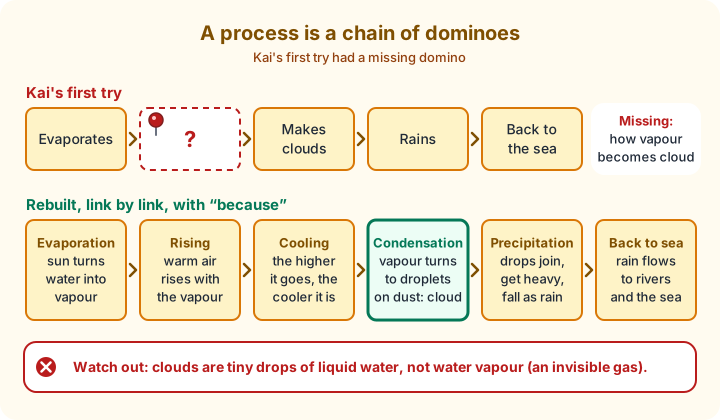
A good explanation names every domino and says why it falls.
Step 4 – Simpler
Kai goes back to his textbook and rebuilds the chain one link at a time, saying "because" between each step.
- Evaporation. The sun heats water in seas, lakes and rivers. Some of it turns into an invisible gas, water vapour, which mixes into the air. (Plants also give off water vapour from their leaves. That's called transpiration.)
- Rising. Warm air is lighter than the cooler air around it, so it rises, carrying the vapour up.
- Cooling. The higher air goes, the cooler it gets.
- Condensation. Cooler air can't hold as much water vapour. So some vapour turns back into tiny liquid droplets, forming around specks of dust in the air. Billions of these droplets together are a cloud.
- Precipitation. Inside the cloud, droplets bump into each other and join. When they get heavy enough, they fall as rain (or snow or hail).
- Back to the sea. Rain soaks into the ground (infiltration), runs over the surface (surface run-off), or moves slowly through rocks (groundwater flow). Most of it ends up in rivers and the sea.
Here's a plain picture for step 4. Think of breathing out on a cold window. Your breath has invisible water vapour in it. When it hits the cold glass, it cools, and tiny droplets appear: mist. A cloud is the same thing happening high in the sky, with the cold air acting like the window.
Now Kai can explain it in one breath:
"The sun evaporates water into invisible vapour. Warm air carries it up, and as the air rises it cools. Cooler air can't hold as much vapour, so it condenses into tiny droplets on dust, which is a cloud. The droplets join, get heavy and fall as rain, which flows back to rivers and the sea."
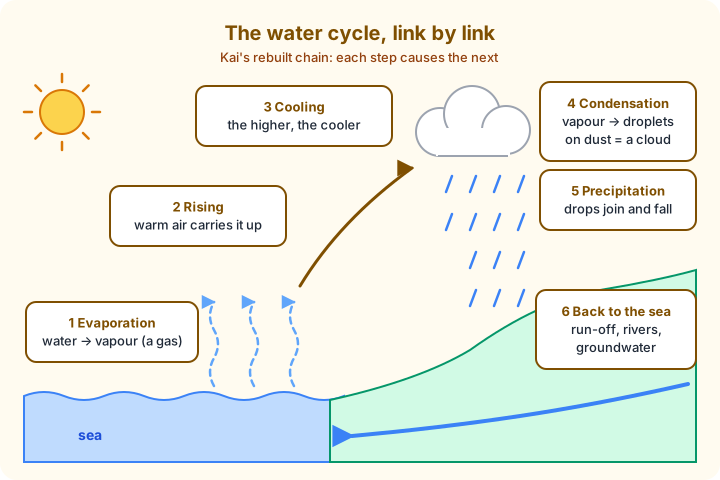
Say “because” between every step, and the middle of the cycle stops being a gap.
Watch out: many students say clouds are made of water vapour. They're not. Water vapour is an invisible gas. Clouds are made of tiny drops of liquid water (or ice crystals), which is why you can see them.
Where the analogy breaks: the window is cold because of the weather outside. In the sky, the air cools mainly because it is rising. Analogies help you picture a step, but they always break somewhere. See how to build analogies that make ideas click.
A second process: destructive plate boundaries
The same "because" chain works for tectonics:
- Two plates move towards each other.
- Oceanic crust is denser than continental crust, so the oceanic plate sinks underneath. This is called subduction.
- As it sinks deeper, it heats up and melts, so magma forms.
- The magma is less dense than the rock around it, so it rises and can erupt as a volcano.
- The plates also stick and then suddenly slip, so earthquakes happen.
The Andes in South America formed this way. If you can explain each "so", you understand it.
From process to people: SEEP
Explaining a process is half the job. Geography also asks: so what for people and places? That's where SEEP comes in:
- Social: how does it affect people's lives, health and homes?
- Economic: what does it cost, or who gains and loses money?
- Environmental: what happens to land, water, plants and animals?
- Political: what do governments and councils decide to do?
Take very heavy rain from step 5. Social: homes flood and families have to move out. Economic: repair costs and lost business. Environmental: soil is washed away and rivers carry pollution. Political: councils argue over paying for flood defences. Now the water cycle is linked to real places. History uses a similar skill when it explains causes and consequences; see the Feynman technique for KS3 history.
Do moving diagrams help?
Processes happen over time, so you might expect animations to be better than still diagrams. A 2007 review (Höffler and Leutner) found animations had a moderate advantage over static pictures on average (d = 0.37), and a 2016 review (Berney and Bétrancourt) found a smaller benefit (g ≈ 0.23). So animation can help. But watching is not the same as explaining. The test of understanding is whether you can talk through the chain yourself without the picture.
How this connects to Learn by Asking
The Feynman way is Learn by Asking when you're the one explaining. In geography, Learn by Asking turns one flat question into four, through SEEP. Kai's sister asked the question that found his missing domino: how does invisible vapour become a cloud you can see? Once the chain works, ask again. If that rain falls on a town by a river, who is affected (Social), what does it cost (Economic), which process makes it flood (Environmental), and who has the power to act (Political)? That is the next question after Simpler. See questions across the SEEP lens.
Mercator, the geography professor
On aitutors.me, Professor Mercator is the geography tutor. Mercator thinks across scales (your street, the UK, the world) and uses SEEP to explain impacts rather than just name features, always through questions. In Jotters, a "Picture it" jot can show a process like condensation moving step by step, right beside the sentence in your notes that describes it. Read more about jotting beside your notes in Feynman notes: jot beside the text, don't copy it.
FAQ
How do clouds form, in simple words?
Warm, moist air rises. As it rises it cools, and cooler air can't hold as much water vapour. Some of the vapour condenses into tiny water droplets around specks of dust. Billions of those droplets together make a cloud. When droplets join and grow heavy enough, they fall as rain.
How do I use the Feynman technique in geography?
Pick one process, like the water cycle or a plate boundary, and explain it out loud as a chain of steps, each one causing the next. Wherever you jump from one step to another without saying why, that's your stuck point. Then use SEEP to explain the effects on people and places.
What does SEEP stand for?
Social, Economic, Environmental, Political. It's a way of making sure you explain the impacts of a process or event from more than one angle, for example how a flood affects people, money, the natural world and government decisions.
Duke Harewood runs aitutors.me: Socratic AI tutors for KS3, plus a free GCSE map and flashcards for Years 10–11. Updated 20 October 2026.