The Feynman technique works in KS3 history when you explain why something happened and how we know, in plain words, rather than reciting dates and events in order. Dates matter, but they are the scaffolding, not the building. Explaining causes out loud quickly shows whether you understand the past or are just retelling it.
This guide is for you if you are in Year 7, 8 or 9. Our worked example comes from Year 7: why did William of Normandy win the Battle of Hastings in 1066?
Why history needs explaining, not just remembering
The physicist Richard Feynman had little patience for knowing names without understanding. He said his father taught him that you can know what a bird is called in every language and still know nothing about the bird. History has its own version: you can know "1066, Hastings, William won" and still know nothing about why.
The popular "four-step Feynman technique" (pick, explain, find where you get stuck, simplify) was written up by later authors from Feynman's habits rather than by Feynman himself. It works well in history, where the trap is telling a story instead of building an argument. For the full steps, see the four Feynman steps, explained simply.
A worked example: why did William win at Hastings?
Meet Maya. Her homework question is: Explain why William won the Battle of Hastings.
Step 1 – Pick
Maya writes at the top of the page: Why William won in 1066.
Step 2 – Explain
She explains to her grandad:
"King Edward died in January 1066 and Harold became king. Then Harald Hardrada invaded in the north and Harold beat him at Stamford Bridge. Then William landed in the south. Then they fought at Hastings on 14 October. Then Harold got shot in the eye with an arrow and William won."
Every fact here is in her textbook. But listen to the shape of it: "and then… and then… and then…"
Step 3 – Stuck?
Her grandad asks: "So why did William win? Was it just the arrow?"
Maya hesitates. "Well, Harold died, so… yes?"
This is the stuck point. Maya has told the story of what happened, but not explained why. And her one "reason", the arrow, is shaky in two ways:
- Harold's death came during the battle. It is part of how it ended, not a reason the Normans were in a position to win.
- Historians aren't even sure Harold was hit in the eye. The famous image comes from the Bayeux Tapestry, and they still argue about which figure is Harold. The main sources for the battle are the Bayeux Tapestry and the Norman chronicler William of Poitiers, and many details remain unclear.
Maya marks "arrow" with a question mark.
Step 4 – Simpler
Maya goes back to her textbook and asks a simpler question: "What made it easier for William, and harder for Harold?" She sorts what she finds into three plain groups.
Luck and timing. William's fleet waited for weeks across the Channel before it could sail. Many accounts blame unhelpful winds: at St Valéry sur Somme, William waited for the wind to be in the right direction. Meanwhile, Harald Hardrada invaded the north of England first. Harold had to march north to fight him at Stamford Bridge in late September. Just days after his victory, William landed at Pevensey on the south coast.
Harold's problems. Harold then marched his army back south to face William. Some of his soldiers were tired or had been lost in the first battle. He chose to fight quickly rather than wait for more men.
William's preparation. William had planned for months. He brought archers and mounted knights, as well as foot soldiers, while Harold's army fought on foot. Norman writers say William's men pretended to run away, which drew some English soldiers off the hill so they could be attacked.
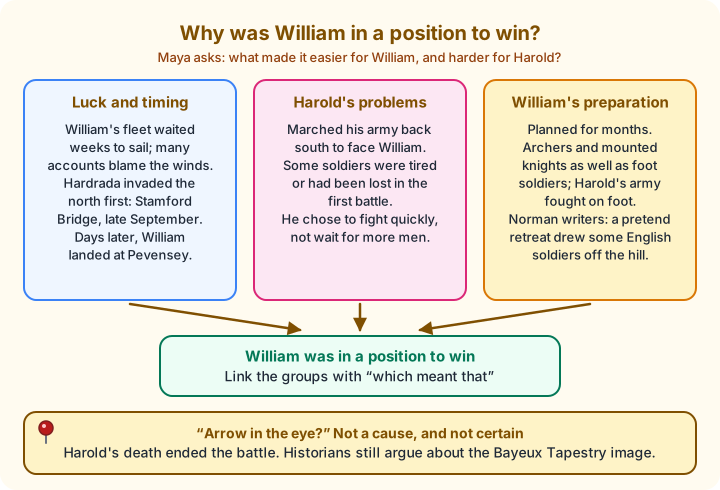
Three groups of causes, linked together, explain more than the arrow ever could.
Now Maya links the groups with "which meant that":
"Bad luck with timing meant Harold had to fight two invasions within weeks, which meant his army was tired and smaller when it reached Hastings. William had used the time to prepare, and had archers and cavalry that Harold lacked. So when the English line on the hill began to break, the Normans could take advantage. Harold's death ended the battle, but these causes explain why William was in a position to win."
That is an explanation. It has causes, it links them, and it says which mattered.
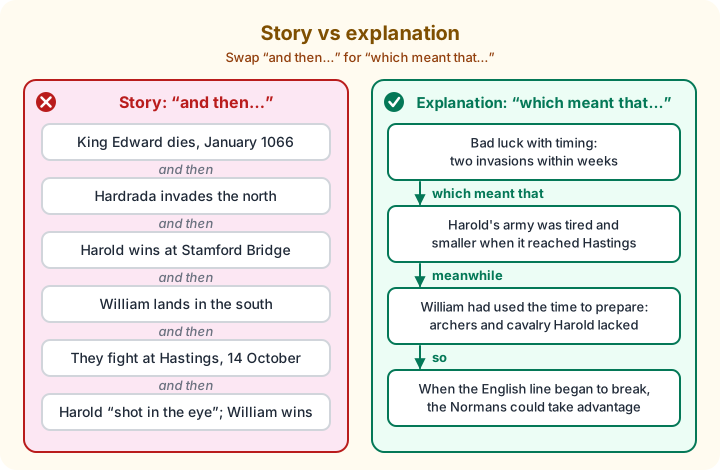
If your paragraph reads like a timeline, you are describing, not explaining.
Watch out: "and then" is the red flag of history writing. If your paragraph could be read as a timeline, you are describing, not explaining. Swap "and then" for "which meant that" or "because".
How do we know? Explaining sources simply
A historian's explanation is only as good as its evidence. For every source, ask three plain questions:
- Who made it, when, and why?
- What does it show?
- What might it leave out?
Take the Bayeux Tapestry. It is an embroidery around 70 metres long, made within a few years of 1066, most likely for William's half-brother, Bishop Odo. It tells the story from the Norman side, so it presents William as the rightful king. That doesn't make it useless. It makes it a source with a point of view, which is exactly what you need to say in your answer.
Try explaining that to a younger sibling without the words "provenance" or "bias". If you can, you understand it. See how to explain anything to a ten-year-old for tips.
Four history stuck phrases
Listen out for these in your own writing:
- "And then…" Story, not explanation.
- "It was the most important cause because it was important." Say what it made happen.
- "The source is biased so it's unreliable." Every source has a point of view. Ask what it's still useful for.
- "People back then were stupid." Usually a sign you haven't yet understood what they knew and believed at the time.
Why explaining helps
Self-explanation, which means talking yourself through why something happened, has a medium-sized benefit on learning across many studies (a 2018 review by Bisra and colleagues found about g = 0.55). Most of those studies were in science and maths rather than history, so the number is a guide, not a promise here. But the habit is exactly what history mark schemes reward: explaining causes and weighing evidence.
How this connects to Learn by Asking
The Feynman way is Learn by Asking when you're the one explaining. In history, Learn by Asking means interrogating a source instead of just reading it: who made this, when, and why? Maya's question mark next to "arrow" is that kind of question. The famous image comes from the Bayeux Tapestry, which tells the story from the Norman side, so "who says so?" matters as much as "what happened?" Her grandad's question also stopped her settling for the first verdict she had. And Simpler began with a new question of her own: what made it easier for William, and harder for Harold? See interrogating a source, not just reading it.
Harari, the history professor
On aitutors.me, Professor Harari is the history tutor. Harari weighs sources with you and shifts perspective (how would an English soldier have seen 1066?) rather than reciting dates, and never hands over a verdict. You build the argument. In Jotters, you can pin a stuck mark next to "arrow in the eye" in your own notes and come back to it. If you enjoy explaining causes, geography uses the same skill for processes; see the Feynman technique for KS3 geography.
FAQ
Can you use the Feynman technique for history?
Yes. In history, the thing to explain is not the date but the "why": why something happened, and how we know. If you can explain the causes of an event in plain words, link them together, and say which sources the evidence comes from, you understand it.
What is the difference between an event and a cause?
An event is what happened. A cause is a reason it happened. "Harold was killed" is an event during the Battle of Hastings. "Harold's army was tired after marching south from Stamford Bridge" is a possible cause of the Norman victory. Mixing the two up is a common stuck point.
How do I explain a historical source simply?
Ask three plain questions: who made it, when and why? What does it show? What might it leave out? The Bayeux Tapestry, for example, was made for the Norman side, so it tells the story in a way that makes William look justified.
Duke Harewood runs aitutors.me: Socratic AI tutors for KS3, plus a free GCSE map and flashcards for Years 10–11. Updated 20 October 2026.