The Feynman technique helps in KS3 biology when you explain a living process in plain words, then zoom in from the whole organism down to the cell until you find the exact point where your explanation stops making sense. Biology is full of long names, like photosynthesis, respiration and diffusion. Explaining them out loud is the quickest way to find out which ones you understand and which ones you have only heard often.
This guide is for you if you are in Year 7, 8 or 9. We will work through one of the most common mix-ups in KS3 science: photosynthesis and respiration.
Why explaining works so well in biology
In 1994, the researcher Michelene Chi and her colleagues asked 8th graders (about Year 9 age) to read a text about the human circulatory system. One group was prompted to explain each sentence to themselves as they read. That group understood the system better afterwards, and the students who explained the most improved the most.
Why? When you explain, you have to connect each new fact to what you already know. If a connection is missing, you notice. Reading alone lets you skip right past the gap.
The steps people now call the "Feynman technique" (pick, explain, find where you are stuck, simplify) were written up by later authors from the way the physicist Richard Feynman worked. He did not publish them as a method. But they suit biology well. See the four Feynman steps, explained simply for the full version.
A worked example: photosynthesis and respiration
Meet Leo. Leo has a test on plants next week.
Step 1 – Pick
Leo writes at the top of a blank page: How plants get and use energy.
Step 2 – Explain
Leo explains, as if to a younger sister:
"Plants do photosynthesis. They take in carbon dioxide and give out oxygen. That's how they breathe. Humans do the opposite: we breathe in oxygen and breathe out carbon dioxide. So plants do photosynthesis and animals do respiration."
It sounds tidy. It is also wrong in two important ways.
Step 3 – Stuck?
His sister asks a simple question: "So what do plants do at night, when there's no light?"
Leo stops. "They… stop breathing?"
That can't be right. A plant doesn't die every night. This is the stuck point. Leo marks it on the page.
There are actually two mix-ups hiding in his first explanation:
- "Photosynthesis is how plants breathe." It isn't. Photosynthesis is how plants make food.
- "Plants do photosynthesis, animals do respiration." Plants do both. Respiration happens in every living cell, plant or animal.
This is why explaining is so useful. Leo had read the right facts. He had just joined them up wrongly, and reading again would not have shown him that. There is more on this in how explaining reveals hidden misconceptions.
Step 4 – Simpler (zoom in)
Leo goes back to his textbook and zooms in, one scale at a time.
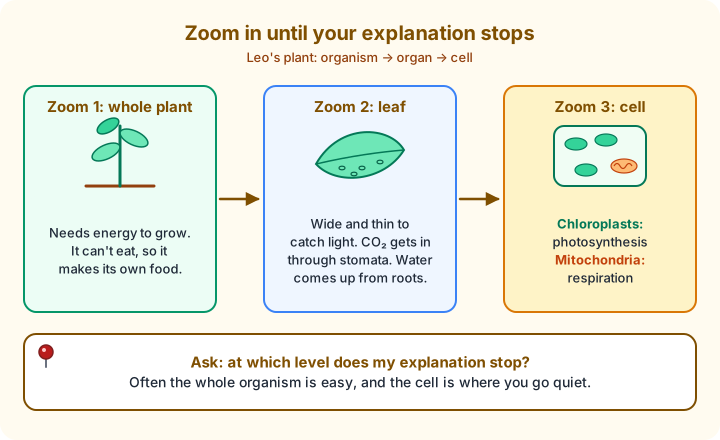
When you get stuck, ask at which level your explanation stops.
Zoom 1: the whole plant. A plant needs energy to grow, just like you do. It can't eat. So it has to make its own food.
Zoom 2: the leaf. Leaves are wide and thin to catch light. Carbon dioxide gets in through tiny holes on the underside called stomata. Water comes up from the roots.
Zoom 3: the cell. Inside leaf cells are green structures called chloroplasts. They contain chlorophyll, which absorbs light. Here, photosynthesis happens:
carbon dioxide + water → glucose + oxygen (using light energy)
Glucose is the food. It is a store of energy.
Now, separately, inside the mitochondria of every living cell (in the leaf, the root, and in you), respiration happens:
glucose + oxygen → carbon dioxide + water (releasing energy)
Here is a plain-words picture. Photosynthesis is like packing a lunchbox. Respiration is like eating it. A plant packs its lunchbox when it has light. But it eats from the lunchbox all the time, day and night, because every cell needs energy all the time.
Now Leo can answer his sister:
"At night there's no light, so photosynthesis stops. But respiration keeps going in every cell, so the plant takes in a little oxygen and gives out a little carbon dioxide. In the day, photosynthesis is usually much faster than respiration, so overall the plant gives out oxygen."
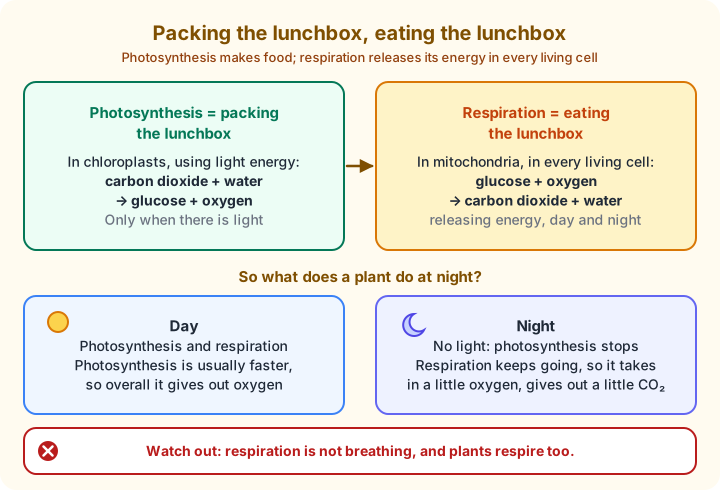
Plants pack the lunchbox when there is light, but eat from it day and night.
Watch out: respiration is not breathing. Breathing moves air in and out of your lungs. Respiration is a chemical reaction in your cells. Breathing brings in the oxygen that respiration uses. And be careful with the word "make": respiration releases energy that was stored in glucose. It does not create energy from nothing.
Where the analogy breaks: a real lunchbox can run empty. A plant in long darkness will eventually run short of stored food. That limit is worth knowing too. See how to build analogies that make ideas click for why every analogy has an edge.
Using scale to find stuck points
The zoom trick works for almost any KS3 biology topic:
| Topic | Organism | Organ | Cell |
|---|---|---|---|
| Digestion | You eat a sandwich | Stomach and small intestine break it down | Small molecules are absorbed into the blood through villi |
| Gas exchange | You breathe faster when you run | Lungs, alveoli | Oxygen diffuses into red blood cells |
| Photosynthesis | Plant grows | Leaf | Chloroplast |
When you get stuck, ask: "At which level does my explanation stop?" Often you can describe the whole organism fine but go quiet at the cell. That's the level to go back and study.
Biology's most common stuck points
These come up again and again in Years 7 to 9:
- "Plants get their food from the soil." (Most of a plant's mass is built from carbon dioxide in the air, through photosynthesis. Soil gives water and minerals.)
- "Respiration means breathing."
- "Only animals respire."
- "Diffusion needs energy." (It doesn't. Particles spread from where there are many to where there are few.)
Studies on so-called refutation texts, which state a misconception and then explain why it is wrong, suggest that naming the wrong idea directly helps students let go of it. A 2010 review by Tippett found this works well in science.
How this connects to Learn by Asking
The Feynman way is Learn by Asking when you're the one explaining. In biology, the Learn by Asking question that does the most work is "what does this look like one level up, or one level down?" Leo's first explanation stayed at one scale: the whole plant "breathing". His sister's question about night-time showed him where it stopped working, and the fix was to ask downwards: what is the leaf doing, and what is happening inside each cell? At the cell level he found respiration going on day and night. Next time, ask that question before you get stuck. See questions that bridge the scales.
Darwin, the biology professor
On aitutors.me, Professor Darwin is the biology tutor. Darwin uses questions to zoom you between scales, organism to organ to cell to molecule, without handing you the answer. In Jotters, a "Watch out" jot can name a mistake like "respiration is not breathing" right beside the line in your notes where it usually creeps in, and a "Picture it" jot can show a process moving step by step. All of this works with a pencil too: draw your three zoom levels and see where you stop.
FAQ
Do plants respire?
Yes, all the time, day and night, in every living cell. Respiration releases energy from glucose. Plants also photosynthesise when there is light. In bright daylight, photosynthesis usually runs faster than respiration, so overall a plant takes in carbon dioxide and gives out oxygen. In the dark, only respiration happens.
Is respiration the same as breathing?
No. Breathing moves air in and out of the lungs. Respiration is a chemical reaction inside cells that releases energy from glucose. Breathing supplies the oxygen that aerobic respiration uses and removes the carbon dioxide it makes, but they are different processes.
How does the Feynman technique help with biology?
Biology is full of processes with long names. Explaining one out loud, in plain words, quickly shows where you are relying on a half-remembered phrase. Zooming between scales (organism, organ, cell) helps you find the exact level where your explanation goes wrong.
Duke Harewood runs aitutors.me: Socratic AI tutors for KS3, plus a free GCSE map and flashcards for Years 10–11. Updated 20 October 2026.