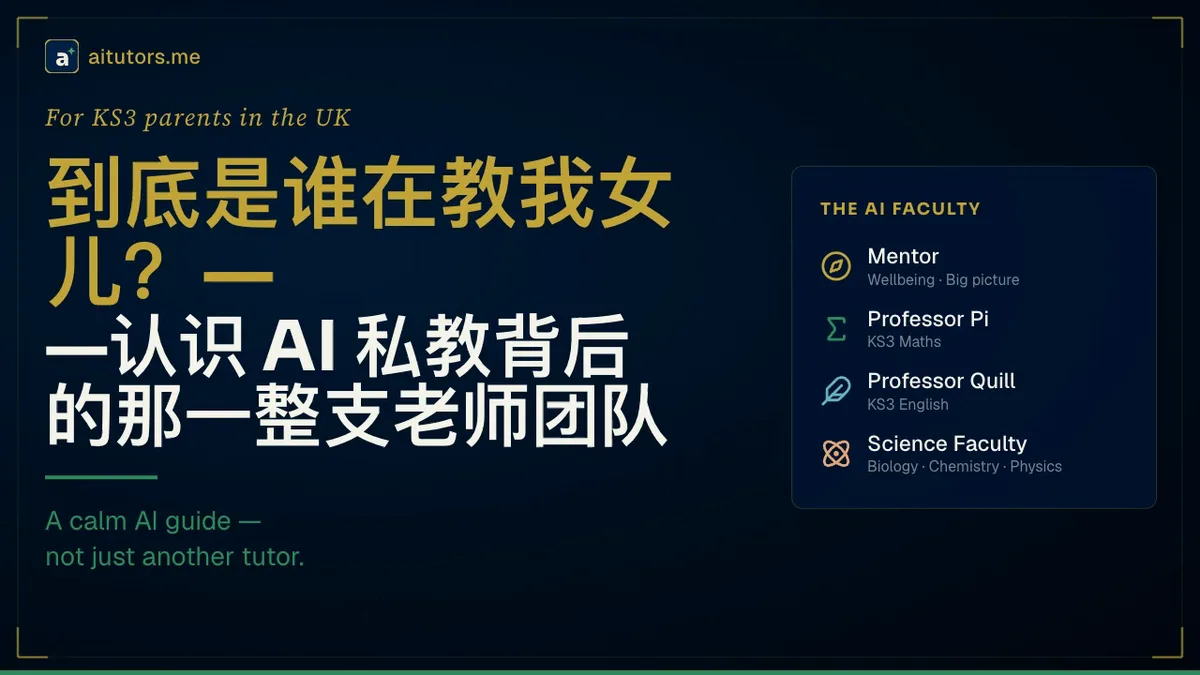
认识教师团队
深度介绍十位AI导师——他们教什么、怎么教,以及为什么有效。
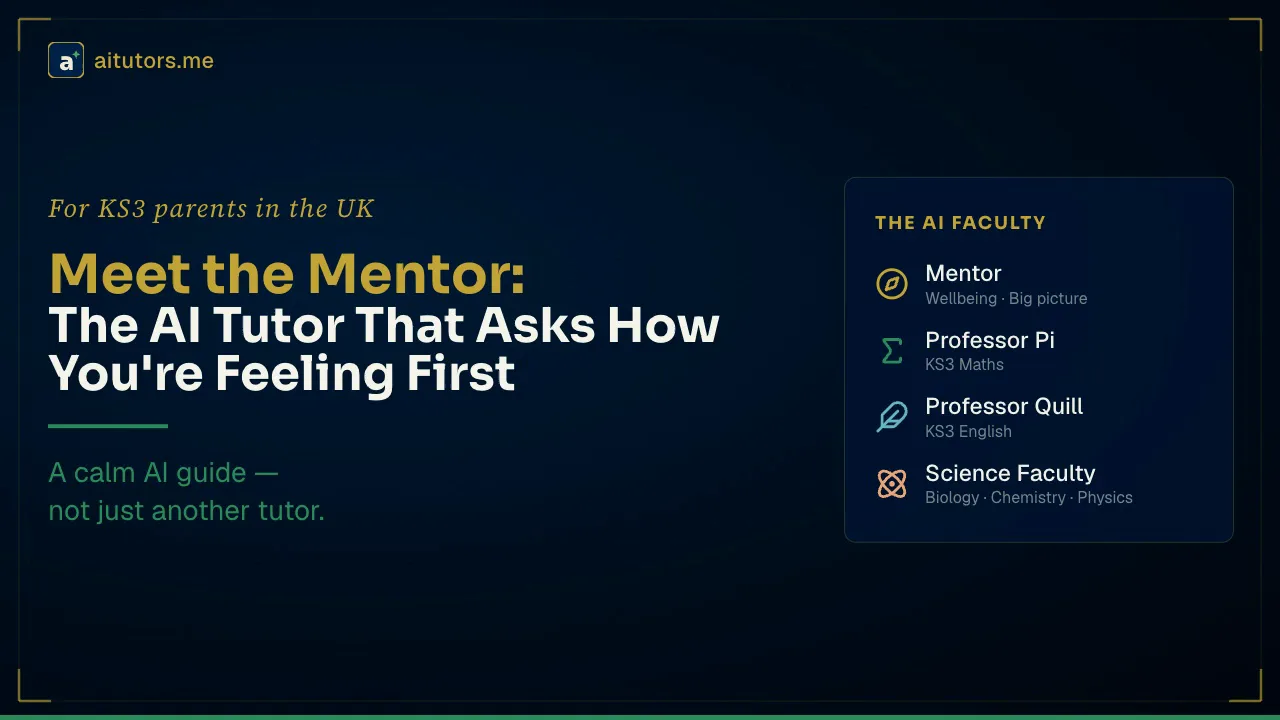
Meet the Mentor: The Tutor That Asks How You're Feeling Before Anything Else
The Mentor is the first agent every aitutors.me session meets. Not a homework helper — a gatekeeper that decides whether a session should run at all.
The Green-Amber-Red Energy Protocol: How the Mentor Decides Whether a Session Happens
The traffic-light protocol that gates every aitutors.me session. Green is full speed. Amber is light touch. Red is rest. Sleep beats sessions.
The Mentor's Safeguarding Flow: The Childline Rule, the One-Hour Parent Email, and What Happens to the Session
If a safeguarding signal fires, the Mentor stops being a tutor and becomes a signpost. Here's the exact flow — the hard rule, the parent email, the data.
Meet Professor Pi: The KS3 Maths Tutor That Refuses to Give You the Answer
Professor Pi is the maths tutor your child argues with — Socratic by design, allergic to answer-leakage, and sat between school maths and Olympiad.
The Four-Level Hint Ladder: How Professor Pi Refuses to Give Answers Without Being Useless
The four-step scaffolding ladder Professor Pi uses instead of giving the answer. Diagnostic question, concept hint, step nudge, worked twin.
'Show Your Working' Explained: Why Professor Pi Insists, and What It Catches
Pi asks for working before marking anything wrong. Here's why — sign errors, fraction-as-division, 'variable is the answer' — and what each misconception looks like.
Meet Professor Quill: KS3 English Without the Spoilers
Professor Quill is the KS3 English tutor that refuses to summarise Macbeth for you. He teaches close reading, voice, and analysis — not the plot.
PEEZL Paragraphs: The Five-Step Engine for KS3 Literary Analysis
PEE and PEEL have served their time. PEEZL — Point, Evidence, Explain, Zoom-in, Link — is the upgrade KS3 students need before GCSE English Literature.
Reader Response: Why There Isn't One Right Reading of a Poem
GCSE English Literature isn't a treasure hunt for the meaning the teacher already knows. Professor Quill teaches Socratic, reader-response analysis — and it scores better.
Meet Professor Darwin: KS3 Biology as Systems, Not Lists
Most KS3 biology tutoring is taxonomy and memorisation. Professor Darwin teaches biology the way it actually works: as connected systems across scales.
Scale Bridging in Biology: Why Most KS3 Problems Are Scale Problems
From molecule to ecosystem, KS3 biology lives at five different scales. Professor Darwin teaches students to move between them on demand — most exam losses are scale failures.
Five KS3 Biology Misconceptions Professor Darwin Was Built to Unwind
Plants don't get their food from the soil. Blood isn't blue inside your body. Evolution has no goal. Five KS3 misconceptions that wreck biology marks — and how Darwin re-teaches them.
Meet Professor Newton: KS3 Physics That Makes You Predict First
Professor Newton is the KS3 physics tutor that won't explain anything until you've guessed. Predict-Observe-Explain is how physics intuition actually gets built.
Predict-Observe-Explain: How Professor Newton Builds Physics Intuition
Predict-Observe-Explain is a 30-year-old physics-teaching method that almost nobody uses one-to-one. Professor Newton does. Here's how it works, with a worked example.
Why Newton Teaches Forces First, Then Energy, Then Motion
Most KS3 physics schemes teach motion before forces. Professor Newton reverses that. Here's why the sequence matters and why most students struggle without it.
Meet Prof Curie: Atoms Before Stoichiometry, Always
Prof Curie teaches KS3 chemistry conceptually before mathematically. Why the particle model has to land before the numbers do, and what that looks like in a session.
Models-First Chemistry: How Prof Curie Teaches the Picture Before the Numbers
Bohr atoms, particle diagrams, equation skeletons. How Prof Curie uses visual models to make KS3 chemistry land before introducing ratios, moles, and stoichiometry.
The KS3 Chemistry Vocabulary Cliff (And How Prof Curie Climbs It With Your Child)
Ion. Isotope. Mole. Oxidation. Displacement. KS3 chemistry vocabulary is a cliff most students slide off. Here's how Prof Curie front-loads the words that unlock everything else.
Meet Prof Mercator: Geography Is Place Plus Process, Not Lists of Rivers
Prof Mercator teaches KS3 geography as 'place + process' — every location tied to how it got that way, every topic tied to live news. Why he's not a memorise-the-capitals tutor.
Place and Process: The Spine of Prof Mercator's Geography Teaching
Every geography topic is two things bolted together — a place (where + what's distinctive) and a process (how it got that way). Here's how Prof Mercator pairs them.
How Prof Mercator Uses Current Events Without Becoming a News Engine
Floods, COP, supply chains, urbanisation. How Prof Mercator integrates live news into KS3 geography topics without slipping into news-summary mode.
Meet Prof Harari: Cause and Consequence Over Names and Dates
Prof Harari teaches KS3 history as cause and consequence, not memorising names and dates. Where he fits in the 1066-to-1900s KS3 timeline and how he differs from textbook history.
Primary Sources Teens Can Actually Read: Prof Harari's Curation Philosophy
Which primary sources are genuinely readable at Year 7-9 level, and how Prof Harari scaffolds them. Source work for KS3 students without the usual translation pain.
Why Did This Happen? Prof Harari's Causation Framework for KS3 History
Short-term causes, long-term causes, contingent factors. Prof Harari's framework for the most common KS3 history question — and how he teaches it without it becoming a checklist.
Meet Prof Turing: Pencil Before Keyboard, Always
Prof Turing teaches KS3 computing with a pen and paper before any code is typed. Why algorithms get drawn before they're written, and what that looks like in a session.
Algorithms Drawn Out: Prof Turing's Pencil-First Method for KS3 Computing
Flowcharts, pseudocode, dry runs. How Prof Turing teaches algorithm design on paper before any code is written — with a worked KS3 example.
The Five KS3 Computing Concepts Every Student Needs (And Prof Turing's Progression)
Variables, loops, conditionals, abstraction, decomposition. The five concepts that unlock KS3 computing — and the order Prof Turing teaches them in.
Meet Professor Abel: For Kids Who Already Love Maths
Professor Abel is the competition maths tutor — JMC, IMC, BMO, olympiad territory. Where Professor Pi ends, Abel begins. The criterion is elegance.
JMC, IMC, BMO: How Professor Abel Structures Competition Maths Prep
The actual six-week structure Professor Abel uses to prepare KS3 students for UKMT challenges and beyond — past papers, mock conditions, sensible sequencing.
Elegant Solutions and Mathematical Taste: What Professor Abel Is Actually Teaching
Abel teaches 'mathematical taste' — the felt sense of when a proof is beautiful, which approach is simplest, why elegance matters far beyond the competition.