The Feynman technique works in maths when you explain why a method gives the right answer, in plain words and with small numbers, instead of just listing the steps. If you can only say "keep, change, flip", you have a rule. If you can say why flipping works, you have understanding. Understanding is what lets you handle the question that looks a bit different on the test.
This guide is for you if you are in Year 7, 8 or 9. We will walk through one full example, dividing fractions, and then a quick one on negative numbers.
What does "explain it" mean in maths?
In most subjects, explaining means telling the story of an idea. In maths it means something more exact. You explain a method when you can answer three questions:
- What is the question really asking? Put it in everyday words.
- Why does each step help? Not "because that's the rule". A reason.
- How would I check it? With small numbers, or a drawing.
The popular "Feynman technique" has four steps: pick a topic, explain it simply, find where you get stuck, then go back and simplify. Richard Feynman, the physicist, never wrote those four steps down himself. Other writers summarised them later from how he worked. But the habit behind them was very much his: he did not trust that he understood something until he could explain it plainly. If you want the steps in detail, read the four Feynman steps, explained simply.
A worked example: why do we flip when dividing fractions?
Here is a real Year 8 question:
Work out 3/4 ÷ 1/8.
Meet Sam. Sam picks the topic and tries to explain it out loud, as if to a younger cousin.
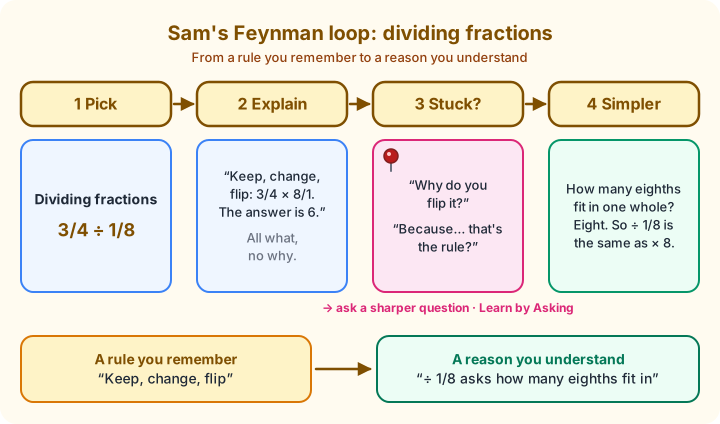
The stuck point “why flip?” is where a memorised rule turns into a reason.
Step 1 – Pick
Sam writes the topic at the top of a blank page: Dividing fractions.
Step 2 – Explain
Sam says: "You keep the first fraction, change the divide to a times, and flip the second fraction. So 3/4 ÷ 1/8 becomes 3/4 × 8/1. Three times eight is 24, four times one is 4. 24 over 4 is 6. The answer is 6."
The answer is right. But listen to the explanation. It is all what, and no why.
Step 3 – Stuck?
The younger cousin (or a parent, or a curious friend) asks one honest question: "Why do you flip it?"
Sam stops. "Because… that's the rule?"
This is the stuck point. It is the most useful moment in the whole exercise. Sam puts a mark next to "flip" on the page. Now Sam knows exactly which part is memorised rather than understood. You can read more about why this moment matters in where you get stuck is where you learn.
Step 4 – Simpler
Sam goes back to the source (the textbook) and tries smaller numbers.
First, Sam says what division means in everyday words. Dividing asks: "How many of these fit into that?" 12 ÷ 3 asks how many threes fit into 12. The answer is 4.
Now a fraction with tiny numbers: 1 ÷ 1/3. How many thirds fit into one whole? Picture a chocolate bar snapped into three equal pieces. There are 3 pieces. So 1 ÷ 1/3 = 3.
Notice something. Dividing by 1/3 gave the same answer as multiplying by 3. That is because each whole holds three thirds.
Back to the real question. How many eighths fit into one whole? Eight. So how many eighths fit into three quarters? Three quarters of eight, which is 6.
Sam checks with a drawing. Draw a bar split into 8 equal parts. Three quarters of the bar is 6 of those parts. So 6 eighths fit into 3/4. It checks out.
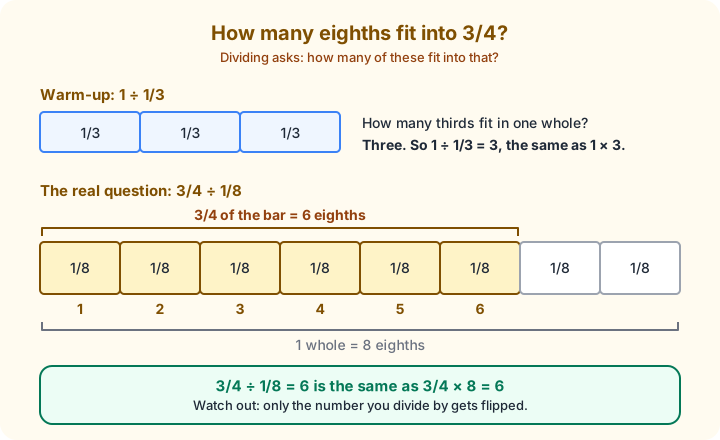
Dividing by 1/8 asks how many eighths fit in, which is why it equals multiplying by 8.
Now Sam can explain the "flip" in one sentence:
"Dividing by 1/8 asks how many eighths fit in. There are 8 eighths in every whole, so dividing by 1/8 is the same as multiplying by 8. That's why we flip 1/8 into 8/1."
That is a real explanation. It uses plain words. It has a picture. And Sam could rebuild the rule from scratch if they forgot it.
Watch out: a common mistake is to flip the first fraction, or both. If you know why you flip, you know only the divisor (the number you divide by) gets flipped, because that is the "how many of these" part.
A quick second example: negative numbers
Another favourite stuck point in Year 7 is this:
5 − (−3) = ?
Most students learn "two minuses make a plus" and get 8. That is the right answer. But ask why, and things go quiet.
Try this simple picture. Think of a number line as a thermometer. Subtracting means "find the gap" or "take away". Taking away −3 is like taking away a debt of £3. If someone cancels a £3 debt you owed, you are £3 better off. So 5 − (−3) = 8.
Analogies like this help, but every analogy breaks somewhere. The debt picture works well for adding and subtracting. It gets clumsy for multiplying negatives. That is normal. For more on building pictures that work, see how to build analogies that make ideas click.
Five maths topics worth explaining, not just practising
These KS3 topics all have a "why" that students often skip:
- Equivalent fractions. Why does multiplying top and bottom by the same number not change the value? (You are cutting the same cake into smaller pieces.)
- Area of a triangle. Why half of base times height? (A triangle is half of a rectangle. Draw it.)
- Expanding brackets. Why does 3(x + 2) give 3x + 6? (Three bags, each with an x and two counters.)
- Percentages. Why is "of" the same as "times"? (Half of 10 is ½ × 10.)
- Solving equations. Why do you do the same thing to both sides? (A balance scale stays level only if both pans change equally.)
Pick one. Explain it on a blank page. Mark where you get stuck. Then go back and simplify.
Why does explaining help in maths?
Researchers call this self-explanation: telling yourself why each step works as you study. A 2018 review that combined dozens of studies (Bisra and colleagues) found that prompting students to explain to themselves had a medium-sized benefit on learning, an effect size of about g = 0.55. Many of those studies were with older students, and the size of the benefit varied. But the pattern is steady across subjects, maths included.
There is a limit, though. Explaining does not make you fast. A big 2013 review of study methods (Dunlosky and colleagues) rated practice testing and spreading practice out over time as the most useful techniques. So once you can explain a method, do a short set of questions. Then come back to it next week.
How this connects to Learn by Asking
The Feynman way is Learn by Asking when you're the one explaining. In maths, Learn by Asking comes down to a weak question versus a strong one. Before Step 3, Sam could only have asked "is this right?", and the answer was already right. The cousin's "why do you flip it?" gave Sam a strong question instead: "why does dividing by 1/8 give the same answer as multiplying by 8?" It names the exact step, so anyone helping knows where to start. See what a good question looks like in maths.
How Professor Pi uses this
On aitutors.me, Professor Pi is the maths tutor. Pi uses Socratic questions and never gives you the final answer. When you are stuck, Pi will ask you something like "how many eighths fit in one whole?" rather than tell you to flip. In Jotters, you can mark a stuck pin on your own notes, and a "Say it simply" jot can explain a step in plain words beside the exact line you are reading. But you can do every part of this guide with a pencil and a blank page.
FAQ
Can you use the Feynman technique for maths?
Yes. In maths you explain why a method works, not just what the steps are. If you can say why "keep, change, flip" gives the right answer when dividing fractions, you understand it. If you can only recite the steps, you have memorised it, and it will slip away when the question looks different.
Do I still need to do practice questions?
Yes. Explaining and practising do different jobs. Explaining finds the gaps in your understanding. Practice questions make the method quick and reliable. Use the Feynman steps on a method first, then do a short set of questions to check it holds up.
What if I can't explain why a maths rule works?
That is useful information, not a failure. Mark the exact step where you got stuck, go back to your notes or textbook for that one step, and try a tiny example with small numbers you can picture. Most "why" questions in KS3 maths can be answered with a drawing.
Duke Harewood runs aitutors.me: Socratic AI tutors for KS3, plus a free GCSE map and flashcards for Years 10–11. Updated 20 October 2026.