The Feynman technique helps in KS3 English when you explain, in plain words, what a writer's choice does to the reader, instead of just naming the technique. Spotting a metaphor gets you started. Saying what that metaphor makes you see, feel or expect is where the real understanding (and most of the marks) lives.
This guide is for you if you are in Year 7, 8 or 9 and your teacher keeps writing "explain the effect" in the margin.
Knowing the name is not knowing the thing
Richard Feynman, the physicist, told a story about his father. His father pointed out that you can know the name of a bird in every language and still know nothing about the bird. What matters is watching what it actually does. Feynman tells the story in his book What Do You Care What Other People Think?
English analysis works the same way. You can write "the writer uses personification" and still have said nothing about the writing. The label is the bird's name. The effect is what the bird does.
What does "explain it" mean in English?
In English, a good explanation of a quotation answers three plain questions:
- What do I picture? What image does the word put in my head?
- What do I feel? Tense, calm, sad, uneasy, amused?
- Why might the writer want that? How does it fit the bigger story or argument?
If those three questions look familiar, they are close to the H-F-W questions that Professor Quill uses on aitutors.me: How did you spot the technique, what does it Feel like, and Why might the writer have chosen it?
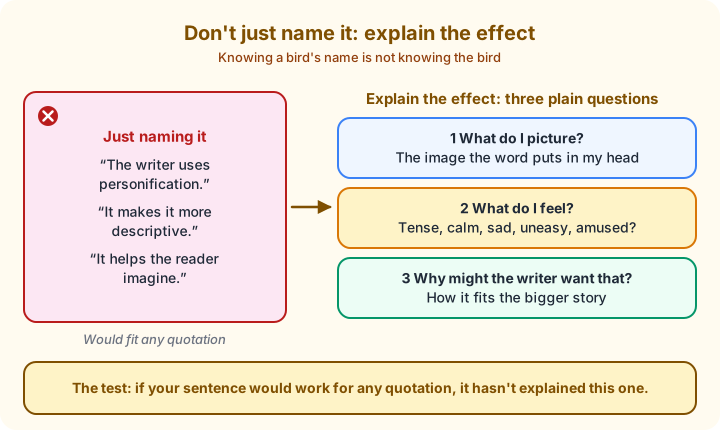
The label is the bird's name; the effect is what the bird does.
The well-known "four-step Feynman technique" (pick, explain, find where you get stuck, simplify) is a later summary by other writers of how Feynman worked. He didn't write it down as a method. But it fits English very well. You can read the steps in full in the four Feynman steps, explained simply.
A worked example: explaining a quotation
Here is a sentence from a made-up Year 8 extract:
The wind howled through the empty streets.
Meet Priya. She is writing a paragraph about how the writer creates a lonely, uneasy mood.
Step 1 – Pick
Priya picks one quotation, not the whole extract. One quotation is enough for one explanation.
Step 2 – Explain
She explains out loud, as if to a friend: "The writer uses personification because the wind is howling, and wind can't really howl. This makes it more descriptive and helps the reader imagine the scene."
Step 3 – Stuck?
Her friend asks: "More descriptive how? What do you actually imagine?"
Priya pauses. She doesn't know. "It just… describes it more?"
This is the stuck point. "It makes it more descriptive" and "it helps the reader imagine" are the two most common stuck phrases in KS3 English. They sound like an explanation, but they would fit almost any quotation ever written. That's the test: if your sentence would work for any quotation, it hasn't explained this one.
Step 4 – Simpler
Priya goes back to one word: howled.
- What do I picture? Who howls? A wolf. A dog left alone. A person crying out in pain.
- What do I feel? Howling is a lonely sound. It is usually a cry that nobody answers. It makes me a bit uneasy.
- Why might the writer want that? The streets are empty. So the only "voice" in the scene is the wind, and it sounds like it is in pain or calling out. The town feels abandoned and a little threatening.
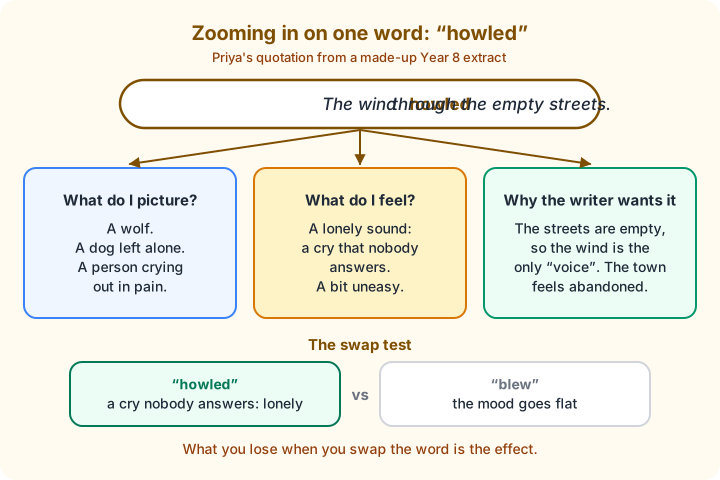
One word, three plain questions, and a swap test to prove the word is doing the work.
Now she can build a proper paragraph using PEEZL (Point, Evidence, Explain, Zoom in, Link):
Point: The writer makes the town feel lonely and uneasy. Evidence: "The wind howled through the empty streets." Explain: The wind is personified as if it is a living creature crying out. Zoom in: The verb "howled" suggests a wolf or a person in pain, a cry that nobody answers. Because the streets are "empty", the howl is the only sound, which makes the place seem abandoned. Link: This lonely mood prepares the reader for the character feeling isolated later in the extract.
Look at the difference. The first version named a technique. The second version explains what one word does, and why it matters here and nowhere else.
Watch out: don't zoom in on a word that does no work. "The" and "through" are not worth a paragraph. Zoom in on the word that, if you changed it, would change the feeling. Try swapping "howled" for "blew". The mood goes flat. That tells you "howled" is doing the work.
Three tricks for saying it simply in English
- The swap test. Replace the key word with a plainer one. What is lost? That loss is the effect.
- The "so what?" chain. After every sentence you write, ask "so what?" once. Answer it. Then stop. Two links of "so what?" is usually enough for a KS3 paragraph.
- Say it to a ten-year-old. If you can't explain the effect to a younger sibling without jargon, you haven't got it yet. More on this in how to explain anything to a ten-year-old.
Jargon is still useful. "Personification", "sibilance" and "semantic field" are real tools. But use the term after you have explained the effect in plain words, not instead of it.
Why explaining helps in English
Researchers call talking yourself through an idea self-explanation. A 2018 review that pooled many studies (Bisra and colleagues) found a medium-sized benefit, with an effect size of about g = 0.55. Most of those studies were in maths and science rather than English, so be a bit careful with that number here. Still, the reason it works is the same: explaining forces you to notice what you don't understand yet.
The Education Endowment Foundation, which reviews evidence for UK schools, rates teaching students to plan, check and evaluate their own thinking (metacognition) as worth about seven months' extra progress on average. Spotting your own "it makes it more descriptive" moment is metacognition in action.
How this connects to Learn by Asking
The Feynman way is Learn by Asking when you're the one explaining. In English, Learn by Asking means questioning a text instead of summarising it. "It makes it more descriptive" is a summary-sized answer: it says there is an effect but asks nothing. Her friend's "more descriptive how?" pushed Priya to ask her own sharper questions about one word: what do I picture, and why might the writer want that? The swap test is a question too: what changes if "howled" becomes "blew"? Ask the same of your own paragraph: does my Explain sentence unpack the quote, or just repeat the Point? More in questioning a text, not just summarising it.
Using your own words
In English, your voice is the point. That is why Professor Quill on aitutors.me never writes or rewrites your paragraph. Quill asks questions until you find the effect yourself.
If your class extract is a PDF or a worksheet photo, Jotters lets you jot beside the exact words, so your explanation sits next to the quotation it explains. Read more in Feynman notes: jot beside the text, don't copy it. A jot will never write your homework answer for you. But a pencil and the margin of your printout work just as well.
FAQ
How do you use the Feynman technique in English?
Pick one quotation, explain out loud what it does to the reader, and notice where you fall back on vague words like "it makes it more descriptive". That vague phrase is your stuck point. Go back to the single word that matters and ask what it makes you picture, feel or expect.
Is naming the technique enough to get marks?
Not on its own. Naming personification or a metaphor shows you spotted it. The marks in KS3 and GCSE English mostly go to explaining the effect: what the word makes the reader see or feel, and why the writer might have chosen it.
What is PEEZL?
PEEZL is a paragraph structure: Point, Evidence, Explain, Zoom in, Link. The Feynman steps fit inside the Explain and Zoom parts, where you say plainly what one word does and test whether your explanation actually holds up.
Duke Harewood runs aitutors.me: Socratic AI tutors for KS3, plus a free GCSE map and flashcards for Years 10–11. Updated 20 October 2026.