You've seen your child's quiz result. You think it might actually explain a few things. Now comes the tricky part: bringing it up without them shutting down completely.
If you've ever tried to start a meaningful conversation with a teenager about how they learn, you'll know it can go sideways fast. The goal here isn't to get your child to agree with the result. It's to open a door. Here's how to do that without it feeling like a parent ambush.
Choose your moment carefully
This sounds obvious, but it's the step most parents skip. Don't bring up the Learning Genius result while they're mid-homework, mid-argument, or mid-anything stressful. Also avoid the car journey to school, where they're already in "endure the morning" mode.
The best moments are genuinely calm ones. A weekend morning before anyone's in a rush. A walk. A quiet stretch after dinner when phones are down. You want them to feel like they have space to respond — not like they're being cornered.
If you're not sure when that is, start by noticing when your teenager is most open. Some kids are talkers in the evenings. Others are surprisingly receptive right after a meal. You know your child better than the quiz does.
Share your own type first
This is probably the single most effective thing you can do. Before you say anything about their result, share yours.
It doesn't matter whether you took the same quiz or a different one. The point is to go first — to model what it looks like to be curious about your own patterns without it being a crisis.
Something like: "I took a version of this too, and I came out as the Deep Owl — apparently I can't move on from anything until I understand it properly. I found that really accurate actually. I still remember spending three hours on one maths problem at school when I should have just moved on."
When you go first, you're doing two things. You're showing them it's not a trap. And you're making it mutual — an exploration you're both in, not a report you're delivering.
How to handle the three most common responses
Teenagers tend to react to this kind of thing in one of three ways.
They're curious and engaged. Some teenagers — especially those who tend towards introspection — will be genuinely interested. They might want to know more about their type, compare notes, or ask whether you think it sounds like them.
If this is your child, lean in. Ask questions rather than explaining. "What parts feel right to you?" is more useful than a monologue about what the Sharp Eagle means. Let them lead.
They're sceptical. You might hear something like "This is basically Hogwarts sorting" or "These things are always vague enough to fit anyone."
Don't argue. Scepticism is a healthy response, and frankly, it's not entirely wrong as a general rule. What you can say is: "Fair enough. I was sceptical too. But I found it interesting as a starting point — like, even if it's not perfect, it made me think about how I approach things when I'm stuck."
You're not trying to convert them. You're just keeping the door open.
They're upset or defensive. This is the response that tends to catch parents off guard. Some teenagers hear a typed description of themselves and feel boxed in — like they're being reduced to a label. If your child says something like "I don't want to be told what kind of learner I am" or goes quiet in a way that feels hurt rather than bored, take that seriously.
What helps here is honesty. "That's completely fair. This isn't meant to define you — it's just one way of looking at things. You're way more complicated than any quiz." And then, genuinely, drop it. Coming back to it another time, more gently, works better than pushing through the discomfort.
Language that works — and language that backfires
The most common mistake parents make is using the result to explain past behaviour. Things like:
- "That's why you always do that."
- "This explains so much about you."
- "See, I knew you were like this."
Even when these are said warmly, they land as judgements. Your teenager hears: "I've figured you out." That's not a conversation — it's a conclusion.
What opens doors instead:
- "I found this interesting about myself when I read it — made me think about how I study."
- "Does any of this feel like you, or does it feel off?"
- "What would you change about this description?"
Notice the difference. The first set is you telling them who they are. The second set is you asking them to help you understand. Teenagers are generally much more willing to engage when they feel like the expert on themselves — because they are.
Avoid the word "type" if it makes them twitchy. Some kids respond better to "your learning style" or just "the way you tend to work best."
Using the AI tutors together
If the conversation goes reasonably well, there's a natural next step. The AI tutors on aitutors.me read your child's Learning Genius before they respond — it changes how they explain things, not what they teach. A Sparky Fox gets shorter bursts and more variety. A Deep Owl gets the full picture, not just the method.
Frame this as something you're both trying out rather than a system you've signed them up for. "Want to see if the tutor actually talks to you differently? We could try a question from their homework and see."
That's low-stakes. It's curious. And if the tutor does happen to nail something about how your child likes to learn, that tends to do more work than any conversation you could have had.
The outcome that actually matters
The best result of this conversation isn't your teenager saying "Yes, that's exactly me."
It's them saying something — anything — about how they experience learning. A complaint about how their teacher explains things. A subject they find easier than they expected. A moment when something finally clicked.
That's the conversation. The Learning Genius is just the opener. What you're really doing is creating a bit more room for your child to tell you what it actually feels like to be them at school — which, at 14, they're often not given many chances to do.
Go gently. Be genuinely curious. And if it doesn't land this week, try again in a month.
The diagram to share
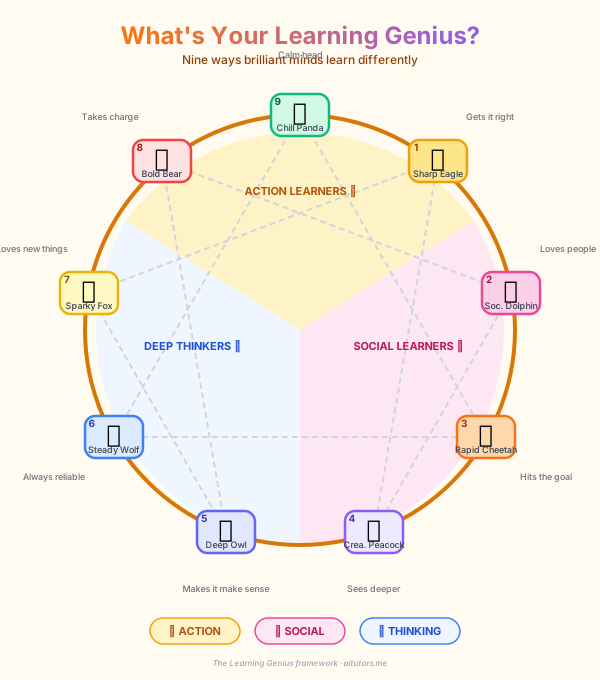
Sometimes a visual does more than words. This is the full Learning Genius map — you can show it to your teen and let them point to the animal that feels right before either of you says anything. It often opens the conversation more gently than a direct question.
Frequently asked questions
What if my teenager refuses to engage with the quiz result?
Don't push. Leave the result somewhere they can find it later — a screenshot on the family iPad, a link in a text — and let curiosity do the work. Many teenagers come back to it on their own terms, often days later.
Should I tell their teachers about their Learning Genius?
That's your call, but the more useful step first is making sure your teenager understands and accepts it themselves. A label you impose through a teacher can feel like a trap. One they own can feel like a superpower.
What if the result doesn't seem accurate?
Tell your teenager that. Genuinely. Say "I'm not sure this one fits you — what do you think?" Treating it as a starting point for discussion rather than a definitive answer tends to get better results than defending the quiz.
My child got the Chill Panda. They seem embarrassed by it. What do I say?
Reassure them that every Learning Genius has real strengths. The Chill Panda's ability to keep the peace, read the room, and support others is genuinely valuable — it just needs the right environment to show up. Then ask what parts they recognise in themselves.
The Learning Personality framework draws on established personality research. Parents wanting the full theoretical model can visit ganjiang.xyz.