Every child has a default way of taking in the world — and it shapes everything from how they revise to why certain homework nights go sideways. This guide covers all nine Learning Geniuses: what you notice at home, the trap that catches each type out, and the approaches that genuinely help.
If you already know your child's type, jump straight to that section. If you're not sure yet, the quiz at aitutors.me/quiz takes about ten minutes.
The full map
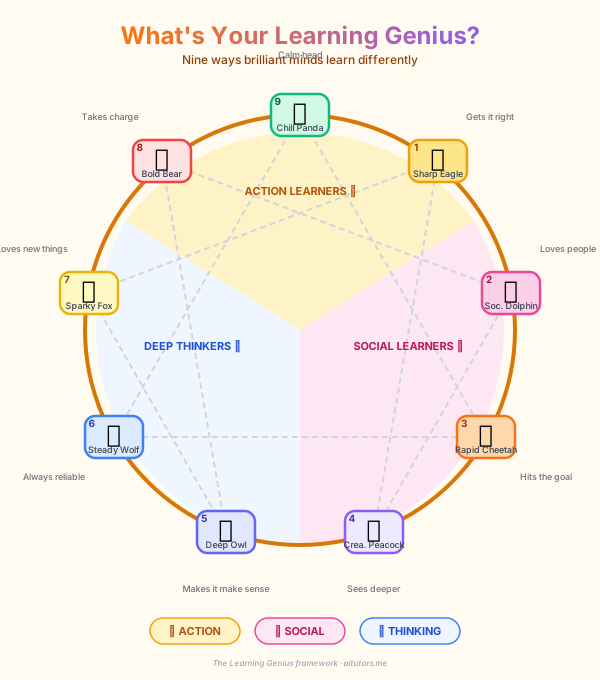
Nine types, three zones. Bookmark this diagram — it's the quickest way to see where your child's type sits relative to their classmates'.
🦅 Sharp Eagle
What you notice at home: Your Sharp Eagle redoes things voluntarily — a diagram redrawn because one label was slightly wonky, a cover page reprinted because the printer left a faint smudge. They ask for the mark scheme before starting practice papers, not to cheat but to understand exactly what's required. They get quietly furious with themselves after making avoidable errors.
The study trap: Perfectionism eats time. They'll spend 45 minutes polishing one paragraph and run out of steam before the rest of the essay exists.
What helps: Separate "good enough to move on" from "final quality". Timers on individual tasks work well — not to rush them, but to make the trade-off explicit.
What backfires: Telling them not to worry about small mistakes. They will worry. Acknowledge the standard they're holding themselves to, then help them prioritise which things actually warrant it.
🐬 Social Dolphin
What you notice at home: They want to talk through what they learned at school — not to perform, but because explaining it out loud is how it becomes real for them. Revision alone in their room is genuinely painful. They'll text a friend to "study together" and then spend most of the time chatting, which isn't entirely wasted.
The study trap: Independent exam preparation. They coast through group work at school and then hit Year 10 mocks without having built any solo study habits.
What helps: Let them teach you. An explanation at the dinner table counts as revision for a Social Dolphin. Study groups with clear tasks (not just "going round a friend's") also work well.
What backfires: Isolating them in their room with a textbook and telling them to focus. Compliance looks like studying but retention is poor.
🐆 Rapid Cheetah
What you notice at home: They want to know the score, the rank, the grade. They'll compete against themselves if there's no-one else to compete against. Homework gets done fast — sometimes too fast. They're energised by a challenge and visibly deflated when there's nothing to aim for.
The study trap: Speed over depth. They get the answer and move on without consolidating why it was right. This creates gaps that widen later.
What helps: Give them a target with stakes attached. "If you hit 80% on this mock paper, we'll [reward]" works better than "do your best". Personal bests are as motivating as external rankings.
What backfires: Open-ended tasks with no clear finish line. "Read this chapter" with no follow-up question loses them quickly.
🦚 Creative Peacock
What you notice at home: Their notes look like art projects. They're drawn to subjects that let them put something of themselves into the work — English, Art, Drama. They resist revision formats that feel mechanical and find mnemonics slightly insulting.
The study trap: Making revision so elaborate that it becomes the project itself. A beautifully colour-coded revision poster can take three hours and cover one topic superficially.
What helps: Channel the creativity into retrieval. Mind maps and illustrated flashcards are fine — as long as they're tested on the content afterwards, not just admired.
What backfires: Forcing them into purely linear note-taking. They'll comply and retain almost nothing.
🦉 Deep Owl
What you notice at home: They get stuck on the same concept for a long time — not because they're struggling, but because they won't accept a surface-level explanation. They ask "but why does that work?" when you just want them to memorise the formula. Homework takes longer than it should because they pursue understanding rather than completion.
The study trap: They stall on hard topics and fall behind on easier ones they've decided aren't worth engaging with yet.
What helps: Give them good explanations, not just answers. A Deep Owl who understands something thoroughly will outperform peers on exam questions they've never seen before. Don't rush that process.
What backfires: "Just learn it, it comes up every year." They won't. Rote learning without understanding is genuinely difficult for this type.
🐺 Steady Wolf
What you notice at home: They like knowing what's happening and when. Unexpected changes to routines — a supply teacher, a rearranged exam, a change of textbook — produce disproportionate stress. They do their homework at the same time every evening and get quietly unsettled when that slot disappears.
The study trap: Rigid schedules can become avoidance. If the plan says "Biology on Wednesday" and Wednesday goes wrong, they may do nothing rather than adapt.
What helps: Build predictable revision blocks and stick to them. Help them create a backup plan for disrupted days — not a rigid alternative, just a simple "if X then Y".
What backfires: Spontaneous "let's change everything" approaches to study. Variety-for-its-own-sake increases anxiety without improving outcomes.
🦊 Sparky Fox
What you notice at home: Your Sparky Fox will have started four different revision methods by Tuesday. They're genuinely excited by new approaches — apps, podcasts, flashcard systems, YouTube explainers — and equally quick to abandon them when the novelty wears off. They're bright and fast, but their attention has a short half-life.
The study trap: Endless prep without actual revision. Downloading the app is not the same as using it. Setting up the flashcards is not the same as testing on them.
What helps: Short, varied sessions with a clear output ("ten questions done" not "twenty minutes of revision"). Novelty is fine — the goal is cycling through topics, not through methods.
What backfires: Long, single-subject revision sessions. Boredom is their kryptonite and they'll find an escape.
🐻 Bold Bear
What you notice at home: They push back. If they think a teacher is wrong, they'll say so — sometimes with more conviction than tact. They resist being told what to do without a reason. Homework instructions that feel arbitrary produce genuine resistance, not laziness.
The study trap: They write off subjects where they've clashed with a teacher, deciding the subject "isn't for them" when the real issue was a personality conflict.
What helps: Frame things in terms of their own goals. "You want to do [sixth form subject] — you need this grade" works far better than "because it's required". Respect their intelligence and they'll respond.
What backfires: Pulling rank. "Because I said so" shuts down a Bold Bear faster than almost anything else.
🐼 Chill Panda
What you notice at home: They seem fine — even when they aren't. A Chill Panda will say "yeah, it's okay" about an exam they're quietly terrified of, to avoid worrying you. They avoid asking for help because they don't want to be a burden. They can coast through school without anyone noticing they've been lost since November.
The study trap: Passive learning. They sit through lessons, they complete the homework, they retain surprisingly little because they never asked the question they needed to ask.
What helps: Check in gently and specifically. "Which bit of that topic feels least solid?" gets further than "are you okay?" Make it easy to admit uncertainty — no drama, no overreaction.
What backfires: Putting them on the spot in front of others. A Chill Panda will deflect under pressure rather than reveal a gap.
Using the quiz and dashboard
The fastest way to identify your child's Learning Genius is the free quiz at aitutors.me/quiz — 30 questions, around ten minutes, results shown immediately on the parent dashboard.
The dashboard shows your child's primary Learning Genius, the behaviours most associated with their type, and how each of the aitutors.me tutors adapts for that type. Every session your child has on the platform — with Professor Pi on maths, Professor Quill on English, or any of the other subject tutors — is informed by their Learning Genius from the first message.
If you're not sure the result fits, read the two neighbouring types. One of them usually fills in the gaps. The quiz is designed to surface the dominant pattern, but most children have a secondary influence too.
The dashboard is also worth revisiting after a term. Behaviour under exam pressure can look different from day-to-day learning behaviour, and it's useful to know which version of your child you're working with at any given point in the year.
Frequently asked questions
How do I find out my child's Learning Genius?
Your child takes the free 30-question quiz at aitutors.me/quiz. Results appear on the parent dashboard within a few minutes, including a summary of what their type means at home and in school.
Can a child be a mix of more than one Learning Genius?
Most children have one dominant Learning Genius with some traits from one or two others. The quiz identifies the primary type — that's the one to focus on for day-to-day support strategies.
Do Learning Geniuses change as children get older?
Core patterns tend to stay consistent, but the way they show up can shift with maturity and circumstances. A Year 7 Sparky Fox and a Year 11 Sparky Fox will look quite different, even though the underlying instincts are the same.
What if my child's Learning Genius doesn't match what I see at home?
Children often show different behaviour under pressure (exams, anxiety) than they do day-to-day. If the result feels slightly off, read the neighbouring types — one of them usually fits better. The dashboard also shows secondary tendencies.
Should I tell my child's school about their Learning Genius?
It can be a useful conversation starter with a tutor or SENCO, especially if your child is struggling. Frame it as "this is how she tends to approach problems" rather than a label — teachers respond better to observations than categories.
The Learning Personality framework draws on established personality research. Parents wanting the full theoretical model can visit ganjiang.xyz.