For Parents
Trust, safety, value — answers to the questions parents ask before signing up for an AI tutor.
Is AI Tutoring Safe for Kids? A UK Parent's Guide
What every UK parent should ask before signing their child up for an AI tutor: data, safeguarding, age limits — measured against the ICO Children's code, DfE guidance and Ofcom's data on what children actually do.
AI Tutor vs Human Tutor: Which Is Right for Your Child in 2026?
Side-by-side comparison of AI tutors and human tutors for UK secondary students — cost, depth, motivation, scheduling. Most families benefit from a blend.
How AI Homework Helpers Avoid the Cheating Trap
ChatGPT does the homework. A Socratic AI tutor refuses to. Here's how anti-cheating is built into the design of the right kind of AI tutor.
UK GDPR and Your Child's AI Tutor: What to Ask Before Signing Up
UK GDPR sets a high bar for processing children's data. Five questions reveal whether an AI tutor meets it — and where the easy wins are.
Preventing Burnout in Busy Teens: Why Your Tutor Should Know Their Week
Over-scheduled teens burn out when tutors don't know their week. The fix: energy-aware tutoring that adapts to football on Wednesday and a maths test on Friday.
What to Look for in a KS3 Tutor in 2026
KS3 is the foundation for GCSE. Six things to check before paying for a KS3 tutor in 2026 — curriculum alignment, Socratic method, schedule fit, and price.
My Child Wants to Chat, Not Study: What a Good AI Tutor Does
Your child opens the tutor and wants to talk about Disney, not algebra. A good AI tutor neither caves into a chatbot nor coldly refuses — it bridges, then rests.
Interest-Based Learning: Turning 'I Only Want Disney' Into Study
A child's obsession — Disney, football, Minecraft, the dog — is the best teaching material you have. Here's how interest-based learning turns it into real KS3 study.
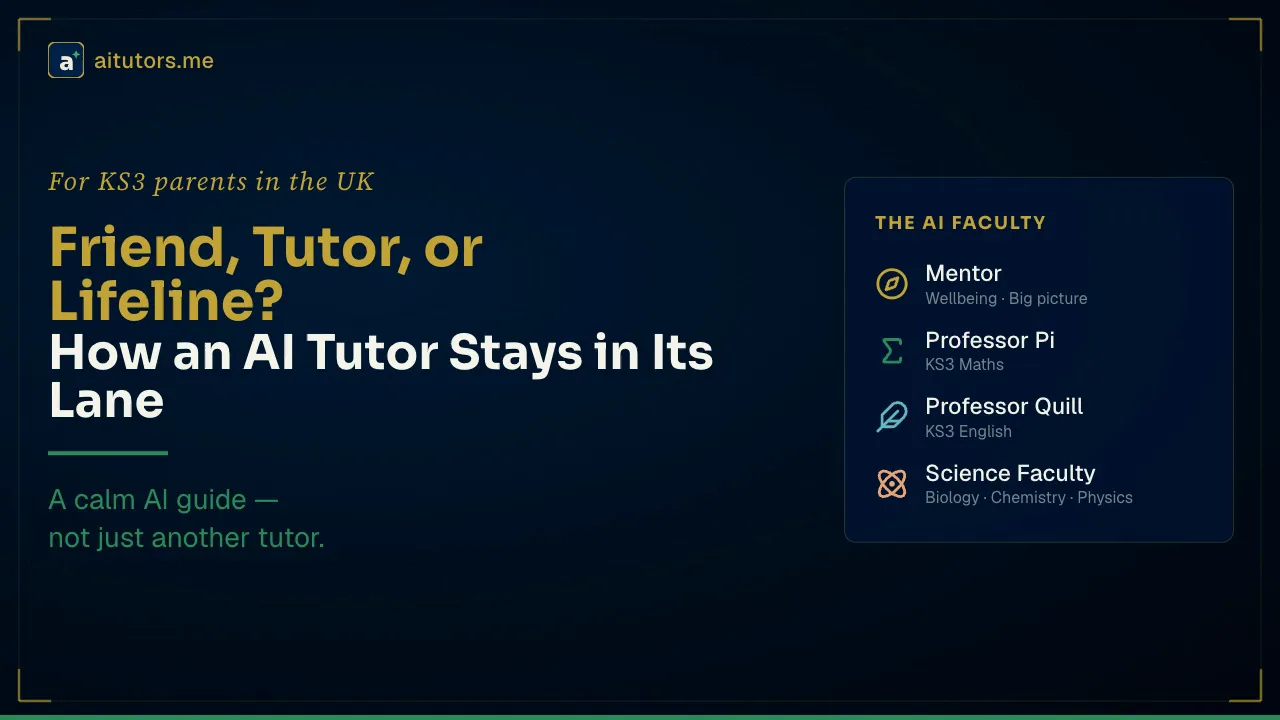
Friend, Tutor, or Lifeline? How an AI Tutor Stays in Its Lane
Companion AI for children is a real safeguarding worry. Here's how a tutor stays a tutor — bounded, never a friend — and the bright line where genuine distress changes everything.
Passwords, Lockouts and Peace of Mind: Keeping Your Child's Account Safe
Your child's aitutors.me login is one you control — you set the password, you can reset or revoke it, and failed attempts lock the account. Here's how the safety model works.
Siblings: Share an Account or Separate?
One subscription covers all your children, but should siblings share a single login or each have their own? A plain-English decision guide based on age, device and temperament.
How Much Screen Time Is AI Tutoring, Really?
A fair worry: isn't an AI tutor just more screen time? In practice it's short, bounded sessions, an energy system that caps busy weeks, and printable worksheets that move real practice off the screen.
Do Points and Rewards Just Bribe My Child?
Points and reward shops can feel like bribery. Here's the honest line between paying a child to perform and recognising real effort — and how aitutors.me stays on the right side of it.
Printable Worksheets: Learning Away From the Screen
Your child's AI tutor can make printable worksheets and pedagogy cards for pen-and-paper practice — then pick up the working when they come back. Here's how off-screen study fits in.
Three Questions That Reveal Whether an AI Tutor Is Actually Personalised
Nearly every AI tutoring app claims 'personalised learning.' Ask these three questions during a free demo to find out which ones actually change what your KS3 child sees next.