You've probably sat next to someone in a revision session and thought: how are we even studying the same subject? One person's flipping between five topics, one person won't move until they've fully understood one equation, and someone else is quietly rewriting their notes in colour-coded columns. Nobody's doing it wrong. They just have different Learning Geniuses.
Here's what that actually looks like — and why it matters more than you might think.
The revision session that goes off the rails
Picture this. Four of you in the library, Geography mock on Thursday. You've got an hour.
Sparky Fox — let's call her Maya — lasts about eight minutes on coastal erosion before she says "right, can we do climate zones? I just remembered something about the Sahel." She's not being annoying on purpose. Her brain genuinely lights up at new angles. The problem is she'll have touched seven topics by the end of the hour and fully absorbed maybe two.
Across the table, Deep Owl — let's call him Reuben — physically cannot move on. He has three questions about longshore drift and until those are answered, nothing else is going in. He finds Maya's topic-hopping almost painful. It feels like building a house and leaving the foundations unfinished.
Meanwhile Rapid Cheetah — Priya — just wants to know what's going to be on the exam so she can drill those specific things. She came with a list. She's already annoyed that fifteen minutes have passed without a single practice question.
And in the corner, Chill Panda — Ollie — is saying "yeah, whatever you lot want to do" and genuinely meaning it. He's fine with any structure as long as there isn't any conflict about the structure.
Four people, one hour, one subject, four completely different experiences of the same revision session. Sound familiar?
The full Learning Genius map
Nine types, three zones. Once you see the whole picture it's easier to spot your own place — and to understand why the person sitting next to you in class operates on a completely different frequency.
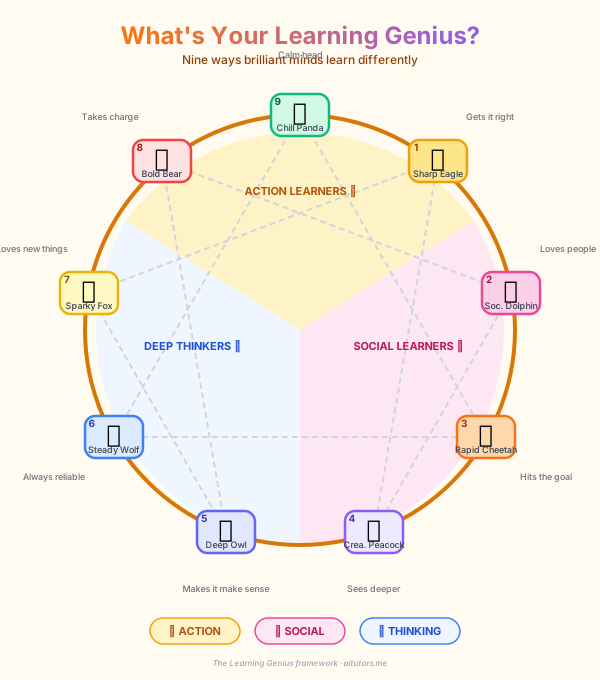
What each Learning Genius actually brings
Here's the thing none of them can quite see in the moment: they need each other.
Maya's topic-switching is irritating to Reuben, but she's the one who randomly connects coastal erosion to climate change mid-sentence and unlocks something none of them had thought about. Sparky Foxes make unexpected connections. That's not a flaw dressed up as a strength — it's a genuine cognitive gear the others don't have.
Reuben's refusal to move on feels like a brake, but when the exam actually lands, he's the one who can explain why the process works, not just that it works. Deep Owls catch the gaps everyone else glossed over.
Priya's exam-focused drilling feels narrow, but she's the reason the group actually does twelve past-paper questions instead of talking about revision for an hour. Rapid Cheetahs get things done.
And Ollie? He's the reason nobody storms off. When Priya and Reuben start having a quiet stand-off about whether to move on, Ollie finds the version of the plan that works for both. Chill Pandas hold groups together more than they ever get credit for.
The group project that nearly implodes
Different scenario. History coursework, groups of five, three weeks to produce a presentation on the causes of World War One.
Bold Bear — let's call her Tamsin — takes charge on day one. She has a structure, a deadline plan, and allocated tasks before anyone else has opened a notebook. For Steady Wolf (Marcus), this is an enormous relief. He needed someone to set the framework; now he can get on with doing his section well and consistently.
For Creative Peacock (Imogen), it's a different story. She had ideas. She wanted to do something unexpected with the format — maybe a news broadcast framing, something with visual metaphor. Tamsin's plan doesn't have room for that. Imogen feels like she's been handed a colouring-in task when she wanted to design the picture herself.
Meanwhile Social Dolphin (Jake) keeps suggesting they meet up to discuss their sections, and nobody else understands why — they could just share a Google Doc. Jake isn't being inefficient. He thinks better out loud, in dialogue. The Google Doc approach feels like working in isolation even when technically collaborating.
And Sharp Eagle (Freya) is quietly rewriting the shared introduction because there are three factual inaccuracies and one sentence that could technically be read two ways. Everyone finds this slightly annoying. The presentation is better for it.
Why identical types would actually be worse
Here's an experiment. Imagine a group of five Rapid Cheetahs doing that same History project. They'd have a plan within five minutes. They'd work efficiently. They'd hit every deadline.
They'd also almost certainly miss the nuance, skip the deeper explanation, not bother with the creative framing, and submit something that looks great on the surface but doesn't fully hold up under questioning. Nobody would catch the factual errors because everyone moved on too fast.
Now imagine five Deep Owls. Incredibly thorough. Every source triple-checked. But it's week two and they're still on the causes section because Reuben found a historiographical debate about the July Crisis that he thinks they need to fully resolve first.
Diversity of Learning Geniuses isn't just a nice idea about inclusion. It's actually how good work gets done. The Cheetah keeps the project moving. The Owl catches what the Cheetah missed. The Peacock makes it memorable. The Bear keeps everyone organised. The Dolphin makes sure nobody drifts apart.
How to actually work with someone whose nature is different from yours
You don't need to fully understand someone's Learning Genius to work with them better. You just need a few translations.
If you're a Deep Owl working with a Sparky Fox: Give them permission to explore, but agree a time limit. "Fifteen minutes of free ideas, then we lock in a structure." They'll feel heard; you'll get your foundation.
If you're a Creative Peacock working with a Bold Bear: Pitch your ideas early and framed as options, not objections. Bears respond well to "what if we also tried X?" better than "I don't like the current plan."
If you're a Rapid Cheetah working with a Chill Panda: Check in. Cheetahs sometimes run ahead assuming everyone's fine. Pandas won't always say if they're struggling — ask directly and mean it.
If you're a Social Dolphin working with someone who prefers solo work: Suggest a brief verbal check-in at the start and end of a session rather than continuous discussion. You get the dialogue you need; they get the focus time they need.
These aren't big compromises. They're just small translations.
The bigger picture
Your classroom contains nine different ways of experiencing the same lesson. The person who always asks one more question isn't slowing things down for the fun of it — they're a Deep Owl, and that's just how their understanding works. The person who's already moved on while you're still processing isn't showing off — they're a Rapid Cheetah, and sitting still feels physically uncomfortable to them.
The more you understand your own Learning Genius, the less you'll misread everyone else's.
And the more you can work with people whose nature is different from yours, the better you'll be at pretty much everything that matters after school — where teams are always mixed, problems are always multidimensional, and nobody succeeds by doing everything alone.
Frequently asked questions
Why do some students learn faster than others?
Speed isn't really the right measure. Different Learning Geniuses process information in different ways — a Rapid Cheetah might crack a problem quickly but move on before fully absorbing it, while a Deep Owl takes longer but builds rock-solid understanding. Neither is faster in the long run.
What's the best Learning Genius to have?
There isn't one. Every Learning Genius has genuine strengths and genuine blind spots. A group with all nine types represented will almost always outperform a group of identical types — because problems have different dimensions and different natures see different angles.
How do I figure out my own Learning Genius?
Take the free 30-question quiz at aitutors.me/quiz. It takes about five minutes and your results go straight to your parent dashboard.
What if my Learning Genius changes?
Your core nature stays pretty stable, but how it shows up can shift depending on stress, the subject, or the teacher. Think of it less as a label and more as a default setting — useful to know, not a cage.
The Learning Personality framework draws on established personality research. Parents wanting the full theoretical model can visit ganjiang.xyz.