You've done the revision. You've read the notes three times. You've written the practice answers. And yet, the night before the exam, some part of your brain is still asking: "But what if it's not enough?"
That question isn't stupidity. It isn't weakness. It's just how Steady Wolves are built — and understanding that is the first step to making it work for you rather than against you.
What makes you a Steady Wolf
Your Learning Genius is built on reliability. When there's a group project, you're the one who actually shows up. When there's a deadline, you don't leave it to chance. You keep notes, you follow through, and you care about doing things properly — not to impress anyone, but because doing things well matters to you.
That's genuinely rare. Teachers notice it. Classmates depend on it more than they probably say.
You're also good at spotting problems before they happen. While others charge ahead, you're the one thinking "yes, but what about..." — and often you're right. That kind of careful thinking is valuable in exams, in group work, and eventually in the kind of jobs that actually matter.
You're loyal to the people you work with. You remember who helped you, and you show up for them. Learning alongside people you trust brings out the best in you.
The traps Steady Wolves fall into
Here's where it gets honest — because knowing your traps is just as important as knowing your strengths.
Over-preparing the unlikely stuff. You've covered the core material. But because you're worried about being caught out, you spend the last two days going deep on the one obscure topic that probably won't come up, while the likely questions don't get another pass. Your revision energy follows your anxiety, not the actual exam.
Catastrophising before you walk in. "What if I forget everything?" "What if my mind goes blank?" "What if the questions are completely different to what I practised?" These thoughts feel very logical when your brain is running threat assessments. But they're not predictions. They're your nervous system doing its job — just a bit too enthusiastically.
Needing reassurance before you submit. You've written a solid answer. You read it back and it seems fine. But you still want someone to tell you it's good before you hand it in. That reassurance-seeking isn't always possible in exam conditions — and the habit of needing it can leave you stuck when you're on your own.
None of this makes you a bad student. It makes you a Steady Wolf student. The strategies below are built around working with that — not pretending to be someone else.
What actually helps
Use practice tests as evidence, not self-assessment
Here's the reframe that changes everything: a timed practice test is not a test of whether you're good enough. It's evidence gathering.
When you sit a 20-minute timed chunk on simultaneous equations — or whatever it is — you're collecting data. What did you get right without hesitation? What did you get stuck on? What did you panic about that turned out to be fine?
That data is concrete. It's real. "I completed 8 out of 10 questions correctly under timed conditions" is a fact. It counters "what if I forget everything" far more effectively than any amount of re-reading your notes.
Keep a log of these mini-tests. Not to judge yourself — to build a file of evidence that your brain can go back to when doubt shows up.
Try before you ask for help
Steady Wolves often want to be sure they're doing something right before they try it. The problem is that certainty usually comes from doing it, not before.
When you're working with Professor Pi or Professor Quill, use the hint system before asking for the answer. The structured hints are there specifically so you can check your thinking step by step — without the full pressure of being wrong. That's a safety net, not a shortcut. Use it.
The discipline is: attempt it first. Even if you're not confident. Especially if you're not confident. The attempt is the thing that moves you forward.
Journal your worries before a big exam
This sounds unusual but it genuinely works — and there's research behind it.
The night before (or morning of) an exam, write down everything you're worried about. Not in a "dear diary" way. Just a list. Every "what if", every fear, every gap you're worried exists.
Then go through the list and mark each one: real or imagined.
Real: "I haven't practised the extended writing question format." — Fine, do one now, or make peace with it.
Imagined: "What if I just completely forget how photosynthesis works even though I've written it out six times." — That's anxiety, not evidence. Cross it out.
Separating the two shrinks the fear significantly. Most of what Steady Wolves worry about before exams is in the imagined column — not because they're irrational, but because they're thorough enough to have already covered the real gaps.
Trust the prep you've already done
This is the hardest one, and there's no trick to it. At some point, you have to decide that the preparation counts — even without a guarantee.
Your Bold Bear classmate walks in looking relaxed. It can look like they know something you don't. They don't. They just have a different relationship with not-knowing. They're okay acting before all the certainty is in. That's not better or worse than your approach — it's different wiring.
Your thoroughness means you've probably prepared more carefully than they have. What they have that you need to borrow (just for exam day) is the willingness to back yourself with what you've got.
You can't know for certain it'll be enough. No one can. But the evidence — those practice test scores, the notes you've checked, the topics you've covered — says it's pretty likely.
How aitutors.me works with your Learning Genius
Every tutor on aitutors.me reads your Learning Genius before responding. For Steady Wolves, that shapes how the tutors talk to you.
Professor Pi won't throw a full solution at you when you're stuck — that can actually make things worse, because you don't know if you could have got there yourself. Instead, you'll get hints in stages. You try. You check. You move forward with evidence rather than just answers.
Mentor — the wellbeing tutor — is worth talking to in the run-up to exams if the anxiety is building. Not because anything is wrong with you. But because having a space to separate the real worries from the imagined ones, with something that won't judge you, is exactly the kind of structured support Steady Wolves respond to well.
The short version
You are more prepared than you feel. Your doubt is not a reliable measure of your ability — it's a measure of how seriously you take this. Those are not the same thing.
Use the evidence. Run the practice tests. Write the worries down. Trust the preparation.
The exam doesn't care how anxious you felt beforehand. It only sees what you put on the page — and you've been preparing for that longer than you realise.
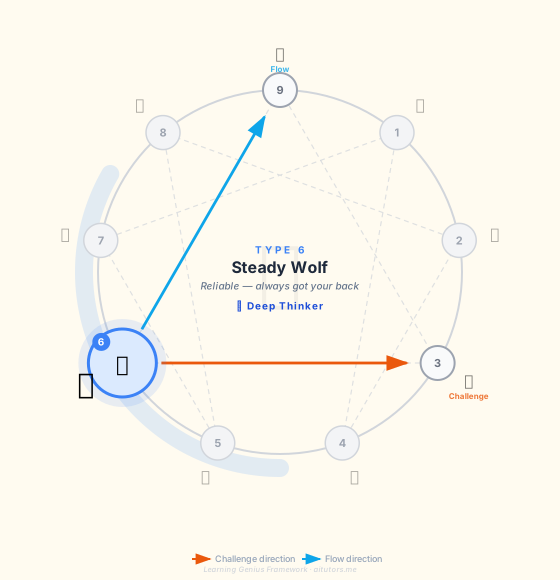
Where Steady Wolf 🐺 (Type 6) fits in the full picture
Every Learning Genius is part of a bigger map. Steady Wolf 🐺 sits in the Deep Thinkers zone alongside Deep Owl and Sparky Fox — all three share an instinct-first, action-or-connection-driven approach to learning. Seeing the whole circle helps you understand why you click with some classmates and feel completely at odds with others.
Frequently asked questions
Why do I feel so anxious before exams even when I've revised loads?
This is classic Steady Wolf territory. You've actually done the work — but your brain keeps asking "what if it's not enough?" That feeling isn't evidence you're underprepared. It's just how your Learning Genius processes uncertainty. The strategies in this article will help you separate real gaps from imagined ones.
Is it bad that I need to check my work multiple times before handing it in?
Not at all. Checking is a strength. The only trap is when it stops you submitting altogether or tips into an anxiety spiral. One structured check is smart. Seven checks because you still don't feel sure? That's your doubt talking, not your ability.
My friend never seems worried about exams. How are they so confident?
Different Learning Geniuses have different relationships with uncertainty. A Bold Bear friend doesn't feel the same need to be certain before they act. That's not better or worse — it's just different wiring. Their confidence isn't arrogance. And your thoroughness isn't weakness.
How can Professor Pi help if I'm anxious about getting maths wrong?
Professor Pi adapts to your Learning Genius. For Steady Wolves, that means offering hints in stages rather than jumping to solutions — so you can check your thinking step by step without the pressure of being wrong in front of someone. It's a safer place to make mistakes.
The Learning Personality framework draws on established personality research. Parents wanting the full theoretical model can visit ganjiang.xyz.