You see connections other people miss. Your work has something in it — a phrase, an angle, an idea — that no one else would have thought of. That's not nothing. That's rare.
The problem is school doesn't always know what to do with you.
You're asked to write in a specific format, revise from someone else's summary, and produce something that looks exactly like the mark scheme wants. And every time you try, part of you rebels. It feels like putting a painting into a spreadsheet.
If that sounds familiar, your Learning Genius is almost certainly the 🦚 Creative Peacock.
What makes you brilliant
Creative Peacocks bring something to their work that no textbook can provide: genuine perspective.
Your emotional intelligence means you understand why things matter, not just what they are. When you write an essay about a poem, you're not just spotting techniques — you're feeling the weight of them. When you learn about a historical event, you're thinking about the people inside it. That depth is a real academic asset. English, history, geography, drama — any subject that rewards interpretation is yours to own.
You also make your work memorable. A Creative Peacock's best essays stay with a teacher. They have a sentence that lands differently, a comparison that surprises, a conclusion that actually says something. That quality can't be faked. It comes from caring, from noticing, from being willing to think for yourself.
And your analogies? They're extraordinary. You explain concepts by connecting them to things you love — and that's not just good communication. It's deep understanding.
The traps Creative Peacocks fall into
None of this comes for free. There are a few patterns that genuinely hold Creative Peacocks back, and they're worth knowing about.
The beautiful-notes trap. You sit down to revise. You pick your nicest pens. You start laying out your notes like a piece of art. An hour later, you've covered half a page and your notes look incredible — but you haven't actually tested yourself on anything. The act of making the notes feel like learning when it isn't. The effort went into the aesthetics, not the recall. And by the time the notes are done, you're tired and you move on.
The perfect introduction trap. You know that feeling when you're writing an essay and you can't move on until the first paragraph is exactly right? You rewrite it four times, the clock ticks, and the rest of the essay gets rushed. Your intro might be genuinely brilliant. But a brilliant intro and a thin body scores worse than a solid intro and a strong middle.
"Maths isn't for me." This one is worth pushing back on. Maths can feel soulless to a Creative Peacock because it seems like there's no room for your perspective. You're told there's one right answer and one right method. That can feel like the subject is rejecting you before you've even started. But maths has history, pattern, elegance, and story. It just needs a different door in.
Rejecting useful frameworks. You see a structure like PEEZL and something in you resists it. It feels like a formula. Like painting by numbers. So you ignore it and write however feels natural — and sometimes that works brilliantly, but sometimes it wanders. The thing about frameworks is they don't replace your ideas. They hold them up.
Strategies that actually work for you
Use PEEZL as a creative canvas, not a cage. Professor Quill's PEEZL framework — Point, Evidence, Explain, Zoom out, Link back — isn't there to make your essays generic. Think of it as the scaffolding on a building. The scaffolding isn't the architecture; it's what lets the architecture go higher. Your Point is your genuine argument. Your Explanation is where your originality lives. Your Zoom out is where you get to say something that matters. The structure makes the space for your ideas to work.
Bring stories into subjects that feel cold. Ask Professor Pi to explain a concept as if it were a story. Try: "Can you explain simultaneous equations like I'm a character in a mystery novel trying to solve a puzzle?" It sounds daft but it works. Your brain is wired for narrative. Use it. The same applies to chemistry, physics, even grammar rules. Give them a story and they become yours.
Work with time, not against it. Before you start a revision session, write down what you're going to do and roughly how long each part gets. Twenty minutes for making notes, thirty minutes testing yourself, ten minutes on the bit you got wrong. The creative part of your brain doesn't like constraints — but creative professionals work to deadlines all the time. The constraint focuses the creativity. It doesn't kill it.
Make the ordinary mean something to you. You retain things that matter to you. So when you're learning something that feels disconnected — say, the water cycle in geography — find the angle that hooks you. What does it mean for drought? For climate? For people? Ask Professor Harari what a historical drought did to a civilisation. Ask Professor Mercator about the geography of water scarcity. Connect it to something you care about and it stops being abstract.
Give yourself permission to be imperfect first. Write the messy draft. Say the wrong thing. Do the rough sketch of the answer. You can make it beautiful afterwards. But the first version doesn't have to be what it becomes. The Creative Peacock who writes a full rough essay scores higher than the one who perfects the first paragraph.
What to make of the Sharp Eagles around you
Your classmates with the 🦅 Sharp Eagle Learning Genius drive you mad sometimes. They write neat, correct, structured answers. They don't seem to care about the feeling of things. They just want to get it right.
But here's something worth sitting with: their precision isn't a lack of creativity. It's a different kind of care. The Sharp Eagle cares about accuracy the way you care about meaning. Neither is better. Both are necessary.
When a Sharp Eagle checks their work three times, that's not anxiety — that's love for correctness. When you spend twenty minutes finding the right metaphor, that's not inefficiency — that's love for truth.
Understanding that your Sharp Eagle classmates aren't doing it wrong — they're just doing it differently — is part of what makes Creative Peacocks genuinely emotionally intelligent. You can see that people care in different ways.
That understanding, by the way, is exactly what makes a great essay.
Where Creative Peacock 🦚 (Type 4) fits in the full picture
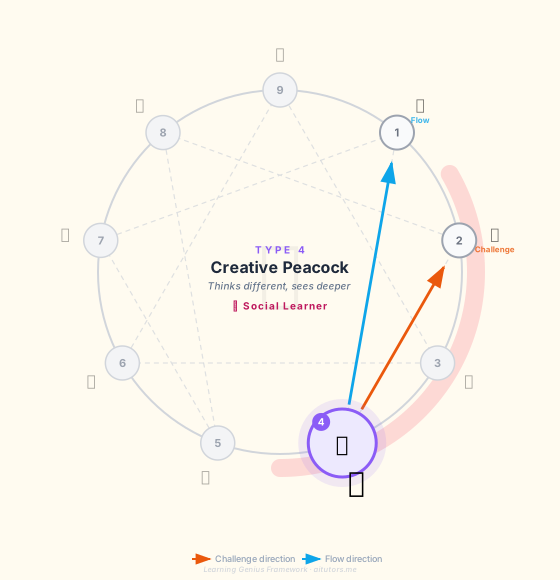
Every Learning Genius is part of a bigger map. Creative Peacock 🦚 sits in the Social Learners zone alongside Social Dolphin and Rapid Cheetah — all three share an instinct-first, action-or-connection-driven approach to learning. Seeing the whole circle helps you understand why you click with some classmates and feel completely at odds with others.
Frequently asked questions
Why do I get bored so easily with revision?
As a Creative Peacock, your brain craves meaning and originality. Generic flashcards or copying out notes feel empty because they don't connect to anything that matters to you. You need methods that let you make the material your own — analogies, stories, visuals, your own voice.
Can creative students do well in maths and science?
Absolutely. The trick is reframing. Maths isn't a cage of rules — it's a language. Ask Professor Pi to explain a formula like a story, or ask why a concept was discovered. Meaning makes the maths stick.
What is the PEEZL framework and how can I use it creatively?
PEEZL stands for Point, Evidence, Explain, Zoom out, Link back — it's Professor Quill's structure for essay writing. Rather than seeing it as a rigid template, treat it as a creative scaffold: your Point is your big idea, your Explanation is where your originality shines, and your Zoom out is where you say something genuinely interesting.
I always spend ages on beautiful notes and then run out of time. How do I fix this?
Set a strict time budget before you start. Tell yourself: 20 minutes making the notes look good, then 40 minutes testing yourself on the content. The pretty version is a reward for finishing, not a substitute for learning.
The Learning Personality framework draws on established personality research. Parents wanting the full theoretical model can visit ganjiang.xyz.