You're the one who keeps the peace, sees everyone's point of view, and never makes things awkward. That's a genuine gift. But it might also be the reason your grades don't reflect what you actually know.
If your Learning Genius is the Chill Panda, you already understand that conflict isn't worth it, that most arguments sort themselves out, and that being easy to work with matters. You're right about all of that. The problem is that some of those instincts — the ones that make you lovely in a group project — can quietly work against you when a teacher needs to see what's in your head.
Here's how to keep everything that's great about how you learn, and stop leaving marks on the table.
What makes the Chill Panda actually excellent
Before the strategies, let's be straight about the strengths, because they're real.
You stay calm when other people panic. In a mock exam week where everyone else is unravelling, you're the one who can still think. That's not nothing. That's a skill that takes some people decades to develop.
You genuinely see multiple sides. When a History essay asks you to assess whether the Treaty of Versailles caused the Second World War, you're not stuck on one view. You can hold the complexity. That's exactly what top-mark answers require.
You make people around you feel safe. In group discussions and science practicals, you're the reason the quieter members of the group actually speak. You include people without being asked to.
You think before you react. You don't blurt. When you do say something, it's usually considered and often right. The trouble is, you often don't say it at all.
The traps that catch Chill Pandas out
Going along with someone else's wrong answer. You're in a pair and your partner confidently says the Battle of Hastings was 1066. You're thinking: actually, isn't that also when William became king, but the battle was the deciding moment — so should I say something about what actually changed? Then your partner moves on and you think, well, it's probably fine. It wasn't fine. You had the more nuanced thought. You let it go to avoid friction.
"I don't know" as a shield. A teacher asks you a question directly. You know roughly what the answer is but you're not certain, and being wrong in front of everyone feels worse than admitting ignorance. So you say "I don't know." The teacher moves on. Nobody saw what you actually understood. This happens dozens of times a year and it adds up.
Under-arguing in essays. You make a point. A solid point. Then you move on to the next one, because the point felt made. But the examiner wanted to see you defend it — push it, develop it, ask yourself "so what?" and answer that question too. Stating a view and then stepping back from it is the single most common Chill Panda essay pattern. It reads as uncertainty even when it isn't.
Avoiding the friction topics. Every subject has a topic that feels like harder going — simultaneous equations, the causes of WWI, organic chemistry. For a Chill Panda, when something feels like a fight to understand, the natural response is to route around it, do the easier bits first, and come back later. Later rarely comes.
Three strategies that actually work
1. Pre-write your starting point before class.
The hardest moment in a discussion is the blank-page moment — being called on with nothing prepared. Remove it. Before any lesson where you might be asked your opinion, write one sentence in your notebook: I think the character of Macbeth is responsible for his own downfall because… or I think the economic causes of WWI were more important than the political ones because…
You don't have to be right. You don't have to finish the sentence before the lesson. But now you have something to say. You're not speaking from nowhere — you're reading from a thought you've already had. The anxiety drops considerably.
2. Use PEEZL as a scaffold for your opinion — not just in English.
Professor Quill's PEEZL framework (Point, Evidence, Explain, Zoom out, Link) is built for English essays, but it works anywhere you need to develop an argument rather than abandon it. Most Chill Pandas do the P and the E fine — they make a point, they give evidence. Then they stop. The Explain step is where your work gets its marks: what does this evidence actually show? The Zoom out step is where you ask: what's the bigger significance here?
Try it in History, Geography, Biology. Any subject where answers need to be argued rather than listed. Use it as a checklist before you submit a paragraph: have I explained what my evidence shows, or did I just quote it and hope the teacher saw what I saw?
3. Timed practice answers in writing first.
If speaking up in class feels hard, start in private. Set a timer for five minutes and write your answer to a question — any question from your revision. Don't stop. Don't edit. Just push through to a conclusion.
What this builds, over time, is the habit of having an opinion. Chill Pandas can sometimes be so comfortable with open questions that they never close them. The timed answer forces a close: I think X because Y and the evidence supports Z. Do this a few times a week and you'll start to notice it happening in your head more naturally — and eventually, in class.
About the Bold Bear — and why their directness isn't what you think
The student in your class who just says their opinion — loudly, confidently, sometimes interrupting — probably irritates you a little. That's the Bold Bear. Their assertiveness can read as aggression or arrogance, especially if you're someone who values keeping things smooth.
Here's the thing: for most Bold Bears, directness is care. They want to work it out. They want the right answer. They say the thing because they trust that the group is strong enough to handle disagreement. They're not trying to dominate — they're trying to move forward.
What they're doing, that you're not, is assuming their contribution is worth saying out loud.
You're allowed to make the same assumption. Your calm, considered view — the one that holds more complexity than theirs — is worth saying. It doesn't need to be loud. It just needs to be said.
How aitutors.me adapts to your Learning Genius
Every AI tutor on aitutors.me reads your Learning Genius before your first message. For Chill Pandas that means a few specific things.
Professor Quill won't accept "I'm not sure" as your final position — gently, persistently, it will ask you to have a go, and then it will help you develop what you've written rather than validating vagueness.
Professor Harari will present two opposing historical arguments and ask which you find more convincing, rather than asking you to list both neutrally. You're pushed toward a view, not allowed to stay equidistant.
Mentor is there for the days when the quiet feels like more than just a learning style — when it's tiredness, or not caring, or something bigger. That's a different conversation, and it's available.
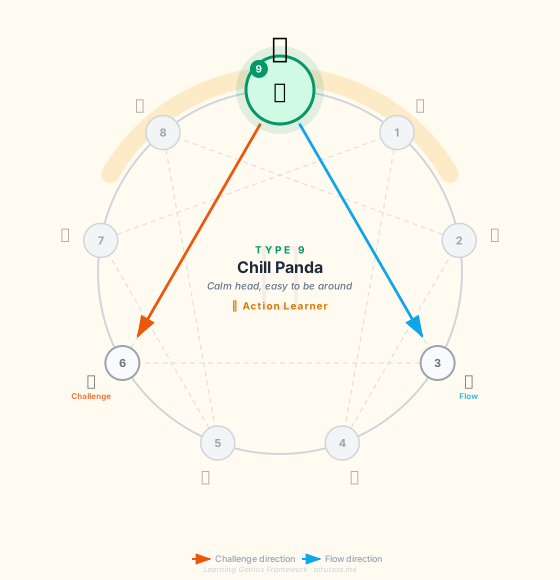
Where Chill Panda 🐼 (Type 9) fits in the full picture
Every Learning Genius is part of a bigger map. Chill Panda 🐼 sits in the Action Learners zone alongside Sharp Eagle and Bold Bear — all three share an instinct-first, action-or-connection-driven approach to learning. Seeing the whole circle helps you understand why you click with some classmates and feel completely at odds with others.
Frequently asked questions
Why do I say "I don't know" when I actually do know the answer?
For Chill Pandas, saying "I don't know" is often less about knowledge and more about avoiding the pressure that comes with being put on the spot. It feels safer than giving an answer someone might challenge. The problem is that over time it hides what you actually understand — from your teacher, and from yourself.
How can I get better at class discussions without feeling anxious?
Start small. Before a lesson, write down one thing you think about the topic — just one sentence. That becomes your starting point if you get called on. You're not speaking from nothing; you're reading from something you already decided. That tiny shift takes the blank-page panic away.
Is being calm and quiet a weakness as a learner?
Absolutely not. Your ability to listen, hold multiple views, and stay calm under pressure is genuinely rare and valuable. The goal isn't to become louder — it's to make sure your actual understanding shows up in your work and in class, so you get credit for what you genuinely know.
What is Professor Quill's PEEZL framework?
PEEZL is a writing and argument framework used by Professor Quill, the English AI tutor on aitutors.me. It stands for Point, Evidence, Explain, Zoom out, Link. For Chill Pandas it's useful beyond English — it gives you a scaffold for developing any opinion to its conclusion, rather than stating it and then trailing off.
The Learning Personality framework draws on established personality research. Parents wanting the full theoretical model can visit ganjiang.xyz.