For Independent School Families
Why UK independent-school parents are quietly adopting AI tutoring — and what to look for.
Why UK Independent School Parents Are Quietly Adding AI Tutors to a £40K Bill
Eton, Westminster, St Paul's — parents are already paying for the best human teaching in the country. Yet AI tutoring is now the fastest-growing line in the education extras column. Here's why.
What Khan Academy and TED-Ed Are Quietly Telling Us About Education in 2036
Sal Khan and the people behind TED-Ed are building AI platforms that could, in ten years, do to universities what Wikipedia did to encyclopaedias. Here's what that means for the UK independent school sector — and the children in it.
The Uncomfortable Question for UK Independent Schools in 2026: Has the Teaching Philosophy Aged?
Twelve-pupil classes, prep at 7pm, weekly tutorials. The model has worked for 150 years. But generative AI changes the unit economics of one-to-one teaching — and the question for school heads is whether the inherited model still answers what 2036 will need.
Oxbridge Admissions in 2026: Why Personality-Adaptive AI Tutoring Matters More Than Ever
Oxbridge admissions now care less about polished answers and more about the quality of a candidate's thinking under pressure. Generic AI homework helpers produce the former. Personality-adaptive Socratic tutors build the latter.
11+, 13+, and Common Entrance: Where AI Tutoring Actually Helps (and Where It Doesn't)
The UK independent school entry exams are a specific kind of pressure: short timed papers, multiple subjects, a child who is ten or twelve years old. Generic AI homework helpers don't fit. Personalised, energy-aware Socratic tutors might.
What AI Tutors Cannot Replace: Pastoral Care, Community, and the Quiet Things
There's a lot of confident futurism about AI replacing teachers. Most of it ignores the things UK independent schools have always been quietly good at — and the things our AI tutors aren't trying to replace.
From Eton's Tutorial System to Claude's Hint Ladder: A Short History of Socratic Teaching
Socratic teaching is older than universities. The UK independent school sector inherited it via the Renaissance and the tutorial system. The newest AI tutors are, surprisingly, more faithful to it than most edtech of the last twenty years.
IGCSE, A-Level, and IB: Where an AI Tutor Fits in the Independent School Curriculum
UK independent schools rarely follow the standard GCSE/A-Level path everyone assumes. IGCSE is now dominant at 16. A-Level competes with IB and Pre-U at 18. Each of these reshapes when and how an AI tutor adds real value.
Year 8 in 2026, University in 2036: What to Build Now if the Credential Game Changes
If Khan Academy, TED-Ed, and the next decade of generative AI do to higher education what Wikipedia did to encyclopaedias, the children currently in Year 8 will graduate into a different world. What should we be helping them build now?
Boarding School Evening Prep and the AI Tutor: A Practical Guide
Evening prep in a UK boarding house has a specific shape: tired children, limited adult support, the dorm three doors down. A well-designed AI tutor fits this context — but only if the school's policies, the housemaster's view, and the device rules align.
Teacher AI Literacy in UK Independent Schools: The Quiet Differentiator for 2026 Admissions
When you're choosing between two excellent independent schools, the difference that will compound over five years isn't the playing fields. It's how good the teachers are at thinking with AI. Most parents aren't asking. They should be.
Scholarship Exam Preparation in the AI Era: An Honest Guide for Independent School Parents
Academic, music, art, and all-rounder scholarships at UK senior schools are the most competitive admissions in the country. Used well, AI tutoring is part of the preparation. Used badly, it disqualifies the candidate.
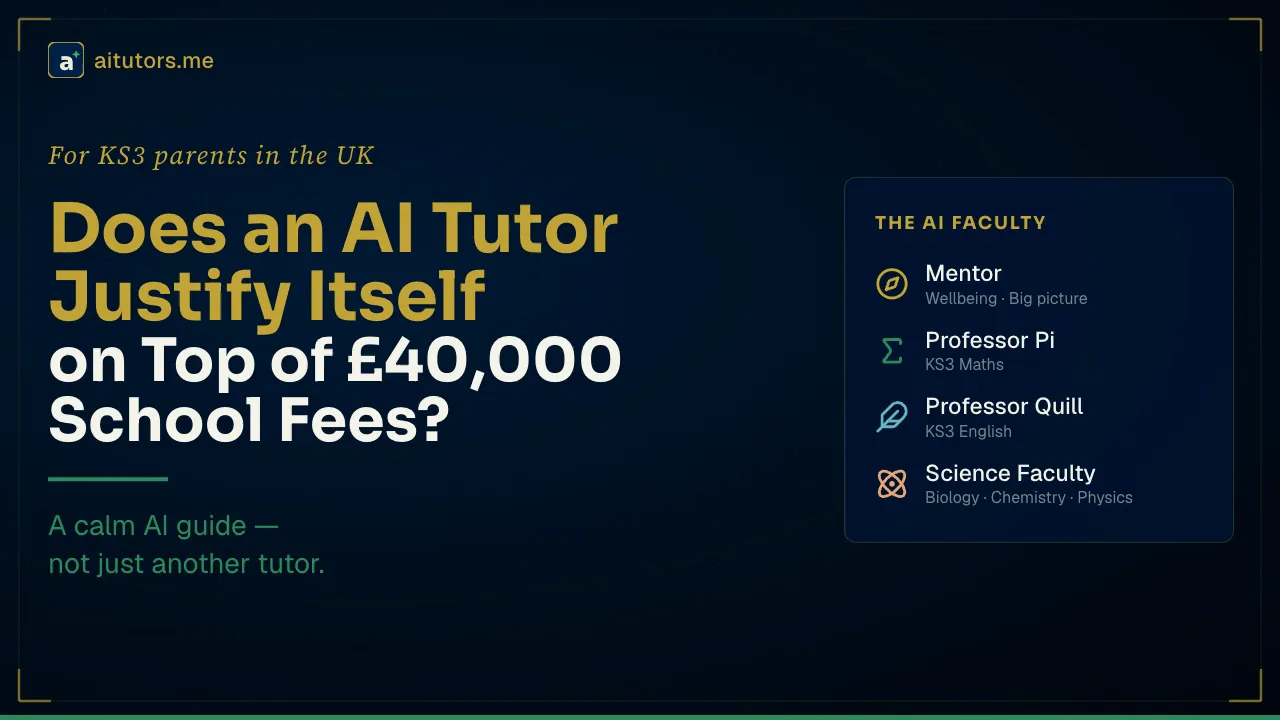
Does an AI Tutor Justify Itself on Top of £40,000 School Fees? An Honest ROI
The economics of adding an AI tutor to a £40,000-a-year independent school bill look obvious until you actually do the maths. The honest answer involves comparison to human tutors, opportunity cost, and a few cases where the answer is no.